The Common Mistake in the MCCQE1 Exam Prep
One of the most challenging qualification exams in North America. Without a doubt, he is the MCCQE1 exam. And for a good reason.
However, a misstep in MCCQE Part 1 exam preparation makes this challenge formidable. The Medical Council of Canada has drawn its line in the sand. Their expectations are explicit, unwavering and they aren’t budging. If you are dreaming of residency in Canada. You must rise to meet that standard.
In this blog, I will unpack the most common mistake candidates make in MCCQE1 preparation. Explain why it quietly sabotages scores or worse jeopardizes your chance of success. I will also show you how to fix it with a practical plan you can start today, using Ace QBank.
What is the Common Mistake in the MCCQE1 Exam Prep?
The day of your MCCQE1 exam will feel a lot like a regular day at the clinic when it comes to diversity. It is a marathon with 230 questions presented over several hours.
Some will feel straightforward. As routine as a prescription renewal for a patient you have known for years.
Others will demand more from you. They will be complex, layered and require you to connect disparate symptoms. Like a heavy smoker patient with a new rash on their shoulder. Who incidentally mentions their voice has changed and they can no longer hit the high notes when they sing.
This exam is one of the most significant hurdles in your medical career. The pressure is immense. And it is natural to look for shortcuts. You might be tempted to game the system. To guess which topics will be underrepresented.
You might hear whispers that psychiatry or ethics are less prominent. And think “I will just focus my energy elsewhere.”
Just to be clear, this is a gamble you shouldn’t risk. It is a risky strategy that I strongly advise against.
The Medical Council of Canada (MCC) doesn’t build this exam by chance. The number of questions in each specialty isn’t arbitrary. It is a carefully considered reflection of clinical importance and the real-world needs of patients in this country.
For instance, with the increasing demand for mental health services. A gap that has only widened in recent years. You can be certain that your understanding of psychiatric care will be thoroughly assessed.
The exam blueprint is your map. The MCC updates its objectives to mirror the landscape of Canadian healthcare.
It is also important to manage your expectations. You will not answer every question correctly. Nobody does. The goal isn’t perfection. It is demonstrating competence.
It is perfectly normal to get a few questions wrong. When they are spread out throughout the exam. But missing a significant proportion of questions. Within a single domain. It is a single factor that can disproportionately impact your score.
If you neglect an entire category. You are not just risking a lower score. You are risking the need to retake the entire exam.
The MCCQE1 is designed to test your clinical reasoning. Not just your ability to memorize facts. The questions are context rich and evidence-based. They present you with a clinical scenario. And ask you to apply your knowledge in a practical way.
They want to see how you think. How do you solve problems? And how you manage the patients.
So, where does that leave you? It leaves you with the most reliable strategy.
Studying all the objectives based on the MCCQE1 blueprint. Don’t look for angles or shortcuts. Instead, practice with high-yield questions.
Questions that mimic the style of the exam. And develop your test-taking strategies. So that on exam day. You focus on answering questions. Not the clock.
Think back to that patient with a long history of smoking. The one with the rash and the changed voice. The answer wasn’t just in a textbook. It was in the connection between two seemingly unrelated facts.
That’s what this exam is about. It is about being a good doctor. A thoughtful clinician who can see the whole picture. Your preparation should reflect that.
Let’s be frank about what’s on the line. The MCCQE1 is more than an academic exercise. It is a gatekeeper to the next stage of your career.
A pass is the ticket you need to enter the Canadian Resident Matching Service process. The national system that pairs you with a residency program.
Trying to outsmart the exam by guessing which subjects to prioritize isn’t just a poor study tactic. It is a common mistake that could cost you time, increase stress and ultimately the exam.
The best way to honour your own hard work is to prepare for everything. And walk into that exam centre ready.
How to Avoid a Common Mistake in the MCCQE1 Exam Prep?

It is called a common mistake for a reason. When preparing for the MCCQE Part 1 exam. We often experience emotional stress. Under the pressure of a looming deadline and a mountain of material. Our brains tend to seek quick solutions to reduce that stress. This can lead to rushing your study plan or avoiding certain topics altogether.
However, understanding these tendencies is the first step. In better exam preparation and avoiding a common mistake. More effective study strategy. Think of it as diagnosing the patterns your own mind falls into during the long marathon of exam preparation.
One of the most common pitfalls during your study period is cognitive avoidance. Your brain naturally seeks comfort. The long list of objectives you need to master. Can feel overwhelming and cause anxiety. So, the quick fix is often to procrastinate.
You might tell yourself, “How many of the 230 questions will really be about psychiatry or ethics? If I nail the other sections, I will be fine.” You may dismiss these topics as low-yield and convince yourself you’ll have time later to focus on the more important areas.
This mindset offers immediate relief. But it leaves significant gaps in your knowledge, often in the very areas the exam uses to set candidates apart.
Then there’s the subtle trap of emotional reasoning. After a long day of rotations. You sit down to study. Feel overwhelmed by a dense chapter. And a thought forms “I feel lost, therefore I am bad at this subject.”
This feeling is misinterpreted as a fact about your ability. The result? You abandon the topic, or your study session becomes completely unproductive because your confidence has been undermined.
That constant state of stress leads directly to working memory overload. Your brain’s capacity for learning and problem-solving is finite. If it’s constantly bogged down by worry, distraction, or the sheer exhaustion from cramming, there is less bandwidth available for deep learning.
This is why you can read a page three times. And still not remember what it said. Your cognitive resources are being spent on managing stress. Not on encoding new information.
Finally, during the long months of prep, your metacognitive awareness can begin to drift. This is your ability to honestly assess your own learning. You might be spending hours passively re-reading notes. Believing you are being productive.
Without realizing you aren’t retaining the information. Without that crucial self-awareness. Without regularly testing yourself and analyzing why you get questions wrong. You can’t identify that your study method is ineffective and make the necessary course corrections.
I believe our brains crave certainty. When uncertainty increases. So does anxiety and the tendency to rely on quick fixes. Your entire MCCQE1 prep is a period of profound uncertainty.
These mechanisms avoidance, emotional reasoning and working-memory overload. Along with metacognitive drift. Are not personal failings. They are the brain’s well-documented coping strategies for managing the overwhelming cognitive and emotional load of exam prep.
They aim to reduce discomfort in the moment, but over a study block, they are what create a “common mistake.”
The best way to manage your brain’s stress response is to minimize the uncertainty that fuels it. This comes from preparation that builds true confidence.
Opting for a comprehensive Canadian question bank can be a key part of this. A platform that lifts some of the heavy weight of preparation off your shoulders.
In the next section. We will explore that option in more detail.
Leverage the Unique Features of Ace QBank for MCCQE1 Success

Before we begin with a clear eyed look at the challenge ahead. I want to remind you that the exam consists of 230 questions.
Questions that are designed to test your clinical reasoning. Not just your ability to recall facts from a textbook. It is built to feel like a real day in a Canadian clinic. Full of complexity and nuance.
Despite the fact, many candidates get tripped up. And it is often for the same reasons. The sheer volume of material leads to a tempting shortcut. Skipping areas you perceive as “low-yield.”
You might convince yourself that for example psychiatry or ethics questions will be few and far between. This strategy almost always backfires. Creating concentrated gaps in your knowledge that can disproportionately damage your score.
At the same time, the immense pressure of this high-stakes exam triggers predictable psychological responses. Stress, the urge to avoid difficult topics. Emotional reasoning and a completely overloaded working memory can render your study efforts ineffective.
The Medical Council of Canada’s objectives list is a map. The only way through is to cover the territory broadly. And to practise with questions that mirror the real thing.
How Ace QBank Fixes the Common Mistakes

This is where a question bank designed specifically for the Canadian context becomes invaluable. Ace QBank is built to do more than just test your knowledge. It is designed to replicate the MCCQE1 experience.
And more importantly to correct the practical errors that so many students make during their preparation. It systematically addresses the exam’s breadth of content. The need for exam-style practice and the importance of deliberate feedback and time management.
The key point here is that it “systematically addresses” the content. This isn’t just empty talk. It refers to the presence of 21 categories in your dashboard. If you have an Ace QBank subscription. You know exactly what I mean.
The dashboard isn’t available through the free demo account. So only subscribers get full access.
Let’s break down the specific features of the question bank. Here is the list:
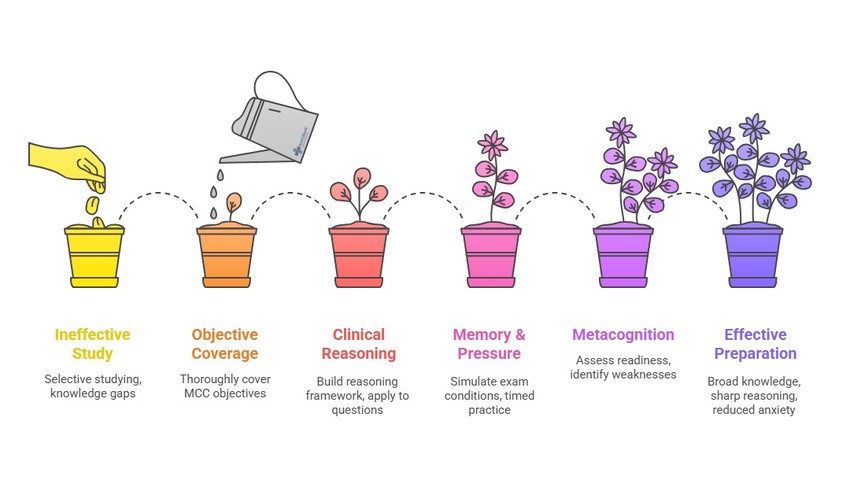
- Prevents Selective Studying and Enforces Objective Coverage
- Builds Clinical Reasoning with Context-Rich Questions
- Reduces Working-Memory Overload and Exam-Day Pressure
- Improves Metacognition
These features are designed to enhance the MCCQE1 exam preparation. I will show you how to use them in a minute.
Prevents Selective Studying and Enforces Objective Coverage
The best way to prepare for the exam is by thoroughly covering the MCC objectives. And you have got a massive list of MCC objectives to cover.
Many candidates feel swamped by a lengthy list of objectives. It is easy to put things off. Especially when you’re up against topics you find difficult. Or to gamble by skipping an entire objective. Leaving dangerous blind spots in your preparation.
But why is it “dangerous”? Simply because these knowledge gaps slow down your pace during the exam.
As we discussed earlier in another post. You could end up submitting your exam with more than half a dozen questions left unread. You can’t make the program wait. It automatically submits your exam when time is up.
However, the question bank here through you a lifebuoy. That is because it is meticulously aligned with the MCC objectives. This ensures that as you work through the questions. You are systematically covering every single objective.
Objectives that the Medical Council of Canada expects you to know. Its topic filters and performance trackers give you a clear. Visual representation of which objectives you’ve mastered and, crucially, where your gaps remain.
Builds Clinical Reasoning with Context-Rich Questions
Then again, the exam doesn’t test isolated facts. It tests your ability to connect clinical information. Synthesize findings and think like a physician. Simply memorizing lists won’t get you there.
Instead, build a framework for reasoning. Start with the core clinical pathways. History, physical exam, investigations and differential diagnosis. Along with management and the most accurate treatment.
Practice applying them to practice question. For each topic, ask yourself. What are the key presenting features. Which bedside maneuvers or imaging will narrow the differential. And what are the time-sensitive actions I must take?
The question bank has also helped here. With 2900 high-yield questions based on the MCC objectives. Questions that mirror the MCC’s style and difficulty. They force you to integrate information and make connections.
You will find questions that deliberately combine systems. For example, a patient presenting with both psychiatric and ENT symptoms. To train the kind of integrative thinking required on exam day.
What you can do though. You can make a daily habit of doing a question block in time mode. Immediately after finishing the question block. Review the detailed explanations for every question. Especially the ones you missed.
Reduces Working-Memory Overload and Exam-Day Pressure
On test day, anxiety and time pressure can consume your cognitive bandwidth. Leaving less of your working memory available for clinical reasoning. The only way to combat this is to train for it.
Start by simulating the exact conditions you will face. Use a quiet room, set strict time limits and practice with a question block. Repeated exposure to the format and pacing reduces novelty. So your stress response becomes smaller and more predictable.
Incorporate timed practice early and often. Gradually increasing the duration and difficulty. So that mental stamina builds alongside knowledge.
Pair timed practice with targeted reflection. After each session. Review both the questions you missed. And those you rushed through. Identify recurring patterns.
Are you answering incorrectly because you misread stems, jumped to conclusions or got stuck on calculations? Or you need to refine time management strategies.
Finding an answer to these questions. Allows you to allocate your working memory on exam day. Where it matters most.
Luckily, the question bank has your back. You can create a question block in two distinct study modes: timed and tutor.
Timed mode challenges you with strict time limits per question. Helping you build speed and decision-making under pressure.
Tutor mode, on the other hand, lets you pause, review explanations and explore targeted learning points. So you can master concepts at your own pace.
The best part is that the timed mode mimics the pacing and mental fatigue of the real MCCQE1.
The question bank also provides summary tables, flow charts and custom illustrations to boost your recall of key points on exam day.
Improves Metacognition

You can’t fix a weakness. You don’t know you have. Many candidates fall into the trap of using ineffective study methods. Because they lack objective feedback on their performance.
You need to assess in ways that actually reveal gaps. The best way is to create exam-like conditions when you feel prepared.
Start by simulating the real test environment. But how would you be able to simulate it effectively?
The Qbank offers two unique self-assessments to evaluate your readiness. What makes these assessments unique?
Their questions are different from those in the main question bank. Meaning you haven’t seen them before. This intentional design allows for a more accurate evaluation of your preparedness for the exam.
Additionally, these self-assessments introduce new questions. Exposing you to unfamiliar material. This approach simulates not only exam-like conditions. But also the unpredictability often experienced during the actual exam.
Overall, by integrating these strategies. You are not just studying. You are training with purpose. You can expect to build a broader. MCC objectives based knowledge foundation with far fewer blind spots.
Your clinical reasoning will become sharper. And your pacing, stamina and time management will improve.
Most importantly, your anxiety will decrease. Uncertainty is the fuel for anxiety. By making your progress measurable and your weaknesses visible. You shrink the unknowns.
Your confidence will grow. Not because you are ignoring the challenge. But because you have a clear, data-driven plan to meet it.
As you prepare. Remember that success is the sum of small efforts repeated day in and day out.
Use Ace QBank to make every one of those small efforts deliberate, measurable and guided by the MCC objectives.
Try Free MCCQE Part 1 Sample Questions

Before you invest your time (or money) in any MCCQE1 study resource, it’s smart to test-drive the actual platform and questions. The QBank makes this easy. It offers 21 free sample questions. No payment, no commitment needed.
You get hands-on platform experience. Explore all the key features. Flagging questions, highlighting important text, switching between tutor and timed modes.
Check the Quality. You want to make sure the explanations are clear, evidence-based and actually teach you something.
Just sign up for the free demo on the website. You don’t need a credit card. You will get access to all 21 sample questions plus the chance to play with the platform’s study features.
This is your chance to see whether Ace QBank lives up to its reputation. And if it’s the right Qbank for you.
Key Takeaways
The common mistake in the MCCQE1 exam preparation. Selectively skipping topics because they feel “low‑yield.” Creating concentrated gaps that can sink your score or force a retake.
Follow the MCCQE1 blueprint completely. The exam’s question distribution reflects real Canadian clinical priorities. So studying all objectives prevents blind spots and aligns preparation with what the MCC expects.
Use Ace QBank to avoid the common mistake. The Qbank is aligned with MCC objectives. Do timed blocks, review every missed question and explanations. Use the performance trackers and self-assessments to reveal blind spots.