Ready for the April 2026 MCCQE1 Exam

April 2026 will be here sooner than you think and if the MCCQE Part 1 is on your calendar. It is time to shift gears and put the pedal to the metal on the MCCQE1 exam prep.
The MCCQE Part 1 isn’t just another test. Meaning you can’t skate through with some last-minute cramming. This moment demands real grit and determination. From clinical decision making to test day strategy, success comes from starting early and studying with intention.
In this post, we will look at the key exam dates for the April 2026 MCCQE1 exam. Then we will talk about how to prepare smart for the exam. We discuss why your question bank choice matters more than ever. And also explore how Ace QBank matches the new MCCQE Part 1 format.
The Key Exam Dates for the April 2026 MCCQE1
When you look at the MCCQE1 exam dates. It is not just a set of dates on a website. It is a timeline that will quietly shape your next year of life.
The Medical Council of Canada (MCC) usually confirms the exam session well in advance. And for the second session of the MCCQE Part I in 2026 will run from April 22 to May 27, 2026.
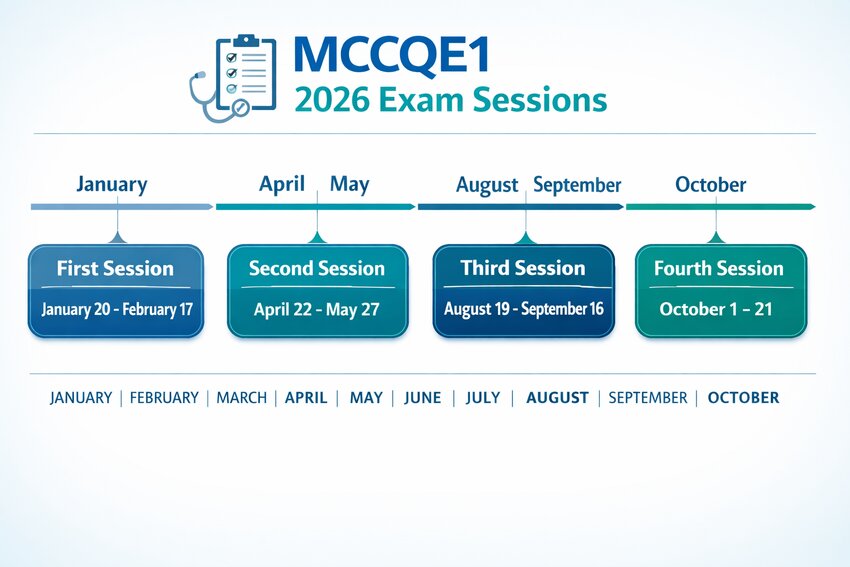
However, when you look at the April session exam. It is not just a set of dates on a website. It is a timeline that will quietly shape your next year.
The thing is that you have to respect the dates or the MCCQE1 exam dates will control you. The keyword in the April 22 – May 27, 2026, MCCQE Part 1 exam window is “window” itself.
It refers to a period of time within that range during which you can select a specific exam day. The exam day that suits your preparation curve, personal life and mental bandwidth.
However, around this window sit other, less visible but equally important things. Things such as when scheduling opens. When seats start to fill and when results are released.
The exam itself is offered on multiple days throughout that window. But you only get one attempt per session. So your chosen day deserves real intention. Think of it as planting a flag on your calendar. And tell yourself “This is the day everything I have been working toward converges.”
Surrounding that window, there are other dates you must keep on your radar. These dates are not even in the periphery of vision for those taking the exam for the first time. For instance:
- Checking the opening date
- Registration and payment deadlines
- Rescheduling and cancellation cut-offs
Checking the opening date
The Medical Council of Canada opens scheduling for a session well in advance. And announces when you can start booking appointments for the April 22 – May 27, 2026 window.
If you wait too long, popular test centers and ideal dates (for example, Fridays or days after a stretch of study leave) can disappear. So, building the habit of checking the MCC website or your physicianapply.ca account regularly in the months before is not obsessive. It is professional.
Registration and payment deadlines
Before you can even think about picking your exam day. You must have completed your exam application and payment for the session.
The MCC emphasizes that candidates must register for their chosen session and follow the posted deadlines. Because missing them usually means waiting until the next exam window.
That can push your residency applications. Licensing steps (NAC exam and language proficiency) and even your relocation plans. All back by an entire year.
The best way to prevent delays is to begin your application early. For Canadian medical graduates, sending the required documents is simple. If you are an international medical graduate (IMG), getting all the documents may take longer.
Ask for official copies of your medical degree verification and transcripts right away.
Then pay promptly. Payment must accompany your registration to secure a seat. Delays in payment can result in losing your preferred session or test centre.
At this point, I would take two extra steps. Keep the proof of payment and check the refund policies.
That is because if there is any discrepancy. These records will speed up resolution. And if your plans change knowing the refund policies. Can help you make the best decision without losing your fee.
Rescheduling and cancellation cut-offs
Life rarely follows a neat schedule. Illness happens and family emergencies appear without warning often at the worst possible times.
This is why you should learn how close to your exam date you can reschedule or cancel. You also need to know what fees you might face if your plans change unexpectedly.
Being in the know on these timelines. Before life throws you a curveball. Let you make thoughtful choices.
How to Prepare Smart for the January 2026 MCCQE1

You don’t “cram” your way into a Canadian medical career. You build your way into it. One brick at a time. Meaning preparing for the April 2026 exam session demands a smart strategy.
A strategy that brings your mindset, study plan and resources into line with the true purpose of this exam. That purpose is grasping what is really at stake. Your ability to provide safe and effective care within the uniquely Canadian context.
This is no abstract challenge. It is a profound responsibility. And every step of preparation must be rooted in the standards and realities faced daily by professionals across Canada.
Only then can you genuinely meet and exceed the measure set by this vital examination.
And if you can reframe April 2026 as your opportunity to demonstrate. Your commitment, your readiness and your ability to safeguard lives in the Canadian healthcare system. Then those long study days will transform.
They will no longer feel like punishment. But rather as purposeful preparation for the physician you are becoming.
However, to prepare effectively for the exam. You need a focused and practical plan. One that matches what the exam actually tests and uses the right resources. This means:
- Understand What the MCCQE1 Actually Tests
- Use the MCC objectives as your “North Star” Not Random Topics
- Use Canadian Resources Primarily for the MCCQE1 Exam Prep
Understand What the MCCQE1 Actually Tests
You need to stop thinking of the exam. As some mysterious and overwhelming challenge. Instead, you should view it. As a structured exam with clear objectives and a predictable format.
That’s because the exam follows a specific blueprint and is based on the MCC objectives. The objectives list, which covers everything from common conditions in family practice. Internal medicine to pediatrics. Psychiatry, obstetrics and emergency care. Along with ethics and public health.
Here’s a quick visual summary of the exam format (2026):
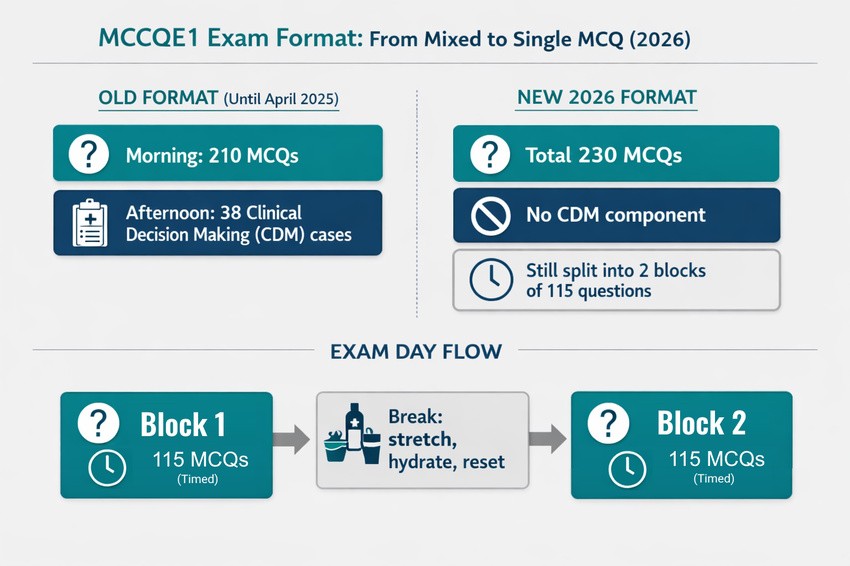
When you understand this framework. You can prepare more effectively and approach the exam with confidence rather than fear.
According to the Medical Council of Canada. The exam assesses whether candidates meet the standard of medical knowledge, clinical decision making and professional behaviour required for independent practice in Canada.
It does this through a multiple-choice question. Questions that present realistic clinical cases. And ask you to choose the most accurate treatment or management steps. To test your applied knowledge and reasoning across disciplines.
However, I must say. The only downside with questions grounded in real-world clinical scenarios is that. Each case demands not only sharp critical thinking. But a commitment to Canadian guidelines that prioritize patient safety and best outcomes.
These questions press practitioners to pick investigations or management steps that align with evidence-based care. Reflecting the gold standard across our country.
From preliminary assessments to tough triage decisions. Every choice mirrors what you would see in clinics and hospitals from Vancouver right through to St. John’s.
And let’s be honest. In this neck of the woods, we expect nothing less than guideline-consistent care. For every patient who walks through those hospital doors.
The key point is this. The MCC does not pick questions randomly. Every question ties back to a specific objective on that list. An objective that reflects what a day-one Canadian physician should be able to handle.
This means smart preparation is not about memorizing rare syndromes or chasing Internet rumour topics. It is about:
- Showing clear clinical reasoning. Can you explain why a test or treatment is appropriate or harmful in a given scenario?
- Aligning your answers with current Canadian practice standards and safety principles.
- Demonstrating comfort with bread‑and‑butter conditions you will see repeatedly in clinics, wards and emergency rooms.
When you are prepared for your exam. The turning point is the day you print the MCC objectives and realize how much you had already seen in real life. COPD exacerbations, postpartum depression and uncontrolled diabetes, etc.
Then, the exam will stop being an alien landscape and start looking a lot like the patients you had already cared for. Just condensed into questions.
Use the MCC objectives as your “North Star” Not Random Topics

The MCC itself strongly encourages candidates to use the MCC objectives and exam blueprint as the foundation of their study plan. Mapping their preparation to these objectives rather than studying in a scattered way.
But how can you transform the objectives for the MCCQE1 April exam session into a useful study plan? The best approach is to read through them. As you would with any standard list. Then identify which topics you already understand well. And which areas need more work?
Start by going through each objective systematically. Notice the subjects where you feel confident and can recall relevant information easily. These are your strong areas. Areas that probably only need a quick review.
Pay closer attention to the topics. Those that feel unfamiliar or leave you unsure. Those are areas where your understanding is weak and needs deliberate study time.
This simple sorting process helps you create a targeted study schedule. For example, you might dedicate one week to “Cardio + Resp.” Another to “Neuro + Psych.” The other to “OB/GYN + Pediatrics” and so on.
Instead of spending equal time on everything. You can prioritize the weaker areas. While maintaining your existing knowledge.
The result is a personalized roadmap. A roadmap that makes your preparation more efficient and effective for the exam.
However, to master the MCC objectives. You need to choose Canadian resources that align with the MCC objectives and mirror the MCCQE1 blueprint. For instance, a question bank like Ace QBank explicitly maps its questions to the MCC objectives and the exam blueprint.
This mapping is powerful. It means that when you answer a question on. Say, new onset atrial fibrillation in an elderly patient. You are not just “doing a question.” You are checking off a real exam objective. I will discuss this in more detail next.
In vividly recalling my own circle. I noticed that the candidates who stayed anchored to their objectives. Were much calmer in the last month before their exam.
While others asked “Do I need to memorize every obscure rheumatology antibody?” They looked at their checklist and knew. “I have hit the big rocks that actually matter.” That confidence is not arrogance. It is in alignment with how the exam is actually built.
Use Canadian Resources Primarily for the MCCQE1 Exam Prep

The internet will try to convince you that you need American resources to pass MCCQE Part 1. That is a lie. The MCC emphasizes that candidates should use a mix of trusted references, question banks and the official objectives to prepare.
But success comes from depth of engagement. Not the sheer number of books or subscriptions.
The other pressing point is this. You are preparing for the Canadian Medical Licensing Exam. Surely, relying primarily on American resources would be, at best, short-sighted.
The subtle nuances and critical differences between the two healthcare systems, Canada and the United States. Are not simply academic.
They are deeply woven into clinical protocols, regulatory frameworks and even patient expectations. Why risk such an oversight when your aim is to serve within Canada’s unique healthcare system?
That said, a question bank that is clearly mapped to MCC objectives and Canadian practice is Ace QBank. It offers targeted high-yield practice questions that align with the exam blueprint.
Covering key topics, clinical reasoning and the style of questions. You will encounter on the exam.
How Ace QBank Matches the New 2026 MCCQE1 Format

Ace QBank was built from the ground up for the MCCQE1 exam. It was never a generic multiple-choice resource and never will be.
Every question in the Qbank is anchored to a specific Medical Council of Canada objective. And you can see that linkage clearly in the reference section. That tiny section beneath each question.
When you read a question stem, you are not just facing an isolated clinical scenario. You are looking at a deliberate representation. Representation of what the Council expects you to know and how it expects you to think.
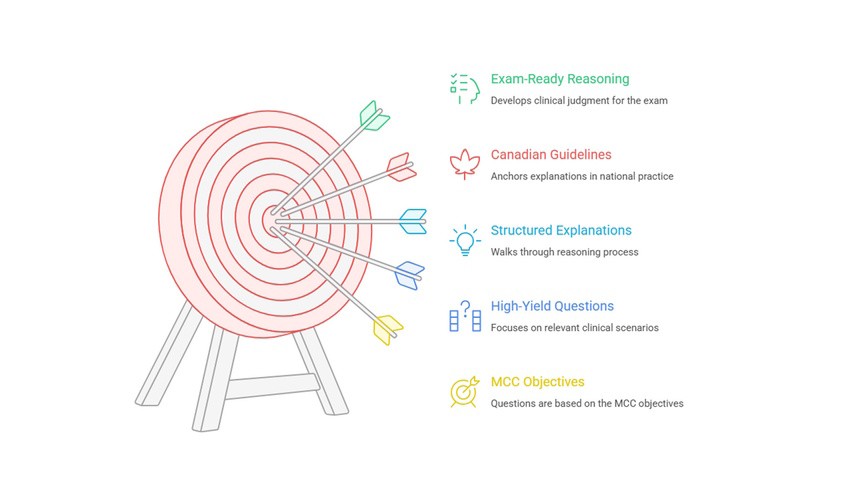
That alignment matters more than ever. Because starting in 2025, the exam moves fully to a single-format, MCQ-only exam.
The content has not become “easier.” It has become more focused. The test now leans heavily on applied clinical reasoning, patient-centred decision‑making and consistent adherence to Canadian guidelines.
When you sit down in a Prometric centre. The questions will press you to weigh risks and benefits. Choose an accurate treatment or diagnosis that fits our health‑care system.
The Qbank mirrors that shift quite deliberately with more than 2900 high-yield questions. As you work through blocks of questions. You will notice that the stems are not built around rare zebras or obscure facts.
Instead, they echo the kinds of situations. You actually face on Canadian wards and in clinics. A worried parent in a small emergency department late at night. A newly arrived immigrant navigating primary care for the first time. An older adult trying to balance polypharmacy and quality of life.
The emphasis is on how you think through these encounters. What you ask, what you examine and what you order. All step by step.
This approach shows up most clearly in the explanation section that follows each question. Rather than a short line stating which option is correct. You are walked through the reasoning process in stages.
The explanations reconstruct how a Canadian clinician would sort the history, physical findings and investigations. Eliminate near misses and commit to a management plan.
They slow down the kind of rapid internal dialogue that usually happens silently at the bedside. “If I assume this is X, what evidence supports that? What would I expect to see if it were Y instead? How does this choice affect the patient sitting in front of me today?”
By repeatedly seeing that logic laid out. You are training yourself not only to pick the right answer. But to think in a structured, exam‑ready way.
Another important detail is the evidence base under those explanations. The rationales are anchored in current Canadian guidelines and widely used references.
Something you do not often see consistently across question banks. That is not accidental. Canadian medical experts have been involved in selecting the evidence and shaping the teaching points.
So that what you read after each question reflects how medicine is practised across the country. When an explanation recommends a specific investigation or therapy. It is doing so with national practice patterns in mind. Not just what might be typical in another health‑care system.
If you have ever tried to cover the MCC objectives entirely on your own. You know how sprawling they are.
The official list is extensive, overlaps across disciplines and can be unevenly distributed. If you simply read textbooks or rely on clinic exposure. It is very easy to spend weeks on certain topics. While barely touching on other topics. Topics that carry the same weight on exam day.
That imbalance is one of the main reasons. Well-prepared candidates still feel uneasy as the test approaches.
The Qbank addresses that problem by mapping its content carefully to the MCCQE1 blueprint. And to make this process less frustrating. The content is organized into 21 clearly defined categories.
These categories correspond to the major disciplines. And problem areas you will see on the actual exam. But they are presented in a way that is easier to navigate. Than a long and abstract list of objectives.
When you first log in to your dashboard after subscribing. Those 21 categories are the first thing you see.
The effect is grounding. Instead of a vague sense that there is “too much to learn.” You are looking at a map. You can decide to focus on one area. Move systematically across the board or return to a category that you know has been weak for you in practice.
Recent updates to the Qbank. Show how this structure continues to evolve alongside the exam. More than 100 new questions have been added to the Qbank.
But they are not filler. Each has been written and reviewed with the MCC objectives in mind. Targeting high‑yield scenarios that recur in both training and real‑world practice.
Many users describe opening a new block after an update and recognizing a situation from their clerkship. Then, seeing it tested in a way that reveals what they might have missed in the moment.
At the same time, existing explanations have been revised for greater clarity and instructional value. In some cases, that has meant expanding a section to spell out a critical decision point that candidates were consistently overlooking.
In others, it has meant tightening the language. So that the central teaching stands out more cleanly, without extra noise. The goal in each revision is the same.
When you finish a question. Whether you answered correctly or not. You should come away with a stronger and more organized understanding of the topic.
Taken together, this design means that when you study with the Qbank. You are not just collecting correct answers.
You are working inside a system that matches the new MCCQE1 format. Follows the Council’s own objectives. And teaches you to reason the way Canadian examiners are now testing.
Over weeks and months. That alignment can be the difference between feeling like you are chasing scattered information. And feeling like you are steadily moving toward the level of judgment and confidence the exam is built to measure.
Self-assessment for the MCCQE1

The moment you book your MCCQE1 exam date. Studying stops feeling abstract. It gets personal. You can do hundreds of practice questions and still lie awake thinking. If the exam were tomorrow. Would I pass or would I just hope?
Here’s the reality, stripped of spin and sugar‑coating. You didn’t need applause. You needed a mirror.
One that doesn’t flatter you. One that also refuses to shame you. A mirror that holds up the truth. Steady and unblinking. Early enough that you still have time to change the outcome.
And a mirror, that is precisely what self-assessment truly represents. It reflects back not just what we wish to see. But with unflinching honesty. It unveils the contours of our strengths. And the shadows of our shortcomings.
Now, here is where the Qbank does something most platforms are not willing to do. Ace QBank offers two distinct self-assessments that are designed as true simulations of the exam.
They are built to mirror the actual exam experience. Question format, clinical focus and difficulty curve. So that when you sit for the real test, it feels familiar, not foreign.
But the real sacrifice is this. The self-assessment questions are completely unique. You do not see these questions while using the main question bank.
The Qbank deliberately withholds these questions from the main pool to protect the integrity of your self-assessment.
From a business perspective, this is costly. Every unique question could have been used to inflate the advertised “total questions” in the main bank. Like many platforms do to look bigger and more impressive.
Instead, Ace QBank chooses to protect the honesty of your self-check. That decision says a lot about priorities. Your readiness over their marketing numbers.
Across North America, most major question banks reuse or recycle questions between self-assessments and their main banks. Or they simply don’t invest as heavily in fully separate pools.
Setting aside a dedicated, non-overlapping set for self-assessment is rare. And it matters deeply to you, because it keeps your performance real. Not inflated by familiarity.
How to Get Started with Ace QBank?

The clearest way to get started with the Qbank is to begin where there is no risk at all. A free demo and some simple, hands-on exploration.
Signing up for the free demo
The process is straightforward. You register for a complimentary demo account on the platform.
In return, you gain access to 21 sample questions. Enough to give a useful snapshot of the content without overwhelming you. It also gives you an authentic sense of the interface. The question style and the key features before you make any commitment.
What to test during the demo?
During that trial run, there are a few practical tools worth putting through their paces. You can flag questions for later review. A small but significant function that allows you to track areas of uncertainty or topics you want to revisit.
You can also highlight key information in the question stems and in the explanations. Mimicking the way many candidates already mark up textbooks and notes.
Just as important are the different study modes. You can switch between timed mode, which simulates exam conditions. And tutor mode, which allows you to slow down and focus on learning from each question.
There is also the option to experiment with building personalized question blocks. Tailor shorter or longer sessions to your schedule and concentration.
The objective of this exercise is simple but critical. To determine whether this platform aligns with your study habits and offers the structure you need.
In an exam year already marked by change and pressure. The degree to which you and the Qbank are well-matched can truly make a huge difference.
Key Takeaways
The April 2026 exam session is closer than it looks. The MCCQE1 April 22–May 27, 2026 window is the backbone of your entire study year. Respect the timeline. Know when scheduling opens and when seats fill. And also, when payment, rescheduling and cancellation deadlines hit. Otherwise, the exam will end up controlling you.
Administrative details can cost you a full year. Missing registration or payment deadlines. Can delay your exam, residency plans, licensing steps and even relocation by an entire cycle. Start paperwork early. Keep proof of payment and learn the rules before life throws you a curveball.
MCC objectives should be your North Star. The exam is built on the MCC objectives and a clear blueprint. Instead of scattered studying, sort the objectives into “strong” and “weak” areas. Then build a targeted plan. This transforms a vague mountain of content into a concrete personalized roadmap.
Canadian context matters. Relying mainly on American resources for a Canadian licensing exam is short-sighted. Ace QBank questions are mapped directly to MCC objectives. With over 2900 high-yield items designed to mirror real Canadian clinical scenarios and guideline-based decision-making.