Ace QBank & MCCQE1 Success in 2025

For years, medical graduates in Canada have hunted high and low for a study companion they could actually trust. Not just some generic resource, but something homegrown. Something that truly understands what it means to face the MCCQE1 exam in this country.
Over the last decade, Ace QBank has stepped up as the frontrunner. It has become a household name among future physicians. Helping countless grads swap nerves for confidence.
In this blog, I’m taking you behind the scenes. We will dig into how Ace QBank keeps raising the bar for the MCCQE1 exam preparation in Canada. And why it’s still turning nervous grads into thriving physicians from Vancouver to St. John’s.
What does Ace QBank stand for?
The acronym ACE stands for the platform’s dedication to helping recent medical graduates succeed by embodying the basic ideals of Achieve, Conquer and Excel.
In the Qbank, the term “Achieve” refers to the platform’s unwavering commitment to assisting candidates in achieving a high MCCQE Part 1 score.
The Medical Council of Canada’s objectives are closely aligned with more than 2900 high-yield questions that make this feasible.
Now let’s talk about “Conquer.” This feature emphasizes how the platform helps candidates get past one of the biggest obstacles in their medical careers. Passing the MCCQE1 and getting a license to practice medicine in Canada.
To help them conquer the exam, the Qbank provides 2,900+ thought-provoking and challenging questions. Based on the MCC objectives and at the exam difficulty level. To facilitate coverage of the objectives and leave no stone unturned. This is how it lays the way to reach this significant accomplishment.
Last but not least, the word “Excel” captures the platform’s overarching goal of helping candidates succeed in their future endeavours.

Including their residency programs. By providing comprehensive and evidence-based explanations of medical concepts. Explanations that are embedded with the latest Canadian guidelines and visual aids to enhance recall.
Enabling candidates to gain the information and abilities necessary to establish a solid foundation for their future medical practice.
The question bank embodies the essence of success in medical education. From achieving high scores in the exam to conquering the challenges along the way. To ultimately excel in one’s future medical career.
The New Reality of MCCQE1 Exam
Now I want to pause and talk directly about the exam itself. The thing that has probably been sitting at the back of your mind while you read this.
You already know that the MCCQE Part I has changed format. The current version is built entirely around 230 multiple-choice questions.
It is tempting to look at that format and think, “This is just a giant trivia test.” But if you have sat in front of those questions or even practiced with good simulations. You know it doesn’t feel like trivia.
It feels like a clinical gauntlet. Each stem pulls you into a small, self-contained clinical world. A crowded emergency department. A family medicine clinic in winter with waves of respiratory illness. A rural hospital ward at 3 a.m. where the lab is slow and the nurse looks worried.
You are asked to make sense of limited data, competing diagnoses and imperfect information.
From the perspective of the MCC Test Committee, that intensity is deliberate. The difficulty and the occasional “trickiness” are not there to frustrate you for sport. They are built into the system with purpose, using a psychometric framework called the Rasch model.
In simple terms, the exam questions are carefully calibrated. So that some items are easier and some are harder. And each one contributes differently to your final score. To distinguish a minimally competent or ready-for-practice candidate from someone who is not there yet.
All of that is mapped back to what the MCC is actually trying to measure. Whether you reflect the MCC objectives, the CanMEDS roles and the realities of Canadian healthcare.
The exam is not only checking if you can recall the textbook answer. It is asking whether you can think and act like a physician who will be working in this system.
That said, your performance is then translated into a scaled score between 300 and 600. With the passing standard currently set at 439.
That number can look cold and arbitrary on paper. But it is built from how you handle a mix of easier and harder questions, each weighted by its confirmed level of difficulty. A correct answer on a more discriminating question may carry more information about your readiness than a correct answer on a very basic one.
This means the exam is designed to ensure that those who pass are not simply good at memorizing lists and guidelines.
It is meant to reward candidates who can reason through ambiguity. Adapt to unexpected twists in a vignette and apply foundational medical knowledge. In a way that would make sense at 2 a.m. on call when no one else is available to double-check your plan.
The questions are written to simulate that feeling. Even if you are physically just sitting in front of a computer in a quiet testing center.
In other words, the MCCQE Part I is less about “Who can remember the most facts?” and more about “Who can think like a safe, thoughtful, Canadian physician under pressure?”
It is engineered to identify doctors who are ready for the specific challenges of Canadian healthcare. Practicing in a multicultural setting, navigating limited resources and working in teams.
Those small details in a stem. The patient’s social situation, language barriers and Indigenous health context or access to follow-up are not window dressing. They are part of what the exam is asking you to see and to respond to.
Once you understand that, a natural question follows. How are you supposed to prepare for an exam built this way?
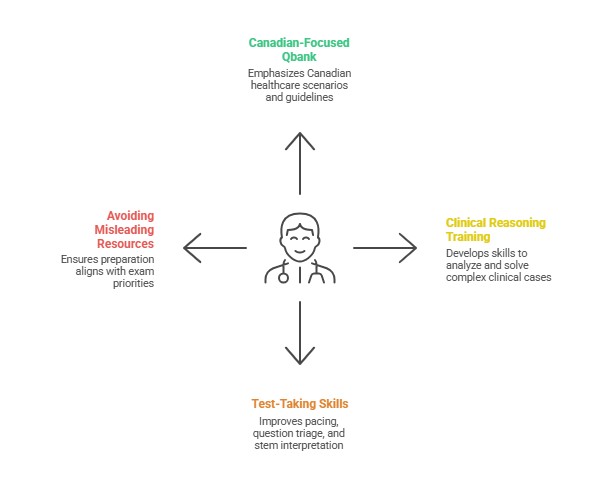
This is where the need for a dedicated Canadian preparation platform becomes clear. You do not just need more questions; you need the right kind of questions.
A Qbank for this exam has to do more than recycle high-yield facts. It must be anchored in MCC objectives. Infused with Canadian guidelines and practice patterns. And structured to push you to apply knowledge rather than hoard it.
When you sit down to study. Your practice questions should feel like training sessions in clinical reasoning, not just memory drills.
A good Canadian-focused Qbank will repeatedly place you in exam-style clinical scenarios. Force you to choose between plausible options. And then walk you carefully through why the best answer is best.
And why the tempting alternatives are wrong in this specific context. Over time, that process reveals where your understanding is solid and where the cracks are hiding.
You should be able to see patterns in your mistakes. A well-designed Qbank will help you identify those weak spots, fill in the knowledge gaps and refine the way you think, not just what you remember.
It should also help you sharpen your test-taking skills. Pacing, triaging difficult questions and interpreting long stems without getting lost in the noise.
With the current format of the MCCQE Part 1 exam. Relying on a generic, non-Canadian question bank is no longer enough.
Many international or outdated resources still emphasize rote recall or focus on practice environments that do not match Canadian realities.
They may give you the illusion of progress. More questions done, more facts reviewed. Without preparing you for the priorities that shape the actual exam. In some cases, these resources can even be misleading. Reinforcing assumptions that will cost you points on test day.
The truth is that using non-Canadian or out-of-date materials now carries a real risk. It can increase your chances of missing the pass mark. Not because you are a poor clinician, but because you are training for the wrong race.
Your time and effort are too valuable for that. If you align your preparation with the exam’s design. Canadian content, MCC objectives and clinically oriented reasoning.
You give yourself a fair shot at not just passing the exam. But emerging from it as a more confident, practice-ready physician.
How to Prepare for the MCCQE1 Exam Fast?

Using daily practice questions as your main study method. By far, it is the fastest way to prepare.
Reading passively can feel productive. But it’s slower because it doesn’t train the exact skill the exam tests. Selecting the best answer quickly and consistently.
You get the biggest score gains when you repeatedly face board-style stems, make decisions under time pressure and learn the exam’s patterns.
Not to mention that it forces you to recall and apply your medical knowledge repeatedly. This helps your memory strengthen and knowledge gaps become obvious.
However, to make question practice actually translate into scores, treat your review as the real learning phase. For every question, especially the ones you miss.
Force yourself to identify why the correct option is correct. Why your wrong option felt tempting. And what specific clue or rule will help you answer the next similar question faster?
Then capture those lessons in your personal list of repeated mistakes and summary notes. To review them every few days. This is one of the most efficient ways to stop bleeding scores in the same predictable areas.
That said, you need to keep your resources tight and your routine repeatable. The best practice is usually one solid question bank, a single concise reference for clarifying algorithms and guidelines.
In this case, Ace QBank will serve as that reliable question bank, and Toronto Note will be that concise reference.
There is a reason why Ace QBank is the best question bank for the MCCQE1 exam preparation. Here I shared the most important of them:
- High-yield questions
- Emphasizing MCC objectives
- Evidence-based medicine explanations
- Customize the study modes
- Performance analytics
- Visual aids to boost recall of key points
- Constantly updating the content
- Two distinct self-assessments
At this point, it is worth mentioning. When it comes to preparing for the exam. You need to know that the objectives set by the Medical Council of Canada aren’t just a suggestion. They are the gold standard.
These objectives guide every question you will face on exam day. However, the real kicker is that MCC keeps updating them. That means staying current is your ticket to passing. Resources that mirror these changes become the backbone of smart exam prep.
That’s why a question bank meticulously aligned with the MCC objectives is downright invaluable. Because it reflects every tweak and trend as soon as they hit.
Let’s not forget the Toronto Notes, another heavy-hitter in the MCCQE1 exam prep circles. Every year, med students from Vancouver to St. John’s wait for the latest edition of Toronto Notes. Why? Because it’s reliable, concise and always tuned to MCC objectives.
The book’s format delivers need-to-know info in bullet points. Perfect for quick review sessions at your favourite coffee shop.
It doesn’t bog you down with unnecessary detail. Instead, it offers clear explanations linked to current research and Canadian practice standards. That’s why it remains a top choice for anyone serious about passing their exams.
These two Canadian resources don’t waste time wading through endless molecular minutiae. Instead, they laser-focus on what you need to know for crushing the exam coast-to-coast.
How to Use Ace QBank for Maximum MCCQE1 Success

The first time you log in to your account with the MCCQE1 truly looming, it does not feel like a question bank. It feels like a crossroads.
On one side is the fear you already know well. This exam is tough, the stakes are high and everyone keeps telling you horror stories.
On the other side is a very practical question. How can I use this Qbank in front of me to actually change the outcome?
I don’t want to give you false hope but I can tell you this. When you understand what the Qbank offers and use it intentionally. It stops being “just a question bank” and becomes a study partner that quietly reshapes your odds.
Let’s start with hard facts, not feelings.
Recent updates from the Qbank in 2025. Describe the platform as offering over 2900 high-yield questions. Questions that are designed around the official MCC objectives for the MCCQE1 exam. That means the questions are not random trivia.
They are built to match what the Medical Council of Canada actually expects you to know and do on the exam.
Those questions are then organized into 21 categories that mirror the exam’s broad areas. Major clinical fields you will see on exam day.
While the MCCQE1 itself is a joint test of knowledge and decision making. The Qbank’s structure takes that huge, abstract idea. And breaks it into concrete pieces you can actually work with.
For a new medical graduate, that structure is gold. Instead of facing “the whole exam,” you face 21 named areas. That alone can lower your stress and give you a sense of control.
That said, the question bank does not force you into a single style of practice. It gives you two main modes:
- Timed mode – to copy the pressure and pacing of the real MCCQE1.
- Tutor mode – to slow down, think and learn while you work through each question.
You can use Tutor mode when you are still learning or rebuilding a topic. And Timed mode when you want to test yourself under exam-like conditions.
This is not a small detail. It matters because it matches what educational research has been saying for years. You do not build strong skills by practicing everything at full speed from day one. You learn slowly, then test fast.
With the Qbank, you can:
- Create custom blocks of questions in either mode.
- Choose how many questions to include.
- Choose which of the 21 categories they come from.
This is where your power as a learner lies. You are not just clicking “Start.” You are designing your own training sessions.
For example, if you know that obstetrics and pediatrics intimidate you. You can build a block pulled only from those categories and run it in Tutor mode. If you feel more comfortable with internal medicine, you can put that into a timed block and focus on speed and accuracy.
You are no longer just “using a question bank.” You are shaping your own battlefield.
However, the platform goes further than just letting you pick categories. It allows you to create a custom block based on the challenging nature of the categories you face. This means you can tailor your practice to your study plan.
But the question is, does this actually change performance or is it just another feature?
From the evidence and a learning science perspective. Targeted practice is one of the strongest ways to improve in any high-stakes test. And you should:
- Use mixed blocks early to discover weak areas.
- Then build focused blocks from those problem categories in Tutor mode.
- Only later, once you gain confidence. Return to mixed timed blocks that look more like the real exam.
This is the same pattern you would see in serious training for anything demanding. Such as sports, music and language learning. You do not hide from your weak spots. You spotlight them. The question bank gives you the tools to do that in a simple, clickable way.
And there is a psychological benefit. Instead of saying “I am bad at this.” You start saying “This is the area I am working on.” That shift in language matters more than most people realize. It turns shame into a plan.
That said, there’s a flip side to this story. A question bank can easily become a guessing machine if you let it. You submit answers, read explanations and move on. That is useless if you actually want to pass a tough exam like the MCCQE1.
The Qbank’s answer to this is its insistence on evidence-based medicine explanations. The 2025 update also highlights that the explanations align with Canadian clinical guidelines. In plain language this means each question is followed by:
- A clear explanation of the right answer.
- You also learn why the wrong options are wrong.
- Where appropriate, explanations point back to up‑to‑date Canadian practice and guidance.
From a learning point of view, this is crucial. You are not just memorizing the letter of the answer. You are absorbing the logic behind it.
These explanations turn every question into a short lesson. Especially when you slow down in Tutor mode and truly read them. In effect, the Qbank becomes more like a living, interactive textbook rather than dry pages.
The best part is that with the Qbank you can turn mistakes into a training ground. There is a built-in feature. A feature that gives you the chance to practice with incorrectly answered questions.
Meaning, instead of losing track of your old mistakes, the Qbank lets you:
- Filter your question history by incorrect answers.
- Build custom blocks made only from those past wrong questions.
- Re‑attempt them.
From my perspective, this is one of the smartest parts of the design. Research in learning science shows that revisiting your mistakes. On purpose and more than once. It is one of the most efficient ways to improve in a complex subject.
You force your brain to confront the exact point. Where it failed before and rebuild that pathway correctly.
Emotionally, this is not easy. It is far more comfortable to keep doing new questions and enjoy seeing higher scores. But real growth often sits inside the questions you got wrong last week.
The Qbank leans into that discomfort and says, very simply “Go back. Try again.” It is up to you to accept that invitation. And the moment you do. You start studying like someone who is serious about passing. Not just about counting how many questions they have done.
The final feature I want to shine a light on is two self-assessments. No matter how much you practice. There comes a point where you need a clear answer to a simple question, Am I ready?
The Qbank addresses that head‑on by including two distinct self‑assessments. Self-assessments that simulate the MCCQE1 exam experience.
These self‑assessments are not there just to scare you or make you feel judged. Used properly, they become an investigative tool in your own hands:
- The first self‑assessment can be used several weeks before your exam as a baseline. It helps answer “Where am I right now?”
- The second self‑assessment can be taken closer to your exam as a dress rehearsal. It answers “How much have I improved and what do I still need to refine?”
You look not only at your score, but at the pattern of your mistakes:
- Are the same categories still dragging you down?
- Are you losing marks because of time, or because of understanding?
- Do you panic under pressure, or do you remain steady?
When you combine the data from these self‑assessments with what you already know from your custom blocks. Your incorrect‑question practice and your explanation review. You gain something priceless, clarity.
Instead of vague panic “I am probably failing everything.” You get specific insight “I am consistently weak in this group of topics, but I know exactly how I am working on them.”
How Can I Sign Up for Free Demo Questions?

To access the free MCCQEI demo questions. First, register for a free demo account. This gives you more than just sample questions. It provides access and hands-on experience to familiarize yourself with the platform.
This hands-on exploration. Giving you a chance to see how it can support your preparation in a meaningful way.
Once inside, you will be able to try out important features. Features such as flagging questions that you want to revisit later. And also highlighting key information within questions and explanations.
These tools are thoughtfully integrated to help you focus your study sessions. Making your learning more effective.
Additionally, the demo lets you create personalized question blocks. And select from different study modes including timed practice or tutor mode.
Sign up for the free demo and dive into the questions. Test the functionality of the platform. See how the Qbank can transform your study experience.
3 Common Mistakes to Avoid Using Ace QBank
You don’t fail the MCCQE1 because you are not smart enough. You fail it because, under pressure, it quietly exposes the way you studied.
Over the years, I have watched a pattern repeat itself. Candidates pour money into a great question bank. Feel a burst of motivation. Then slowly slip into habits that sabotage the very tool that could have helped them pass.
They grind through questions without really thinking. Avoid the topics that scare them and postpone serious practice until the exam is uncomfortably close. On the surface, they are “working hard.” Deep down, they are building a fragile foundation.
A success in high-stakes exams doesn’t come from passively staring at more information. It comes from active practice. Honest feedback and repeated exposure to the way you will actually be tested.
A high-quality question bank is one of the most powerful ways to do this. But only if you use it wisely. When you treat it as an afterthought or just another pile of content. You simply blunt its impact.
As you prepare for the MCCQE1 exam. You are not just collecting facts. You are training your brain to think like a Canadian physician under exam conditions. The Qbank is designed to support exactly that transformation.
To let it do its job. You need to avoid a few common mistakes. Mistakes that quietly erode its value and your confidence. Let’s start with the first one.
Treating Question Banks as Just “More Content”
You already know how it feels. Hundreds of questions staring back at you. A looming exam date and that quiet panic that says “If I just do enough questions, I will be safe.”
So you start grinding. Question block after block, more and more items checked off. It feels productive. But underneath, something dangerous is happening. You may be mistaking motion for progress.
The thing is that active retrieval (trying to recall the answer yourself before seeing it) and feedback (carefully reviewing explanations and errors). These two are what actually build long‑term memory and understanding. Not the sheer volume of questions completed.
When you rush through a Qbank just to “finish it.” You often skip this deeper work. You click, guess, skim the explanation and move on. The short-term satisfaction is real. But the gains for exam day are tiny.
When you treat the Qbank as “just more content.” you fall into two subtle traps:
- Mindless question grinding.
You answer question after question on autopilot. Checking whether you are right instead of asking why you were right or wrong. This passive pattern undermines your brain’s ability to connect concepts. Especially for a reasoning-heavy exam like the MCCQE1. - Chasing completion instead of mastery.
You start measuring success by how many blocks you have done. Not by how many concepts you have actually mastered.
You might not realize it. But mastery comes from deliberate practice. Targeted work on weaknesses, slow review of explanations and repeating problems or topics until they feel easy.
The Qbank is built to reward mastery, not mindless grinding. Its value isn’t just in the number of questions, but in the quality of each learning loop. Read the vignette, think deeply and commit to an answer. Then dissect the explanation.
When you slow down enough to ask “What is this question really teaching me?” Every single item becomes a mini-tutorial grounded in the real Canadian context you will be tested on.
If you resist the urge to rush and instead use the Qbank as a learning tool rather than a scoring treadmill. You shift from surviving your prep to actually transforming the way you think through clinical problems.
Ignoring Weak Areas Because They are Uncomfortable
There’s a quiet, familiar pattern almost every serious candidate falls into. Postponing studying the difficult categories. You tell yourself you will “come back to it later.” But later rarely comes.
Instead, you practice and cover topics where they feel confident. All because it gives an emotional payoff. And studying challenging categories triggers stress and self-doubt.
The problem is that medical licensing exams like the MCCQE1. It is designed to expose exactly those blind spots.
As a matter of fact, unaddressed weak areas. It can drag down your overall performance. Even if you are strong in multiple other systems. In other words, one neglected domain can become the leak that slowly sinks an otherwise solid ship.
This is where the Qbank can quietly become your strongest ally, if you let it. The platform’s performance statistics are not there to judge you. They are there to map your vulnerabilities with precision.
By breaking your performance down. It helps you see what your intuition often hides. Maybe you are consistently missing questions on antenatal care, or you are shaky on managing chronic diseases in older adults.
Without data, you can’t see those patterns clearly. With data, you have a roadmap.
The turning point comes when you stop seeing those red. As accusations and start seeing them as opportunities to score points other candidates will lose.
Saving the QBank for “Later”
“I’ll start doing questions once I finish studying the textbook.” You have probably said this to yourself at some point. It sounds perfectly reasonable, almost responsible.
But it has been remarkably clear for many years. Delaying practice questions is one of the most costly mistakes exam candidates make. And early retrieval practice. Trying to recall and apply information soon after you learn it dramatically improves long-term retention.
When you wait until “later” to start using a question bank. You are working against how your brain actually consolidates knowledge. Without early testing, new facts fade faster and concepts never really get wired into decision-making pathways. By the time you finally open the QBank, you are often re-learning rather than reinforcing.
This delay can be especially harmful. For the MCCQE Part 1 exam which tests not just recall. But also clinical reasoning in the Canadian context.
However, if you integrate questions early and consistently. Even before they “feel ready.” You will perform better than those who front-load only reading or lectures. That’s because questions don’t just assess knowledge; they shape it.
They show you how content is used. And how details come together in real-world-like scenarios.
On the other hand, when candidates “save the QBank for later.” They often end up in a frantic rush near the exam. Trying to sprint through hundreds of questions in a short time.
This creates almost no space for proper review and reflection. The result, you gain a shaky sense of exposure, not the deep, calm familiarity you actually need.
Starting the Qbank early. Even with just a few questions a day. Let’s help you build active engagement into your routine from the beginning.
You read, you think, you answer and you reflect. Over time, this steady rhythm turns anxiety into preparation and chaos into a plan.
By exam day, the questions you see don’t feel like strangers. They feel like relatives of the hundreds of clinical cases you have already worked through.
Key Takeaway
Ace QBank is an MCC objective aligned question bank. 2,900+ high-yield questions organized into 21 categories. All are designed to train clinical reasoning for the MCCQE1 rather than rote memorization. It uses evidence-based explanations, Canadian guidelines, visual aids and regular updates to mirror exam priorities.
Highest-yield study strategy. Start early with daily practice questions. Alternate Tutor (learning) and Timed (simulation) modes. Identify weaknesses then focus on remediating them. Actively review explanations and repeated mistakes rather than mindless question grinding.