Final 2026 MCCQE Exam Dates

Many candidates are now facing a rare moment of relief. With the final 2026 MCCQE exam date extension. Those who need additional time can complete their preparation without the immediate pressure of an earlier deadline.
However, you should view this extension as an opportunity. And use the extra time strategically. Start with objectives that you find the most challenging. Direct your study time toward these difficult topics. This way, you will increase your chances of success on the MCCQE Part 1 exam.
In this blog, we will discuss the final 2026 MCCQE exam date and what the extension means for your study plan. We will also explain why it is important to think beyond the exam itself. Finally, you will learn how Ace QBank can help you prepare more efficiently. And discover three common mistakes to avoid as you work toward a strong MCCQE performance.
The Final 2026 MCCQE Exam Date
A sense of urgency hangs in the air this year. And for thousands of Canadian medical candidates. The stakes feel even higher.
The Medical Council of Canada has just announced that the final MCCQE Part I testing window for 2026 has been expanded. This offers a rare glimmer of relief for candidates. They now have from August 19th to October 21st to secure a spot and prove their readiness.
This extension is a lifeline. Now, with more opportunities. Scheduling feels less like a chess game and more like a fair shot. For many, these extra weeks could make all the difference between managing family responsibilities, work rotations and exam readiness.
But the practicalities matter. Log in to your physiciansapply.ca account as soon as possible. Check, double-check and set reminders for the available dates. Mark your chosen exam date not just in your calendar but in your mind.
If you log in and find the unexpected. A missing date or a confusing time slot. Don’t simply hope for the best; reach out. Get clarification today. Fixing a small glitch now can spare you that gut-churning anxiety later.
We are living in a Canada that values resilience. Supporting one another has never mattered more. As summer turns to autumn. Let’s remember to look out for our peers. If someone seems lost in the administrative maze, point the way.
Because at the end of the day. The exam is just one step. Your determination, your commitment to serve and your courage in the face of the unknown. That’s what will shape Canadian medicine for years to come.
Think Beyond the MCCQE Exam

The MCCQE matters, certainly. It is an important gate, and no serious candidate should pretend otherwise. But in Canada, it is only one gate.
Beyond it lies the far more demanding test of residency. Where knowledge is no longer organized neatly on a page. But called upon at speed, under pressure and in full view of colleagues and patients.
That is where your medical identity begins to take shape. A residency program is not simply a training requirement. It is the setting in which your clinical judgment, your discipline and your seriousness about medicine become visible to others.
Long after an examination is written. People remember how you think, how you work and whether you are prepared.
And that is precisely why preparation for the MCCQE should be seen in broader terms. The objectives set by the Medical Council of Canada do not vanish once the exam is over.
You will meet them again. On the wards, in case discussions and in the daily reality of postgraduate training.
By then, however, time will be short. Residency programs are famously intense. The hours are long, the learning curve is steep and the opportunity for structured review becomes much harder to find.
So the sensible course is clear. Master these objectives now. While you still can do so deliberately. If you build that foundation before the exam. You are not merely improving your chances of passing.
You are equipping yourself for what comes next. You are making the transition into residency less abrupt, less overwhelming and far more manageable.
Another point I would like to highlight. It is true that the MCCQE result is ultimately reported as pass or fail. But that should not lead you to underestimate the value of strong performance.
Let’s address another crucial point. Yes, the MCCQE result ultimately boils down to a simple pass or fail. It is a binary verdict and stark in its clarity. But do not, for one moment, underestimate the profound significance that lies beneath strong performance.
A high score is not by itself the decisive factor in an application. Interviewers know that medicine demands much more than test-taking ability.
Still, strong results send a signal. They suggest diligence, command of core material and a candidate who has taken the profession seriously. In a competitive process, that signal can help your application stand out.
But the deeper value of preparing well goes beyond how your file is read on paper. It shapes how you enter the next stage of your career. That matters more than many graduates realize.
So think beyond the exam date. Think beyond the result release. Think beyond the temporary relief of having it behind you.
What you are building now is not only a passing performance. You are building habits of mind that will follow you into residency. Into independent practice and into every clinical encounter that asks the best of you.
3 Common Mistakes to Avoid to Ace the MCCQE Exam

The exam marks an important transition from medical graduate to practicing physician in Canada.
This means your preparation needs to be more focused than typical exam studying. Many candidates arrive with strong intelligence and genuine dedication. Yet many of these same people do not achieve their goals.
The problem is not a lack of ability. Instead it comes from mistakes that candidates can actually control. These failures do not happen because of weakness. They happen because of time consuming mistakes that are avoidable.
The positive side is that you can fix these mistakes. If you address them early. Doing so, you will feel more prepared. And have a better chance of passing the exam. Here are three common mistakes to avoid to do well on the exam.
- Underestimating Time Management
- Ignoring Weak Content Areas
- Waiting Too Long Before Taking a Self-Assessment
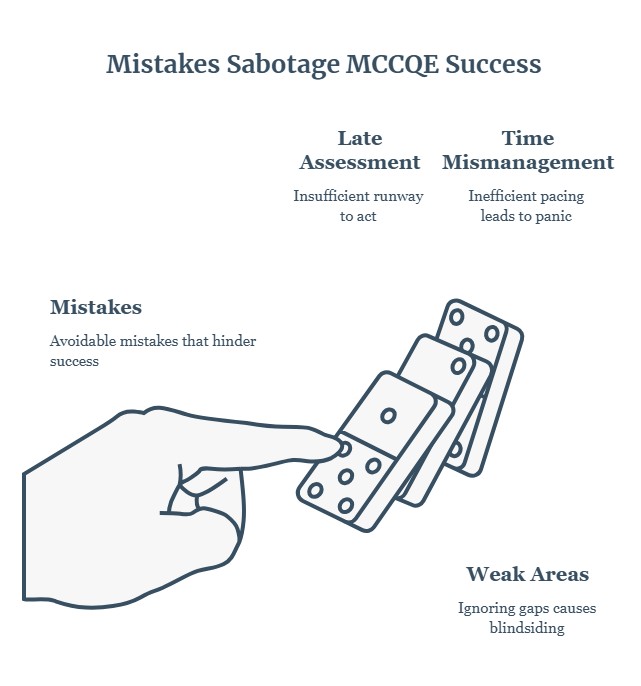
Underestimating Time Management
Time management is one of those exam skills people nod at politely. And then ignore it until it is too late.
Almost every MCCQE candidate knows, in theory, that time matters. But knowing it and preparing for it are two very different things.
The mistake usually begins with a false sense of security. You answer questions during untimed study sessions. You feel reasonably comfortable and you start believing that knowledge alone will carry you through.
But exam day is rarely that generous. The MCCQE contains 230 questions divided into two sections of 115 questions. This means endurance and pacing are not side issues. They are part of the test itself.
If you have not trained your pace in advance. The exam can begin to feel less like a demonstration of what you know. And more like a race against your own rising panic.
That is why I feel strongly that many graduates misunderstand what pacing really means. They think time management is about reading faster. It is not.
It is about moving with control. It is about recognizing when a question deserves an extra moment. And when it is already taking too much from you.
It is about protecting your attention. So one uncertain item does not drain the next ten. The real challenge is not speed for its own sake. It is consistency under stress.
This is also where knowledge gaps need to be discussed. A hidden weakness in a topic does not stay neatly contained. It slows you down. It makes you reread. It makes you hesitate between two options you should have separated quickly.
That hesitation costs time, time loss creates more anxiety and anxiety makes the next question harder than it should be.
So if you want to take this seriously. Practise in timed mode long before the real exam. Learn what your natural pace feels like. Notice where you slow down. Build rules for when to move on.
Review the questions that trapped you. And ask whether the issue was timing, uncertainty or both. That kind of preparation is exactly. What turns time management from a weakness into a quiet advantage.
Because the truth is simple and unforgiving. On the MCCQE, knowing the material is not enough. If you cannot access it steadily under pressure.
In fact, underestimating time management is one of the easiest ways. To let months of preparation unravel in a single sitting.
Ignoring Weak Content Areas
Studying what already feels comfortable is one of the most dangerous mistakes you can make. But this kind of studying can become a quiet form of avoidance. You are working hard, yes. But not always where it matters most.
The deeper problem is that weak areas rarely stay isolated. What looks like a bad subject is often a sign of something more important. A gap in reasoning, a shaky framework or a habit of memorizing without truly understanding.
That is why medical graduates, who ignore their weak zones. Often feel blindsided on exam day. They reviewed strengths and postponed discomfort. Eventually, that bill comes due.
The truth is that feedback only matters when you use it. And mistakes only become valuable. When you actively correct them. Simply seeing that you got a question wrong is not enough.
You need to slow down and ask why your thinking failed. Was it a knowledge gap? A missed clue? A rushed assumption? A pattern you never fully understood in the first place? That kind of review is harder than passive reading. But it is exactly what turns weak areas into stable ones.
In other words, the goal is to repair faulty thinking. And this is where many candidates get trapped by rote memorization. Because memorizing “patch” a weak area. Sometimes that works for a day or two. But it almost never holds under pressure.
The MCCQE is not designed to reward shallow recall alone. It asks you to think through clinical presentations. Choose between plausible options and apply medical knowledge. If your preparation is built on memorization without understanding. Your confidence will collapse the moment the question is framed in a new way.
A much better approach is brutally simple. Treat every weak area as a project. Relearn the core concepts. Review every wrong answer. Explain the medical concept back to yourself in plain language. Then return to that area again a few days later. And do more questions to see whether the improvement holds.
If you want to prepare well for the exam. You have to resist the urge to protect your ego and start protecting your score. The sooner you treat your weak areas the more your studying shifts. From repetitive effort to meaningful improvement.
And when exam day comes, that honesty pays off. You do not walk in hoping the test avoids your weak spots. You walk in knowing you already faced them before the exam ever began.
Taking the MCCQE Self-Assessment Late
Waiting too long before taking your self-Assessment is a mistake. One that can sabotage your exam preparation.
It rarely feels like a mistake in the moment. Usually, it feels responsible. You tell yourself you need just one more week. One more pass through your notes. One more block of questions before you are ready to see a real score.
I understand that instinct. A self-assessment can feel like a verdict. But that is exactly the trap. A self-assessment is not there to comfort you. It is there to tell you the truth while the truth is still useful.
That timing matters more than many candidates realize. The broader evidence on practice testing shows that tests do more than measure learning. They improve it. Especially when they are paired with feedback that helps you correct mistakes.
In other words, the value of the score is what it exposes. The clinical topics you keep missing and the patterns in your reasoning that break down under pressure.
If you take that assessment too late. You may still receive feedback. But you no longer have enough runway to act on it.
If you avoid taking the self-assessment. Because the possibility of a disappointing result feels unbearable. You will keep studying in the dark and hoping that more effort will automatically become more readiness.
Then, close to the exam, you finally sit down for a full practice test and discover something painful. But you no longer have enough runway to act on it. At that point, the self-assessment has turned from a guide into a source of panic.
However, when talking about a challenging exam like MCCQE Part I. We should not forget the elephant in the room – anxiety. Anxiety does not just make people feel worse. It often pushes them toward avoidance and delay. That is why postponing a self-assessment out of fear can be so costly for anyone.
By postponing the self-assessment. You are not protecting your confidence. You are postponing the information that could help you study smarter. The better approach is to take the self-assessment at a point when the result can still change your outcome.
Not so early that the score is little more than noise. And not so late that it becomes emotionally crushing and practically useless.
How Ace QBank Accelerates Your MCCQE Exam Preparation

On exam day, confidence does not come from how many hours you studied. It comes from how often you have already practiced the exact kind of thinking the MCCQE requires. That is where Ace QBank can meaningfully accelerate your preparation.
The first advantage is volume with purpose. The question bank offers more than 2,950 high-yield questions. More importantly, these questions are based on the MCC objectives.
This means questions are designed in MCCQE style. At the same level of difficulty, if not more challenging. This gives you repeated exposure to the patterns and clinical reasoning demands that define the exam.
That matters because your performance improves. When your brain stops treating each question as a surprise. As you work through large numbers of well-targeted practice questions. You are building exam instinct.
I am not trying to explore an educational point here. Retrieval practice has been shown again and again. That testing yourself produces stronger long-term retention.
In other words, the act of pulling knowledge out of memory is itself a learning event. That is why question banks work when used well. Every time you force yourself to choose the best answer, eliminate distractors and commit to a clinical decision.
You strengthen the pathways you will need later under exam conditions. Ace QBank accelerates preparation because it keeps you in that active mode.
The best part is that the question bank offers this in two study modes. Timed and tutor study modes. You can use these study modes in an alternative way to properly cover the 21 categories in your dashboard.
Earlier, we discussed properly managing your time. Here you can create a question block in a time mode from familiar categories. This will help you to get your time pacing right.
Earlier we talked about how crucial it is to wrangle your time like a pro. Here is your shot to put that advice into action. Dive into the question block section. Pick a familiar category and choose a time mode. This hands-on experience will let you practise time management. So you can nail your pacing when it really counts.
The second advantage is feedback. Practice questions alone are not enough. If they only tell you whether you were right or wrong. What improves performance is meaningful feedback.
One that helps you understand why an answer was correct. Why your reasoning failed and what pattern you missed.
The QBank’s white feedback for you in the three levels. One of those feedback items is the evidence-based medicine explanation.
This is especially valuable when you are reading an explanation. Where you made a mistake and reflect on a deeper misunderstanding rather than a careless miss. A good explanation turns every wrong answer into a shortcut for future growth.
That is how time is saved. You do not need to relearn an entire discipline. And later a focused review can also reveal the exact concepts that keep tripping you up.
The best part is that the explanation section includes hundreds of summary tables. Diagnostic flowcharts and custom illustrations that make recalling the key points more efficient.
Ignoring weak content areas was another topic we discussed. He won’t leave any stone unturned. With the QBank, evidence-based medicine explanations for each option.
MCCQE self-assessments offered by Ace QBank include two separate self-assessments. Each with 120 high-yield questions. And the question sets are distinct rather than recycled. That design matters more than many students realize.
Repeated exposure to the same questions. Just creates a false sense of progress. You may feel stronger simply because the material looks familiar. Not because your clinical judgment has genuinely improved.
Distinct self-assessment forms are much more honest. They test transfer, not recognition. They ask whether you can perform again with fresh material. Which is much closer to what the MCCQE will demand from you.
That honesty is useful, even when it stings. In fact, especially when it stings. A realistic self-assessment taken early enough in your preparation. It can completely change your trajectory. This shows that what you believe are your strengths. May not be as stable as you assumed.
I know feeling uncomfortable in that moment might not be pleasant. But it can help you improve quickly before the exam. A false sense of readiness delays correction. Accurate feedback accelerates it.
In the end, the question bank accelerates MCCQE1 exam preparation. Because it aligns with how strong exam performance is actually built. It uses thought-provoking questions to reinforce learning with feedback. Instead of leaving mistakes unexplained.
The question bank offers self-assessments that test real readiness instead of familiarity. It develops pacing, endurance and pattern recognition. Instead of assuming knowledge alone will carry you.
Most importantly, it helps you study with direction. And direction is what turns hard work into useful work. If I had to take the exam again after two decades. Ace QBank would be my top choice. It is that good.
How Can I Try Ace QBank?

To try the question bank you can sign up for a free demo account. Then you can explore the platform on your own terms. Without pressure or commitment.
You simply register for a complimentary demo account. The process is straightforward and in return. You receive access to 21 free sample questions.
That may seem modest at first. Yet it provides a clear and authentic window into the content, the question style and the interface itself. You see how the platform actually works before deciding whether it belongs in your study plan.
During this trial period. You should put a few practical features to the test. The ability to flag questions for later review stands out as especially useful. You can also highlight key details in both the question stems and the explanations. Mirroring the way you already annotate your textbooks and notes.
Equally important are the study modes available to you. Timed mode replicates the pace and pressure of the actual exam. While tutor mode allows you to slow down and learn deliberately from each question.
You can also experiment with building your own personalized question blocks. After adjusting the number of questions within a question block.
The real value of this exercise lies in discovering whether the question bank fits the way you learn. When the platform supports your habits and gives you the structure you need. Your preparation gains focus and direction.
You owe it to yourself to find out early. Whether this Qbank will help you study more effectively and with greater confidence.
Those who take this first step. Discover that the right match becomes one of their strongest assets. As they move through the months ahead.
Key Takeaways
Use the extended exam session strategically. Confirm your date through physiciansapply.ca early. Use the additional time to strengthen challenging areas. Also accelerate your exam preparation by avoiding time-consuming mistakes.
A focused Canadian question bank can support effective preparation. A question bank such as Ace QBank helps candidates practise high-yield questions. It provides evidence-based medicine explanations, tracks weaknesses and assesses readiness through mock exams. It walks with you every step.