3 Essential Tips for Studying for the MCCQE1

The MCCQE Part I is a high stakes medical licensing exam in Canada. It tests your ability to think like a clinician, not simply to recall facts. The true difficulty lies in the breadth of the Medical Council of Canada (MCC) objectives. Master that list, and you stand a much better chance of passing.
Preparation must be deliberate. Anchor your study in the MCC objectives and practise with high yield questions that mirror the exam’s style. Mindless hours do not equal readiness. But focused and strategic MCCQE1 exam preparation does.
This is why I would like to share with you three essential tips that will help you study smarter. Align your study with the MCC objectives. Help you enhance your clinical reasoning based on the Canadian guidelines. And also build your test-taking strategy along with your stamina for the exam day.
How is MCCQE1 Different from other Medical Licensing Exams?
You have probably noticed this already. Not all licensing exams are built to measure the same thing. The MCCQE Part I looks a lot like other big exams on the surface. Computer-based, multiple choice and clinical scenarios.
But once you scratch that surface. It behaves very differently from the USMLE steps. And if you don’t understand those differences. You risk preparing “hard” but not “smart.”Let’s unpack how the MCCQE1 really stands apart. And why that matters for how you study.
A Canadian exam for Canadian practice
Most major licensing exams are designed for broad international mobility. The USMLE is tuned to the U.S. health system. PLAB is built around practicing safely in the U.K. The AMC exam reflects the Australian context. The MCCQE Part 1 exam, in contrast, is unapologetically Canadian.
It tests your readiness to practice medicine in Canada. Not just your ability to recall global medical facts. Content is anchored in Canadian clinical practice, health-system realities and population health priorities.
And the exam blueprint is explicitly tied to the Medical Council of Canada (MCC) Objectives. That means Canadian guidelines, Canadian standards of care and Canadian expectations of what a “day‑one” physician should be able to do.
So, while you will recognize shared core science and clinical principles across exams. The MCCQE1 asks. Can you apply those principles the way a Canadian physician is expected to?
MCCQE1 is Built on the MCC Objectives
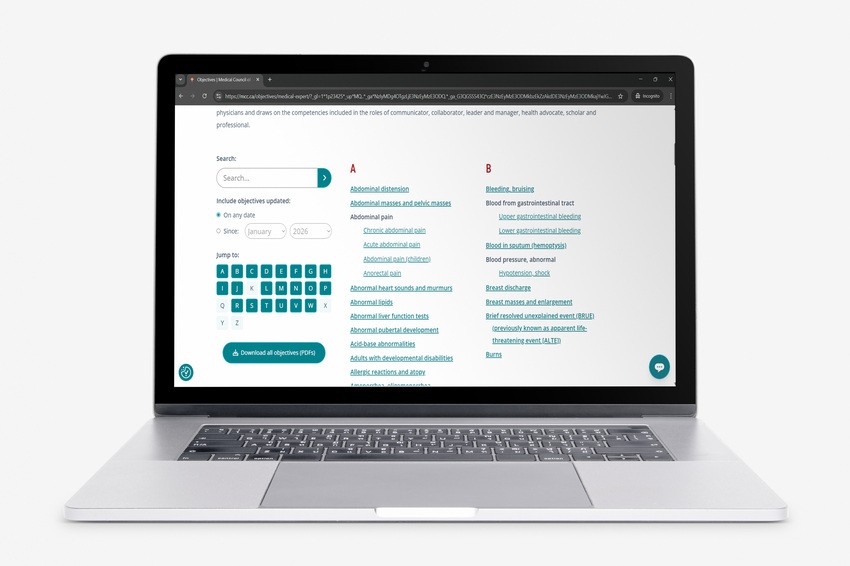
Many exams, think USMLE Step 2 CK or similar. Organize content primarily around organ systems and disease categories.
The MCCQE Part I goes further. It’s based on the objectives outlined by the Medical Council of Canada. And the exam blueprint is explicitly aligned with the CanMEDS roles. The national framework that defines what a competent physician in Canada should be.
I have discussed the CanMEDS framework in detail before. And you can read about the CanMEDS here. However, the MCCQE1 blueprint is organized around two pillars:
- Physician Activities
- Dimensions of Care
These two form the core blueprint of the MCCQE Part 1 exam. Organizing content under the CanMEDS framework to assess physician competencies across clinical scenarios.
As you see, Physician Activities represent the key tasks physicians perform in daily practice. And the Dimensions of Care categorize patient care contexts. From preventive to acute, chronic and psychosocial needs.
Meaning where a USMLE-style blueprint might start with “cardiology.” The MCCQE1 effectively starts with. What is the physician doing? In what context? And are they meeting the CanMEDS expectations while they do it?
That’s a subtle shift. But it deeply shapes the questions you will see.
The Exam has High Emphasis on Clinical Reasoning

You are not being asked only, “What is the diagnosis?” But often, “What is the most appropriate next step in this specific Canadian context?”
Compared with some other exams. The exams that may reward high‑level memorization of mechanisms and rare differentials. MCCQE1 leans hard into applied clinical reasoning:
- Interpreting incomplete or evolving clinical data
- Applying Canadian guidelines to everyday scenarios
- Prioritizing patient safety
Candidates often compare MCCQE1 to the USMLE Step 3. In its focus on clinical application rather than heavy basic science. That’s a useful mental anchor. But remember that MCCQE1 layers in CanMEDS roles. Canadian guidelines and broader physician competencies.
So when you prepare for the MCCQE1 exam. You are not just learning facts. You are training yourself to think like a Canadian clinician, making real-time decisions.
That said, the MCCQE1 recently underwent a format overhaul aimed at improving candidate experience.
Earlier versions included a CDM component in addition to multiple-choice questions. The new structure focuses on a streamlined, one-day and computer-based format. With content still mapped rigorously to the MCC objectives and blueprint.
Even without the older CDM structure, the exam hasn’t become “easy.” The shift is more about fairness and reducing exam fatigue, not watering down expectations.
You still face a long, demanding day of questions. Questions that require you to apply your medical knowledge. To interpret the given clinical data and choose the most accurate answer available.
Think of it this way. The MCC didn’t lower the bar. They just redesigned the track so more candidates can run at their best.
To succeed on your first attempt, you need strong grounding in core clinical medicine. Comfort navigating Canadian guidelines and public health priorities. And the ability to frame your answers through the CanMEDS lens.
Thinking as a communicator, collaborator and health advocate. Not just a “walking textbook.” If you approach MCCQE1 as “just another multiple‑choice test.”
You will miss that deeper competency orientation. But if you train yourself to think. “What would a safe, competent Canadian physician do in this situation?” You are already aligning with what the exam is truly measuring.
What Are 3 Essential Tips for Studying MCCQE1?
Preparing for this exam. It is about mastering clinical reasoning, time management and test-taking strategies. You should focus your time and energy. Where they will deliver the biggest return.
I remember sitting that exam years ago. A coffee cup stood forgotten at my side. Cooling as I reread the same summary note for the third time. You have likely been there. Eyes heavy, mind loud and confidence wobbling.
The exhaustion and anxiety make every question feel larger than it is. You begin to doubt whether your study plan is making any real difference. Here are three practical tips that cut through the fog.
Tip 1 - Practice with High-Yield Canadian Questions
The Medical Council of Canada has outlined the list of objectives for the exam. And from high-yield Canadian questions. I mean, questions that are not only based on the objectives. But also high-yield and clinically oriented.
Practising with these types of questions helps in several ways. It improves your clinical reasoning and helps you focus on common medical conditions. It also helps you identify and fill knowledge gaps efficiently.
Since questions are based on the MCC objectives. It also helps you to properly cover the objectives. Align your study with the exam expectation. And ensures you are not wasting time on low-yield topics.
On the other hand, regular practice with high-yield, clinically oriented Canadian questions. It will reinforce patterns of presentation and management that are emphasized on the exam. As well as improve test-taking strategy. Such as recognizing distractors and better managing time.
Tip 2 - Hone Your Time Management Like It’s a Clinical Skill
The exam is a standardized, computer-based exam. That means everyone will get the same clock and the same ticking timer. Your advantage doesn’t come from having more time.
It comes from using the time you have like a focused clinician uses a stethoscope. Deliberately, confidently and with practice.
Poor time management often goes unnoticed. Like a fault line until it ruptures. Too many students discover, with a sinking realization. That poor time management was their undoing. And that realization arrives only after they click to submit their exam with half a dozen blank answers.
The sad part is that if you have submitted your exam with unanswered questions. Your habits persist. And you stand a very good chance of repeating the same mistakes in part two.
That’s why we highly recommend not taking the timed question block likely. In fact, that’s exactly what most top scorers avoid.
The best part is that Ace QBank lets you create custom question blocks in time mode. Use that feature to simulate real exam pacing. Set up blocks to the max number of questions.
Then practise as if you are in the exam room. No stopping and no skipping the clock. Treat each practice block as a mini exam. This will improve your speed and composure.
Note
I also have some good news to share. Your feedback to our support team regarding the timing issue was discussed. You guys asked for more time per question. So, the practice environment better matches the actual exam. The board has approved that change. This means every question will be allotted extra time to match the actual exam format. We will announce the update on social media later this month.
Thank you for Speaking Up. Your feedback made a difference.
Tip 3 - Assess Your Readiness Before the Exam

Before you sit down for the exam. Give yourself one powerful gift. An honest self‑assessment.
You pour so much energy into studying. You read, review and do questions. But without a check‑in, you guess how ready you feel. That guess often fuels anxiety.
A structured self‑assessment replaces that guess with real information. You see where you stand and what you still need.
When you face a long list of exam objectives. Your brain loves to focus on familiar topics. You flip through sections you know well because it feels good. In the process, you skim over the trouble spots.
A self‑assessment interrupts that pattern. It points straight at your weak areas. So you stop flying blind.
Think of it as a focused map for your final stretch. You don’t have to wonder “What should I study next?” You can look at your results and decide with intention.
You spend your remaining time on the areas that move the needle. That simple shift makes your prep more efficient and your days feel more purposeful.
You deserve to go into the exam feeling prepared. A thoughtful self‑assessment helps you get there.
Where can you find self-assessments for the MCCQE1 exam? Ace QBank offers two self-assessments for the exam. If you have a Premium subscription, the self-assessments are already included in our package. If you have a basic package subscription, you should purchase the self-assessments separately.
Why Ace QBank is Non-Negotiable for MCCQE1 Exam Preparation?

You already know this. The exam is not an exam you “wing.” It is a Canadian licensing exam built on MCC objectives, CanMEDS roles and real clinical reasoning under time pressure.
You need a question bank that matches that reality. Not generic question banks. Most certainly not recycled USMLE content with a maple leaf slapped on top. That’s exactly why Ace QBank isn’t just “nice to have” for MCCQE1 exam prep.
It is very hard to build a truly Canadian, exam-level strategy without it. Just think back to the three pillars we have already talked about. All those three tips to help you score high in the MCCQE Part 1 exam:
- Practice with high‑yield Canadian questions
- Hone your time management like it’s a clinical skill
- Assess your readiness before the exam
The Qbank checks all three boxes. In a way that is actually aligned with the MCCQE1 blueprint, not just “inspired by” it. I know it sounds like a gross exaggeration. But let’s break down what this question bank actually offers:
- Provide High‑yield Canadian questions
- Help you to train in exam like condition
- Assessing readiness with true simulation
- It turns mistakes into understanding
- Aligns with Canadian guidelines
Provide High‑yield Canadian Questions
You are not preparing for a simple international exam. You are preparing for a Canadian licensing exam for Canadian practice. Built on MCC objectives and CanMEDS competencies. That difference matters.
The Qbank is built explicitly around those MCC objectives and the MCCQE1 blueprint. The question bank contains 2900+ high‑yield questions. Each mapped back to the MCC’s expectations, with in‑depth explanations, summary tables and algorithms.

That means you are not guessing whether a topic is relevant. It is already curated against official objectives. And you are training your brain to think in the patterns the exam uses (physician activities, dimensions of care and Canadian guidelines).
You are also repeatedly exposed to Canadian-specific guidelines and high-yield scenarios. Not just generic board-style questions.
In other words, you are not just doing “more questions.” You are doing the right questions. When you sit in front of the real exam, you want that déjà vu feeling. “I have seen this style, this framing, this level of nuance before.” The Qbank is purpose built to deliver that.
Help You to Train in Exam Like Condition
You already know time management can make or break your score. Even if your knowledge base is strong. MCCQE1 is long, mentally taxing and unforgiving if you get stuck in perfectionism on a few questions.
The Qbank doesn’t treat time management as an afterthought. Its practice environment is designed to simulate the pacing demands of the real exam. You are not learning time management from reading a blog post.
You will learn it through practice. By creating timed question blocks that mirror exam conditions.
The success of MCCQE1 “hinges on how you manage your time.” And each correctly answered question directly translates into a stronger result. By repeatedly facing exam-style time pressure in a realistic interface, you convert time management from a vague tip into a learned behaviour.
Over time, your internal script changes from “I hope I finish on time” to “I know exactly how fast I need to move through this block. And I have done it dozens of times already.”
Assessing Readiness with True Simulation
One of the biggest mistakes strong candidates make is flying blind into the exam. They do thousands of questions. But never test themselves in a true exam simulation. That’s where anxiety spikes and performance drops. Not from lack of knowledge but from lack of rehearsal.
The Qbank’s Self‑Assessment product is designed specifically as a true simulation of the MCCQE1 exam. Focusing on the most critical and high‑yield clinical content.
This isn’t just “another block of questions.” It mirrors the format, difficulty, and distribution of the real exam as closely as possible.
It also provides a performance snapshot. A snapshot that tells you whether you are likely to pass on the first attempt. And where you are still vulnerable.
Without a realistic self-assessment. You are essentially guessing whether you are ready. With MCCQE Part 1 Self‑Assessment, you have data, not vibes.
Qbank Turns Mistakes into Understanding
You are not just trying to get questions right. You are trying to build durable clinical reasoning. That only happens if every missed question becomes a high‑yield mini‑lesson.
The question bank leans into that. Explanations aren’t just one‑line rationales. The explanations are evidence-based medicine. They include detailed reasoning for why the correct option is correct. And clear explanations of why other options are wrong.
The explanation section also contains summary tables, algorithms, and visuals. That helps you compare diagnoses, management options or simplify complex medical concepts.
This structure supports pattern recognition. Over time, you stop memorizing answers and start recognizing clinical archetypes.
The unstable patient needing immediate action or the subtle red flag in a chronic scenario. And the preventive care opportunity you shouldn’t miss. That’s exactly how MCCQE1 expects you to think on exam day.
Aligns with Canadian Guidelines
Because Ace QBank is written for MCCQE1 and rooted in MCC objectives. Its cases feel closer to real Canadian practice than many generic question banks.
You will see preventive and public health themes that reflect Canadian health system priorities. Scenarios that require you to consider psychosocial factors, communication and professionalism. Echoing the CanMEDS roles.
And decision-making that matches the Canadian standard‑of‑care expectations. Not just “what is theoretically possible.”
This doesn’t just help you pass the exam. It nudges you toward the mindset. Mindset you will need in residency and beyond. How to think like a Canadian physician dealing with real people, in real systems and under real constraints.
But why Ace QBank for MCCQE1 exam prep isn’t “non‑negotiable” an exaggeration? You have a finite number of hours to prepare.
Every resource you choose is also a resource you are choosing instead of something else. So what makes the Qbank cross the line from “helpful” to “non-negotiable.”
It is a direct reflection of the MCCQE1 blueprint and objectives. So your time investment aligns with the exam’s expectations. Along with delivering high‑yield Canadian questions. Not repurposed content from other exams.
Honing your time management. A skill that helps you maintain consistent peace during the exam. Offering a true exam simulation self-assessment. So, you can assess readiness before you ever walk into the test center.
Not to mention, transforming your mistakes into a clear understanding. Which is where most of your score gain actually happens.
If your goal is simply to “get through” the MCCQE1 exam. You can patch together multiple resources and hope for the best. But if your goal is to walk into the exam confident, aligned with Canadian expectations and aiming for a strong first‑attempt performance.
Then, a purpose-built Qbank like Ace QBank stops being optional. It becomes the backbone of your preparation.
You already know the stakes. MCCQE1 is a Canadian exam for Canadian practice. Grounded in MCC objectives and clinical reasoning. Your strategy has to respect that reality.
Ace QBank lets you:
- Practice with Canadian-specific, high-yield questions
- Train your time management under realistic pressure
- Objectively assess your readiness with an exam-style self-assessment
- Build deeper clinical reasoning through evidence-based medicine explanations
That’s why calling it “non‑negotiable” isn’t hype. It is about making your preparation match what the exam is actually trying to measure.
How to Get Started with Ace QBank?

The clearest way to get started with the Qbank is to begin where there is no risk at all. A free demo and some simple, hands-on exploration.
Signing up for the free demo
The process is straightforward. You register for a complimentary demo account on the platform.
In return, you gain access to 21 sample questions. Enough to give a useful snapshot of the content without overwhelming you. It also gives you an authentic sense of the interface. The question style and the key features before you make any commitment.
What to test during the demo?
During that trial run, there are a few practical tools worth putting through their paces. You can flag questions for later review. A small but significant function that allows you to track areas of uncertainty or topics you want to revisit.
You can also highlight key information in the question stems and in the explanations. Mimicking the way many candidates already mark up textbooks and notes.
Just as important are the different study modes. You can switch between timed mode, which simulates exam conditions. And tutor mode, which allows you to slow down and focus on learning from each question.
There is also the option to experiment with building personalized question blocks. Tailor shorter or longer sessions to your schedule and concentration.
The objective of this exercise is simple but critical. To determine whether this platform aligns with your study habits and offers the structure you need.
In an exam year already marked by change and pressure. The degree to which you and the Qbank are well-matched can truly make a huge difference.
Key Takeaway
Study in alignment with MCC objectives. Focus your preparation around MCC objectives, CanMEDS roles and Canadian guidelines. So you train yourself to think and act like a safe Canadian clinician.
Practice with Canadian, high‑yield questions under realistic exam timing. Use a purpose‑built Canadian Qbank like Ace QBank to drill exam‑style MCQs in timed blocks. Treating time management as a core clinical skill you must master before test day.
Continuously assess your readiness and let data guide your final prep. Use self‑assessments to identify weak areas. Then shape your final weeks around closing those specific gaps. So you walk into MCCQE1 with clarity and confidence about where you stand.