3 MCCQE1 Study Secrets for 2026 Success

- Why Clinical Knowledge Alone Is Not Enough for MCCQE1?
- How To Properly Cover the MCC Objectives for the MCCQE Part 1?
- What Are the Best Canadian Resources for the MCCQE1 Exam Prep?
- Underestimating Volume Is the Silent MCCQE1 Killer
- How 3 MCCQE1 Study Secrets Lead to Success?
- What Makes Ace QBank the Best Question Bank for MCCQE1?
- Key Takeaways
Preparation for the MCCQE1 exam has always been a challenge. The volume of material is large, the exam style is very specific and many candidates are balancing study time with clinical duties.
For 2026, the exam continues to test not just medical knowledge. But also clinical reasoning, ethics and decision‑making under time pressure. Success comes from studying smarter, not simply studying more.
In this blog, we will break down why strong clinical knowledge alone is not enough to succeed on the MCCQE1. We will outline three practical strategies that consistently lead to MCCQE1 success. Finally, we will discuss what sets Ace QBank apart as a focused and effective question bank for this exam.
Why Clinical Knowledge Alone Is Not Enough for MCCQE1?
Canadian medical graduates often walk into the MCCQE1 steady on their feet. They know the terrain. They trained for it. The essentials feel familiar, almost second nature.
For many International Medical Graduates, the confidence runs just as deep. Years of training. Long hospital shifts. Real patients. Real decisions. It feels reasonable to assume that experience alone will carry the day.
But this exam has a way of humbling even the most seasoned clinicians. The MCCQE1 no longer rewards knowledge in the broad, informal sense. It asks something more precise. More deliberate. And this is where many capable doctors hit an unexpected wall.
At the centre of it all sit the MCC objectives. Objectives that are outlined by the Medical Council of Canada. They do more than outline topics. They define how the exam thinks. What it values. How it expects candidates to prioritize care, assess risk and make decisions under pressure.
You can know the medicine cold and still lose marks if your reasoning does not line up with those objectives. I have seen it happen. Smart clinicians. Solid judgement. Answers that simply missed the frame.

Then there’s the Canadian lens. And yes, it matters. A lot. Canadian guidelines, ethics, and health‑care realities are woven into every corner of the MCCQE1. This isn’t trivia. It is context.
Relying only on non-Canadian question banks can leave you a step behind. The answer that works elsewhere may not work here. Not in our system. Not with our standards.
Candidates often choose an option that feels clinically sound. Only to discover it wasn’t the Canadian best answer. That’s a tough lesson and it’s avoidable.
The final curveball is the sheer scope of the exam. It is a lot. No sugar‑coating it. Clinical medicine, public health and ethics. Along with preventive care practice. All in one sitting.
Even strong clinicians can struggle if they underestimate that breadth. You can’t just study what you like. You have to cover the waterfront.
Success on today’s MCCQE1 comes from balance. Clinical knowledge still matters. But it must pair with objective‑driven study. Canadian specific resources and a realistic plan that respects the size of the exam. Skip one of those and the odds tilt fast.
This exam isn’t questioning your worth as a doctor. It is asking whether you understand how medicine is practised, prioritized and evaluated in Canada. Get that right and you give yourself a fair shot.
How To Properly Cover the MCC Objectives for the MCCQE Part 1?

Using a question bank is not just one option for covering the Medical Council of Canada’s objectives. It is, in practice, the most reliable way to work through them in full.
When you first look at the official objectives list. It stretches on for page after page. Outlining what future physicians are expected to know and do.
The length and detail easily turn many candidates toward passive studying. Where you recognize the words but are not sure you could act on them in a real case.
What changes that dynamic is the simple act of applying your knowledge to concrete scenarios. I can assure you that answering questions and then reviewing the explanations. It is one of the most effective ways to uncover weak areas and strengthen memory.
In exam preparation courses across Canada, instructors emphasize this point in straightforward terms “You don’t really know it until you have used it in a case.”
Question banks do exactly that. They take an abstract objective. Say, assessing chest pain or managing new‑onset diabetes. And give you a patient, a setting, and a decision to make under pressure.
A Canadian question bank that is built directly on the MCC objectives goes one step further. That’s because its authors begin with the same list you see on the Medical Council website. Then design questions to match each area of knowledge and clinical skill.
In internal meetings and item‑writing workshops of Ace QBank, for example. They map scenarios to a specific objective. Checking that the wording and difficulty align with what the exam is likely to test.
This behind-the-scenes process means that. When you sit down to work through a block of questions. You are not guessing which parts of the curriculum you are touching. You are actively walking through those objectives in a structured way.
The experience on your side is more concrete. You open a set of Canadian‑written questions and encounter cases that feel familiar. An elderly patient in a small prairie town. A new immigrant family navigating the health system. A teenager in an urban emergency department.
Each vignette asks you to interpret symptoms, select investigations or choose management steps that reflect Canadian practice. When you get an answer wrong or right, but only by guessing.
The explanation traces the thinking back to the underlying objective. Over time, patterns emerge. You notice, for example, that you consistently miss questions that involve preventive care or that you hesitate with certain psychiatric presentations. Those patterns are your knowledge gaps made visible.
This process is very different from simply highlighting a line in a textbook or scrolling through the objectives list again and again. In quiet study rooms, libraries and shared apartments across the country.
I can tell you with confidence that regular use of a question bank forces you to confront what you do not yet know. While also confirming where you are solid. It turns a static and overwhelming list into a living checklist you engage with every day.
Each completed question becomes a small piece of evidence that you have actually met, tested and reinforced a specific objective.
Because the objective list is so long. And because the exam is built around applying knowledge rather than reciting facts. Using a Canadian question bank rooted in those objectives becomes more than a helpful supplement.
In that sense, prioritizing a well-constructed Canadian question bank is not just a study preference. It is the most dependable strategy for making sure the MCC objectives move from the page into your practice.
What Are the Best Canadian Resources for the MCCQE1 Exam Prep?

When you are staring down the MCCQE Part 1 exam. It is tempting to grab every shiny resource you see. And hope that more equals better. But just like packing your pantry. What really matters is how well the pieces work together.
That’s why I love talking about Ace QBank and Toronto Notes in the same breath. They are both Canadian, and both are carefully mapped to the MCC objectives. And they don’t compete. They truly complete each other.
Think of Toronto Notes as your deeply stocked, classic Canadian pantry staple. And Ace QBank is the hands-on. Every day, you cook with those ingredients.
For decades, Toronto Notes has been used by Canadian medical students and international graduates as a core review text for high-stakes exams.
It is updated regularly by contributors from the University of Toronto and other Canadian centres. And it’s structured around the clinical disciplines tested on licensing exams, including the MCCQE Part 1.
Because its content is grounded in Canadian practice patterns and guidelines. It aligns naturally with the MCC’s own objectives and expectations.
What makes Toronto Notes so valuable is its big picture structure. It pulls together:
- Concise summaries of common conditions
- Diagnostic approaches that reflect Canadian standards
- Management plans that mirror what you’d actually do in Canadian clinics and hospitals
This isn’t a book you “memorize.” It is a book you live with for months.
On the other hand, if Toronto Notes is your pantry. Ace QBank is you in the kitchen, apron on, actually cooking.
Ace QBank is a Canadian developed question bank designed specifically for the MCCQE1 exam. With questions built around the MCC objectives rather than a generic international exam.
What stands out is how intentionally it mirrors the style and reasoning the MCCQE1 expects:
- Clinical vignettes that feel like real Canadian cases
- Integration of ethics and population health
- High-yield questions aligned with MCC objectives so you can see exactly what you are practising
But the real magic is in the explanations. When you miss (or even guess) a question. The Qbank walks you through why each option is right or wrong. Often tying the reasoning back to Canadian guidelines and practical decision making.
This kind of feedback loop is exactly what educational research highlights as powerful. You apply knowledge, receive targeted correction and then reinforce the corrected understanding. Over time, this process significantly boosts your score
However, here is the beautiful part. Toronto Notes and Ace QBank don’t try to do the same job. That’s why they are such a strong pairing.
As you move through your prep, remember. You don’t need ten different books and five question banks. With Toronto Notes as your core Canadian text and Ace QBank as your MCCQE1 focused question bank.
You already have a powerful, complementary duo that respects the MCC objectives and mirrors real Canadian practice.
Underestimating Volume Is the Silent MCCQE1 Killer

I still remember the winter I started preparing for the MCCQE1. Snow piled up outside our Toronto condo, and I told myself I had plenty of time. I cooked big batches of soup and made a neat little study schedule. It felt calm. It felt doable. And it was completely wrong.
If there is one lesson. I wish someone had pressed into my hands earlier, it’s this. Most candidates don’t fail from lack of intelligence. They fail because they underestimate. How much they must learn. The exam covers everything. From newborn care to end of life decisions.
The Medical Council of Canada publishes a detailed blueprint. And when you read it closely, the scope is staggering. Family medicine. Surgery. Psychiatry. Obstetrics. Ethics. Public health.
The exam tests not just recall, but judgment. Research from medical education journals consistently shows that time pressure and incomplete content coverage rank among the top reasons for underperformance on high-stakes licensing exams. That’s not opinion. That’s a pattern.
I saw this play out in my own family. My cousin trained overseas and moved to Canada full of hope. She studied hard every night after work. When her results came back, she was crushed. “I knew the content” she kept saying.
But when we reviewed her plan together, the truth emerged. She had focused deeply on her comfort zones and skimmed the rest. The volume caught her off guard.
Underestimating sheer volume to cover is sneaky. It doesn’t feel like a mistake at first. It feels like confidence.
The MCCQE1 isn’t testing trivia. It tests how broadly and safely you can think. Studies on clinical reasoning show that wide exposure matters. The more scenarios you have seen, the faster and more accurately you decide.
This is why question banks work. Not because they are magical. But because they force you to confront gaps you didn’t know you had.
Here is what helped her and what I now tell everyone who asks:
- Map the content early. Print the MCC objectives. Highlight weak areas. Be honest.
- Plan for repetition. Spaced review improves retention. One pass isn’t enough.
- Use questions as teachers. Every wrong answer points to a knowledge gap.
- Respect mental fatigue. Cognitive studies confirm that tired brains miss easy points.
- Start sooner than feels necessary. If you think you need three months, plan for four.
I know how heavy this can feel. Some of you are juggling immigration stress and finances. Some other family expectations. But there is power in naming the real challenge. Volume isn’t your enemy. Ignoring it is.
The MCCQE1 rewards steady, broad preparation. When you respect the scale of what you are learning. You stop blaming yourself and start working smarter. That shift alone can change everything.
You are not behind. You are just waking up to what this exam truly asks of you.
How 3 MCCQE1 Study Secrets Lead to Success?

These three strategies work together. In fact, the synergy between these three leads to success in the exam. Let’s wait a second here. And see what I mean by the statement.
The Medical Council of Canada has outlined the list of objectives. The list defines the medical knowledge expected of a Canadian physician.
More importantly, these objectives serve as the foundation for the MCC examinations. And organized according to the CanMEDS roles and clinical presentations to guide both learning and assessment.
So, mastering the MCC Objectives properly means more than memorizing lists for an exam. It means understanding how each CanMEDS role shapes day-to-day clinical decisions.
How medical knowledge connects with ethics, population health and systems of care. And how these expectations come together in real Canadian practice.
When you use the objectives as an active study guide. You can easily identify knowledge gaps and weak areas. You will also train yourself to think like a Canadian physician, not just pass the MCC examinations.
On the other hand, using Canadian resources for MCCQE1 exam preparation is strongly recommended. As the MCCQE1 exam is built around Canadian practice standards, clinical guidelines and health care systems.
High yield preparation should focus on resources that align with MCC objectives, CanMEDS roles and the Canadian clinical context.
Obviously, there is a lot to cover for the exam. Underestimating the sheer volume of material can result in inadequate preparation and gaps in knowledge. All of which can be avoided by using the MCC objectives as a structured study map and regularly checking your progress against them.
When you study with the objectives in hand. You shift from passive reading to intentional preparation. You know what to study, why it matters and how it fits into the expectations of a Canadian physician.
Over time, the objectives become more than a checklist. They become a reliable framework that keeps your studying focused, efficient and aligned with the MCCQE1 exam.
Now imagine the question bank that is built based on the MCC Objectives themselves.
Each question targets a defined expectation. Not random facts. Not trivia. But what a Canadian physician is actually expected to know and apply.
Instead of guessing what might appear on the exam. You practise exactly how the MCC tests.
- Clinical scenarios mirror Canadian practice.
- Ethical questions reflect Canadian law and values.
- Public health questions follow Canadian guidelines and population needs.
This is where the three strategies truly come together.
- The MCC Objectives tell you what to learn.
- Canadian resources show you how that knowledge applies in real practice.
- A well‑designed question bank trains you to apply both under exam conditions.
This brings us to a critical point. One that deserves a pause.
Ace QBank stands alone as the only Canadian question bank aligned directly with the MCC Objectives for MCCQE1 preparation. That matters. And I will unpack why in the next section. Because once you see it clearly, your entire study strategy shifts.
Most candidates take a different path. They bounce between resources. They lean on American question banks to prepare for a Canadian qualifying exam. That disconnect matters. It breeds a shallow understanding of what the MCC is actually testing.
So they grind through questions without a clear purpose. They hope repetition will do the heavy lifting. It feels productive. It looks busy. But let’s be honest. It is rarely efficient.
When your question bank maps directly to the MCC Objectives, every question has intent. You stop guessing. You stop practising blindly. You start measuring yourself against the actual standard set by the MCC.
That’s when studying stops feeling like a shot in the dark and starts feeling, well, dialled in.
What Makes Ace QBank the Best Question Bank for MCCQE1?

Ace QBank is not just another pile of practice questions. It is built very deliberately around the way the MCCQE1 actually tests you. And that is what makes it stand out.
Ask anyone who has prepared for the MCCQE Part I. It can feel like chasing a moving target. One that never stops shifting, just as you think you have it lined up. The exam is broad and demanding.
And it remains relentlessly focused on how you think when a real patient sits in front of you. This is where Ace QBank quietly changes the game.
High-yield Questions Based on the MCC Objectives
First, the questions themselves are built for this exam. Ace QBank offers more than 2900 high-yield questions and they are not random trivia. Each one is linked to a specific MCC objective, the same blueprint that the actual exam uses to test you.
That means when you answer a question on Ace QBank. You are not just “getting another question right or wrong.” You are actively checking off pieces of the real exam map.
What makes this even more powerful is the way each question is explained. After every question. You get an explanation based on evidence-based medicine.
In simple terms, this means the reasoning is grounded in up-to-date clinical research, not guesses or shortcuts. You see:
- Why the correct answer is right
- Why the wrong options are wrong
This has a dual effect of alignment with the exam and real clinical reasoning. It is what helps move you from rote memorization to actual understanding. You are not just studying to pass. You are training to think like a safe, confident doctor in Canada.
Different Study Modes to Help You Prepare Quickly
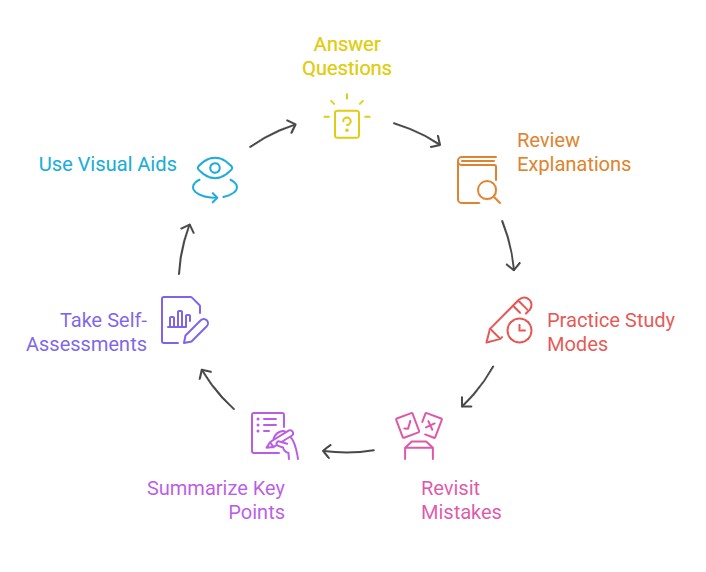
One of the most frustrating parts of exam prep is feeling like your Qbank does not “get” where you are in the journey. Ace QBank addresses this with two simple but very smart study modes, timed mode and tutor mode.
- Timed mode lets you simulate the pressure of the real exam. You answer questions under a countdown. Which forces you to balance accuracy with speed. Over time, this helps you manage one of the most feared parts of MCCQE1, running out of time.
- Tutor mode removes the clock and lets you slow down. This is where you dig deep into the topics that keep tripping you up. You can pause, re‑read explanations and genuinely understand what is going wrong without feeling rushed.
This combination is more than a convenience. It mirrors how top candidates naturally prepare. fast practice on areas of strength, and slow, thoughtful study on weak spots. Ace QBank simply builds that strategy into its design so you do not have to reinvent it on your own.
A Second Chance System for Your Mistakes
Most of us, instinctively avoid our mistakes because they feel uncomfortable. But for a high‑stakes exam like MCCQE1. Your mistakes are pure gold if you know how to use them.
The Qbank turns your incorrect answers into custom “question blocks.” When you get a question wrong, that question does not just disappear into the past.
Instead, you can collect those missed items into a dedicated block and face them again later. This does two powerful things:
- It forces you to revisit what hurt you once. So it cannot surprise you again.
- It gives you a visible record of progress as questions that were once confusing slowly become easy wins.
Psychologically, this is huge. You stop seeing wrong answers as proof that you “can’t do it.” And start seeing them as clear signposts pointing to exactly where you need to grow. For an exam as intimidating as MCCQE1, that mindset shift matters.
Capturing the Essence So You Remember Under Pressure
At the end of each explanation. The Qbank adds summary points that distill the key points from the question and explanation. These are not long paragraphs. They are short, sharp takeaways that capture:
- The core concept you must remember
- The critical clues that point to the right diagnosis or management
- The “don’t miss” key points that often show up in exam scenarios
These summaries act like mental anchors. When you are sitting in front of the real exam and a question feels familiar. It is often these concise points that float back into your mind.
Instead of trying to recall a full textbook page. Your brain pulls up a few strong, clear lines and that is often enough to unlock the answer.
True Simulation for Exam Day
Ace QBank also has self-assessments for MCCQE1. These self-assessments simulate the real MCCQE1 experience. Here is what matters most for you. And the best thing about these self-assessments is that they use unique questions, different from the main question bank.
So when you sit down to take one. You are not just retesting what you have already memorized. Instead, you are:
- Experiencing new questions under exam style conditions
- Testing your ability to apply what you have learned from the question bank
- Getting a realistic sense of your readiness well before you pay the exam fee or pick an exam date
For many candidates, this becomes a turning point. You finish a self-assessment and, maybe for the first time. You have honest data about where you stand.
That can be confronting but it is also incredibly empowering. You can decide, with evidence, whether you are ready and if not. Exactly where to focus next.
Turning Confusing Topics into Clear Pictures
Some parts of medicine do not stick easily when you only read text. Complex diagnostic pathways. Subtle differences between similar diseases or step-by-step management steps can feel like tangled wires in your brain.
The Qbank tackles this with visual aids such as flowcharts, summary tables and custom illustrations.
Flowcharts turn messy decision trees into simple “if–then” paths you can trace with your eyes. You see clearly. If the patient has this feature, you do this. If not, you do that.
Summary tables line up similar conditions side by side. Showing you differences in symptoms, tests and treatments at a glance. This is incredibly helpful for topics where the exam loves to test subtle distinctions.
Custom illustrations break down complex ideas into clear images. Instead of wrestling with abstract descriptions. You see the concept and remember the picture.
The best part is that the visual information is remembered more easily and for longer than text alone, especially under stress. For MCCQE1, where time is short and stress is high. Having these mental images can be the difference between a vague guess and a confident answer.
When you look at Ace QBank as a whole. The 2,900+ high-yield questions. The evidence-based explanations, the adaptive study modes and the second‑chance question blocks.
Along with the sharp summary points, the realistic self-assessments and the visual aids. A clear picture emerges. This is not just a question bank. It is a structured training ground that:
- Mirrors the content and style of the actual MCCQE1
- Trains your clinical reasoning, not just your memory
- Helps you identify and repair your weak spots
- Builds your timing, confidence and exam‑day endurance
- Supports you emotionally by turning confusion into clarity and fear into a plan
You are not supposed to walk into MCCQE1 feeling perfect. But with a question bank like Ace QBank. You can walk in feeling prepared.
How Can I Sign Up for Free Demo Questions?

To access the free MCCQEI demo questions. First, register for a free demo account. This gives you more than just sample questions. It provides access and hands-on experience to familiarize yourself with the platform.
This hands-on exploration. Giving you a chance to see how it can support your preparation in a meaningful way.
Once inside, you will be able to try out important features. Features such as flagging questions that you want to revisit later. And also highlighting key information within questions and explanations.
These tools are thoughtfully integrated to help you focus your study sessions. Making your learning more effective.
Additionally, the demo lets you create personalized question blocks. And select from different study modes including timed practice or tutor mode.
Sign up for the free demo and dive into the questions. Test the functionality of the platform. See how the Qbank can transform your study experience.
Key Takeaways
Study Using the MCC Objectives as Your Guide. Use the official Medical Council of Canada objectives to guide study priorities. Treat them as an active checklist.
Use Canadian Resources that Reflect Canadian Guidelines. Prepare with materials (e.g., Toronto Notes and Ace QBank) that align with Canadian guidelines, ethics and healthcare context to avoid choosing clinically reasonable but non-Canadian answers.
Respect the Exam’s Breadth and Turn Mistakes into Progress. Start early, plan for repetition and spaced review. To systematically fix knowledge gaps and retain high-yield concepts under pressure.