Why Do Most MCCQE1 Study Plans Fail?

The vast majority of medical graduates in North America. All believe that doing more practice questions positively correlated with a higher score on the medical licensing exam. And to be fair, they are not wrong.
However, two key points are missing from this statement. key points that are often ignored by medical graduates and can lead to inefficient preparation, false confidence and disappointing results on exam day.
In this post, we will look beyond the common advice of “just do more questions”. We will discuss the two missing ingredients in MCCQE1 exam preparation. And how you can study smarter for the MCCQE1 exam.
What are the Two Missing Ingredients in MCCQE1 Exam Preparation?
Most medical graduates are preparing for licensing exams. Accept one idea almost without argument. The more practice questions you complete the better your exam score is likely to be.
There is truth in that belief. Walk into any library or online preparation group in the months before the MCCQE1 exam. And you will see the same pattern.
Candidates sit with laptops open, coffee cooling beside them and moving from one question to the next. They compare question counts. They ask one another how many blocks they have completed.
In that environment, it is easy to believe that volume alone is the measure of progress. But that statement is incomplete.
Two important points are often left out. They are simple, but they matter. When they are ignored, preparation can become inefficient.
You see, a high question count may create confidence. A confidence that does not hold up under exam pressure. And on exam day, the options are close and the clock keeps moving. That false confidence can quickly turn into disappointment.
The first missing ingredient is question quality. I have always said that one of the cornerstones of MCCQE1 success is practising high-yield questions. Questions that reflect the MCC objectives, current evidence-based medicine and Canadian clinical guidelines.
This distinction is very important, particularly now. That the MCCQE1 is designed to assess whether you can apply medical knowledge. Safely and appropriately in clinical situations that reflect Canadian practice.
A quality question does more than tell you whether you were right or wrong. It shows you how you think. It exposes weak areas, but it also strengthens your understanding.
It forces you to recognize patterns, separate similar presentations and decide what should happen next.
In many cases, the real learning happens after you answer a question. When you read the explanation and ask yourself why one option was better than the others. This is where real confidence begins to grow.
Not from reading alone. Not from highlighting another chapter. Not from memorizing one more isolated fact. Confidence grows because you repeatedly apply knowledge in the same way. You will be expected to apply it on exam day.
You learn to recognize what matters in a question stem. You learn to ignore distracting details. You learn to identify the correct diagnosis and the safest next step in management.
Medicine is not always difficult because the facts are impossible. Often it is challenging. Because the decision has to be made with imperfect information.
Two diagnoses may look similar. Two management options may seem reasonable. One investigation may be tempting, but not necessary yet. The real test is whether you can stay steady, understand the clinical picture and choose the best next step.
High-quality questions help you build that steadiness. They train your mind to think less like someone collecting facts and more like a clinician working through a patient presentation. For the MCCQE1 that means learning to reason within Canadian medical standards.
The second missing ingredient is time management. This is often misunderstood. Many candidates hear the term time management. They immediately think, “I just need to read faster.”
They imagine racing through question stems. Shaving seconds off each question and pushing themselves to move more quickly. But speed, by itself, does not win this race.
In the exam setting, time management is not about charging ahead. It is about staying in control. And that control comes from an understanding of the objectives. Objectives that are outlined by the Medical Council of Canada (MCC).
When you know a topic well. You do not have to reread every sentence in panic. You are less likely to be thrown off by an unexpected detail in the stem.
Let me reiterate myself here. When you know a clinical presentation well. You do not have to reread every sentence in panic. You are less likely to be thrown off by an unexpected detail in the stem.
Because you can identify the key clinical clues, connect them to the clinical concept and eliminate unsafe or unlikely options. Then move forward with a clear decision.
When your foundation is weak. Time disappears in a different way. You hesitate. You reread. You second-guess. You narrow the answers to two choices and then circle between them. While the clock keeps moving. The problem is not only speed. The problem is uncertainty.
Therefore, the stronger your comprehension of medical concepts. The less likely you are to be knocked off track by a surprise twist in the question. You are anchored in understanding.
And that anchor matters when the exam becomes stressful. Because stress has a way of magnifying every small doubt.
But when you are in control you will beat panic-fuelled adrenaline every time. So do not measure your preparation only by how many questions you have completed. Measure it by how much better you are becoming at thinking through clinical problems.
Practice with high-quality MCCQE1 style questions. Review the explanations carefully. Build your knowledge foundation based on evidence-based medicine and Canadian guidelines. And learn from every mistake and every lucky guess you make.
If you prepare this way. Then time management will not feel like a separate skill you are trying to force. It will begin to follow naturally from stronger knowledge, clearer reasoning and calmer decision-making.
That is the kind of preparation that carries you into the exam with confidence that is earned.
Why More Questions Alone Won’t Guarantee MCCQE1 Success?

More practice questions can absolutely help you prepare for the exam. No serious candidate should ignore them. They expose your weak areas and force you to apply medical knowledge rather than simply read it.
But here is the part many candidates miss. More questions alone do not guarantee success. The number of questions you complete does not necessarily have a direct relationship with the quality of your preparation.
Meaning the total number of questions completed is not a predictor of preparation quality. As the relationship between quantity and exam readiness. Depends on factors such as accuracy, understanding, review quality and retention.
You can finish hundreds, even thousands of questions and still feel uncertain on the exam day. If those questions are not properly aligned with the MCC objectives, Canadian clinical guidelines, and the kind of reasoning expected from a physician in the Canadian healthcare system.
The MCCQE Part 1 does not test whether you can memorize every detail in medicine. It is testing whether you can apply medical knowledge in a clinical situation.
It asks whether you can recognize the common medical conditions. And make a clinical decision that reflects Canadian standards of care. That is why the quality of the questions matters so much for exam preparation.
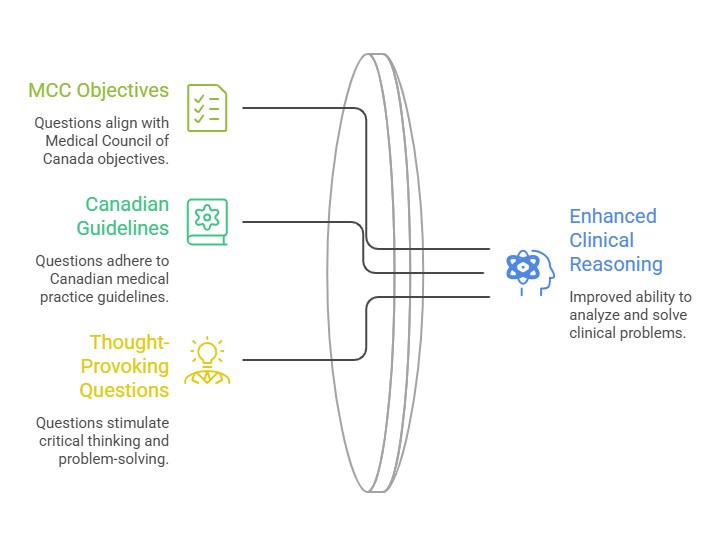
A quality MCCQE1-style question should be built around the MCC objectives. These objectives are the framework that tells you what the exam considers important. If your practice questions are not connected to those objectives.
You may spend hours studying material that feels medical. But it does not truly prepare you for the exam in front of you.
The same applies to Canadian guidelines. Many medical graduates come with strong clinical backgrounds. But their previous training may be based on another healthcare system.
Here is a quick example off the top of my head. Canadian healthcare has changed the preventive screening age for both colon and breast cancer. So anyone studying with USMLE material is more likely to miss this.
The exam expects you to think within the Canadian context. Screening recommendations, preventive care and primary care management. Along with ethical expectations and emergency decisions may not always be identical to what you learned elsewhere.
This is where high-quality questions become essential. They help you identify your weak areas. But they should also do more than that. A good question should help you understand the medical concepts behind a question.
It should show you whether your gap is a knowledge gap, a reasoning gap or a guideline gap. Sometimes you miss a question because you did not know the diagnosis. Other times, you knew the diagnosis but chose the wrong next step.
And sometimes, you selected an option that may be reasonable in another setting. But it is not the best answer according to Canadian practice.
You see, this kind of feedback is powerful. it turns a wrong answer into a map. It shows you where to go next.
Instead of simply saying, “I am weak in cardiology.” You can say, “I need to review the approach to chest pain, risk stratification and the next best investigation in a Canadian clinical setting.”
That is a very different kind of studying. It is focused, efficient and far more likely to improve your score. This is why thought-provoking questions matter.
The MCCQE1 values clinical reasoning and problem-solving. Because they are central to the exam.
The best questions make you pause, prioritize and decide. They do not simply ask “Do you remember this fact?” They ask, “Can you use this fact correctly when the patient presentation is not perfectly straightforward?”
A thought-provoking question pushes you to ask:
- What is the most likely diagnosis?
- What is the safest next step?
- What information in the stem actually changes management?
- Which answer is tempting but not correct?
- Which option reflects Canadian guidelines?
- What would I do first if this patient were in front of me?
This is where real learning happens. If you are only counting questions, you may feel productive. You may look at your daily target and think.
I completed 100 questions today. So I must be improving. But if you rushed through them, skipped the explanations and ignored your mistakes. Or, if you memorize the answers without understanding the reasoning. You may be building false confidence.
The question will not look exactly like the one you practised on the exam day. The stem may be longer. The wording may be unfamiliar. Two answer choices may seem correct. A small detail may change the entire management plan.
At that moment, you need clinical reasoning. You need to understand the concept deeply enough to identify the key clue, eliminate distractions and choose the best answer with confidence.
That confidence does not come from question volume alone. It comes from reviewing questions properly, understanding the explanations and learning how Canadian guidelines shape clinical decisions.
That is why more questions alone won’t guarantee MCCQE1 success.
You do not just need more questions. You need the right questions. Questions that are aligned with the MCC objectives. Questions that reflect Canadian guidelines. Questions that expose your weak areas.
So yes, do practice questions. Do many of them. But treat every question as a training opportunity.
The Best Time Management Strategy for the MCCQE1 Exam

The best time management strategy for the MCCQE1 is to stay in control. That may sound simple. But it is one of the most important truths about this exam.
The exam tests not only what you know. It is testing whether you can apply what you know under pressure, with limited time and answer choices that often look uncomfortably close to one another.
Many candidates think time management means speed. I strongly disagree because speed helps only when it is built on understanding. If you rush without comprehension. You will miss key details, misread the question and waste even more time going back to fix mistakes.
In the MCCQE Part 1 exam control beats speed every time. And control on exam day is largely built during your preparation. If your medical foundation is weak. Every question feels heavy. You read the stem once, then again and then a third time.
You recognize some clinical clues. But not enough to feel confident. You narrow the options down to two. Then you sit there, staring at both and hoping one of them will suddenly look more correct. That is where time disappears.
But when your understanding is strong, you move differently. You recognize the clinical pattern earlier. You know what the question is really asking. You can identify the key clue, ignore the noise, eliminate unsafe options and make a decision.
This is real time management. It does not come from panic. It comes from preparation.
In clinical practice, you don’t win by being the fastest person in the room. You win by being safe, organized and decisive. The same principle applies to the exam.
You need to train yourself to read each question like a clinician receiving a patient handover. You are looking for the details that change the diagnosis, risk level and investigation plan.
On the other hand, control on exam day also depends on having a repeatable method. You should not approach every question randomly. And know that not every question deserves the same amount of your time.
When you are uncertain, effective test-taking strategies help protect your score. Mainly with saving time and preventing mental wandering. Here are practical strategies for exam day:
- Read the stem actively. Do not passively scan the words. Look for age, sex and vital signs. Along with red flags, medications, and key physical findings. Also pregnancy and immune status
- Identify the clinical problem. Ask yourself “What is the main issue here?” Is this chest pain? Abdominal pain or abnormal bleeding. Confusion or a mental health crisis?
- Form your own answer before looking too deeply at the options. This is important. If you look at the answer choices too early. They can pull your thinking in different directions. Try to decide what you expect the answer to be first.
- Eliminate unsafe or irrelevant options. Some options may be technically related to the condition but not appropriate as the next step. Remove what is unsafe, too invasive or not aligned with Canadian practice.
- Choose and move. Once you have made a reasonable clinical decision. Do not keep arguing with yourself unless you have a clear reason to reconsider.
That said, you should also know when to move to the next question. Because some questions will be straightforward. You will recognize the diagnosis or management step quickly. Answer them confidently and move on.
Some questions will require thought. Give those questions the time they deserve. But stay disciplined.
Some questions will be unclear. No matter how long you stare at them. These are dangerous. They can steal three or four minutes from you and still leave you uncertain.
You need to learn when to move on. You should not allow a difficult question to damage the rest of your exam. One question is one question. Your job is to protect the entire exam. Not to win an argument with a single stem.
If you are stuck, make your best educated choice or flag a question and continue. However, since there is no negative score. And often your first structured answer. It is better than the answer you choose after two minutes of panic.
I am keener on an educated choice. But this is my personal preference.
Why Do Most MCCQE1 Study Plans Fail?

Most MCCQE1 study plans fail because they emphasize busyness. Rather than clinical decision-making.
What usually happens is that medical graduates open a fresh calendar and build a tight schedule. Within this period, they complete many questions each day. In the hope that exam success will follow.
At first, the plan feels solid. Boxes get checked. Numbers climb. Progress looks obvious. Because it can be counted. But then something unsettling happens. Practice scores stall, time starts slipping during timed practice and confidence thins out.
I said many times that one of the most common traps is the belief that more questions automatically mean better preparation. A plan built on volume turns studying into a race. It rewards speed and endurance and not understanding.
When the day’s target is a number, the mind learns to move on quickly. Sometimes after a guess, sometimes after a shallow review of the explanation.
Over time, the habit becomes muscle memory. Finish, submit and move forward. That approach can feel productive. But it quietly avoids the hardest part of the MCCQE Part 1 exam. Making careful choices from a clinical story and not just recognizing patterns.
The other reason a study plan fails is the assumption that any practice question is a good teacher. In reality, some questions sharpen judgment and force clear thinking. They focus on collecting facts instead of building clinical reasoning.
On the other hand, the exam pressures you to read a situation, decide what the main problem is and choose the best next step. It demands a comprehensive understanding of the medical concepts.
When the MCCQE1 study plan leans too heavily on passive review or rapid question blitzes. Knowledge stays scattered. Little islands of information that don’t connect when the clock is running. On exam day, scattered facts feel like noise. Clear reasoning feels like a path.
Another common failure point is misalignment with Canadian expectations. Studying medicine in general is not the same as preparing for this exam in particular. Plans often drift toward broad, comfortable material and away from the standards the exam is built to test.
When preparation is not tied to the MCC objectives and Canadian guidelines. You will be surprised by what the exam emphasizes and how it frames decisions. The result is frustration.
Last but not least, many study plans fail because they treat time management as a last-minute concern. There are two contributing factors to proper time management. As I mentioned earlier, a comprehensive understanding of medical concepts and good test-taking skills are required.
These two will give you control and help you maintain your pace during the exam. You should acknowledge the fact that proper timing is not a personality trait; it is a practiced skill. Without a trained approach. Active reading, naming the clinical problem early and moving with disciplined pacing.
Even strong candidates can still lose scores. They know the material, but the clock turns their knowledge into unfinished work. The worst part is that the exam does not grade effort. It grades completed and correct decisions under pressure.
Any unanswered questions on the exam won’t receive a score. The higher the number of such questions, the lower the likelihood of passing the exam.
A study plan succeeds. When it stops worshipping quantity and starts demanding quality. High-quality questions for real reflection, deliberate clinical thinking and better alignment with Canadian expectations and trained pacing.
The quality questions are the engine. And when that engine is built, the story changes. Practice stops feeling like a treadmill. And starts feeling like progress that holds up when it matters most.
How to Study Smarter for the MCCQE1 Exam?

The most effective MCCQE1 preparation is built around a high-quality Canadian question bank. The exam has evolved into a broader, more clinically oriented assessment. One that emphasizes clinical decision-making rather than simple fact recall.
Now success in the exam depends on identifying clinical clues. Weighing plausible options and selecting the correct answer.
Therefore, your preparation must go beyond memorizing clinical presentations. You need repeated exposure to questions. High-yield questions that mirror the style, scope and reasoning demands of the exam.
A Canadian-specific resource is especially valuable. Because the exam reflects current Canadian practice standards, MCC objectives and the application of evidence-based medicine.
A well-designed Canadian question bank helps bridge that gap. By presenting tough thought-provoking clinical cases that require interpretation. Clinical cases that help you apply and test your medical knowledge.
This kind of deliberate practice strengthens your diagnostic thinking. Improves your performance across a wide range of clinical topics and also promotes more efficient studying.
That said, evidence-based explanations are equally important. Because detailed explanations help students understand why an answer is correct. Why are alternative options less appropriate? And how current guidelines shape clinical choices.
This shifts the exam preparation from memorization to meaningful clinical reasoning. In that sense, the smartest way to prepare for the MCCQE1 is not simply to study more. But to study with resources that are Canadian-focused, clinically realistic and grounded in evidence.
The good news is that there is already a Canadian question bank. One that contains high-yield questions based on the MCC objectives. Along with an evidence-based explanation. With over a decade of history in helping medical graduates prepare for the MCCQE1 exam.
Yes, I am talking about Ace QBank, which we will cover in more detail in the next section.
How Ace QBank Can Help You Achieve MCCQE1 Success?

In my opinion, the Qbank is the most effective way to prepare for the exam. Because it trains you in the way the exam rewards. It helps you separate signal from noise and select the best answer under time pressure.
This approach to the exam is significantly more effective than passive learning. Instead of asking you to recognize information on a page. It challenges you to use your clinical knowledge. Not on one occasion but repeatedly.
What makes it a genuinely strong and helpful platform is not just the number of questions. It guides your learning by hammering your understanding and pointing out your flaws. Until critical thinking and problem-solving become your second nature. And you start making the best clinical decision under pressure more comfortably.
It walks you through the kind of clinical reasoning the exam expects. In broad terms, you are getting five practical advantages with the Qbank:
- Proper coverage of the MCC objectives.
- Quality questions that are exam-level challenging.
- Evidence-based explanations.
- A whole lot of learning assistance.
- Personalized analytics feedback based on your performance.
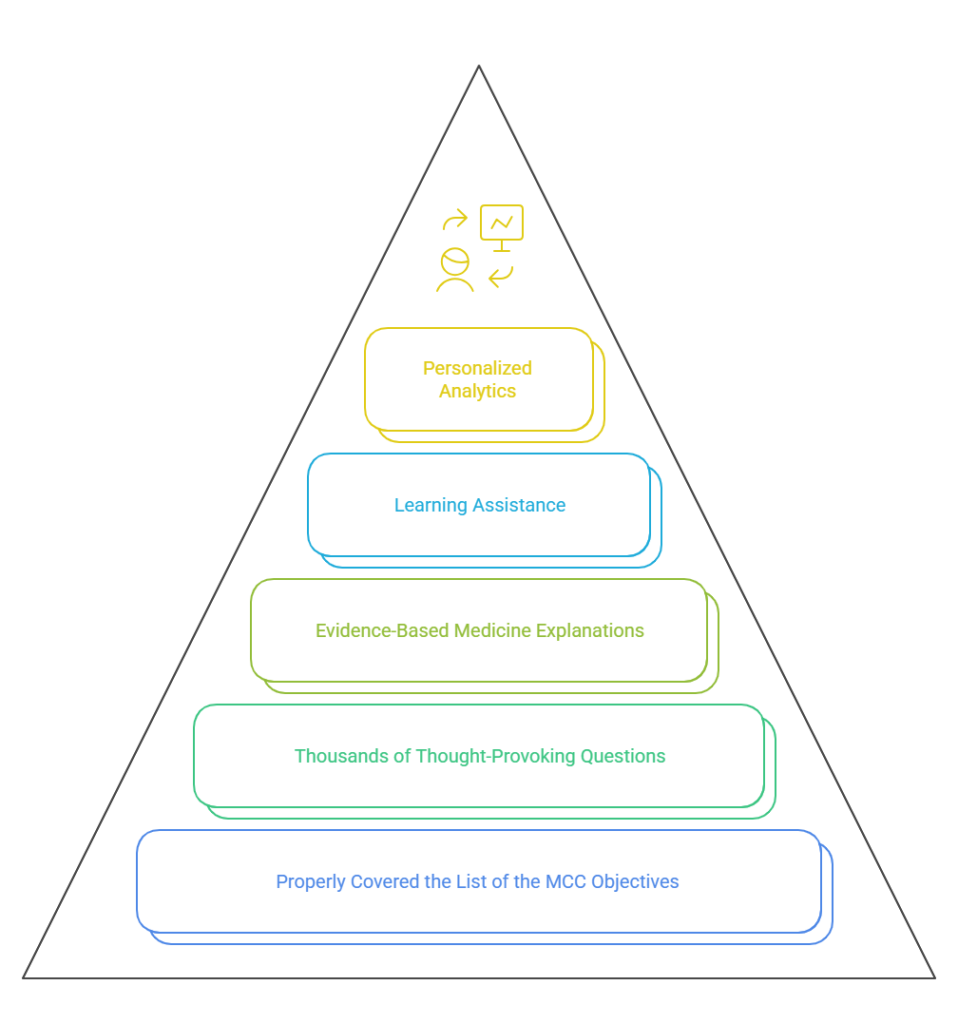
First and foremost, the Qbank offers proper coverage of the MCC objectives. As a result, every hour you spend studying focuses on what actually matters for the exam. And therefore you avoid wasting precious energy on irrelevant details.
Moreover, the questions themselves meet true exam-level difficulty. You will have access to more than 2950 questions. Questions that are deliberately challenging and carefully written to mirror the depth and complexity.
Consequently, each vignette recreates the clinical pressure of the exam. Forcing you to pause, weigh competing variables and commit to a definitive choice.
In other words, the questions make you slow down and process the clinical clues. Then select the most correct answer.
Equally important, the explanations remain firmly evidence-based. And this is where meaningful learning happens. You are not simply told which option is right. Instead, the Qbank walks you through the clinical reasoning behind the correct answer.
At the same time, it methodically breaks down the other plausible choices. Clearly explaining why they fall short according to current Canadian guidelines.
This approach matters on the exam. Where distractors often look convincing. And your score depends on choosing the most correct answer rather than a possible one.
In addition, the question bank provides extensive learning support. Under the fatigue of exam day, you will rely on mental shortcuts. Whether you plan to or not.
For this reason, the explanation sections include visual aids such as summary tables, flowcharts and custom illustrations.
I can tell you from experience that you will not recall every sentence you read. But you will remember the structure and key points. A clean flowchart may flash in your mind and help you decide what comes first. What rules something out or what is the best next step in the management?
The Qbank also delivers personalized analytics based on your performance. Timed practice, after all, is not only about answering quickly.
When you study in timed mode. The platform analyzes your pacing and highlights patterns in your time use.
Time management often becomes the quiet obstacle on exam day. And this feedback acts as an honest mirror. Ultimately, it fine-tunes your speed and sharpens your strategy. So you walk into the exam with far more control.
And the platform’s self-assessments add another layer that many candidates underestimate until they experience it. The value is that these assessments use unique questions. Meaning you are not simply re-answering questions you have practiced with.
That design choice is deliberate. It is meant to simulate the actual exam. Where familiarity disappears and your reasoning is what remains.
In plain terms, those self-assessments function like a reality check. They show you where your thinking is stable and where it still slips. While you still have time to correct it.
How to Get Started with Ace QBank?

The easiest way to get started with the Qbank is to begin where there is no risk at all. A free demo and some simple, hands on exploration.
However, you need to sign up for the free demo. The sign up process is straightforward. You register for a complimentary demo account on the platform.
In return, you gain access to 21 sample questions. Enough to give a useful snapshot of the content without overwhelming you. It also gives you an authentic sense of the interface. The question style and the key features before you make any commitment.
What to test during the demo?
During that trial run, there are a few practical tools worth putting through their paces. You can flag questions for later review. A small but significant function that allows you to track areas of uncertainty or topics you want to revisit.
You can also highlight key information in the question stems and in the explanations. Mimicking the way many candidates already mark up textbooks and notes.
Just as important are the different study modes. You can switch between timed mode, which simulates exam conditions. And tutor mode, which allows you to slow down and focus on learning from each question.
There is also the option to experiment with building personalized question blocks. Tailor shorter or longer sessions to your schedule and concentration.
The objective of this exercise is simple but critical. To determine whether this platform aligns with your study habits and offers the structure you need.
In an exam year already marked by change and pressure. The degree to which you and the Qbank are well-matched can truly make a huge difference.
Key Takeaways
Question volume alone is not enough. Completing many practice questions helps. But only if they are high quality, based on Canadian guidelines and MCC objectives.
Time management comes from understanding. Strong clinical knowledge helps you read faster, avoid panic and make better decisions under pressure. However, good pacing is built through practice and test-taking strategies
The best study plans are focused and Canadian-specific. Plans that emphasize thoughtful clinical reasoning, evidence-based review and realistic exam-style questions are much more likely to lead to MCCQE1 success.
Ace QBank supports smarter MCCQE1 preparation. It offers more than 2950 high-yield questions based on the MCC objective-based questions. Evidence-based medicine explanations and performance analytics.