The Best 3 Tips for the MCCQE1 Exam Preparation

Every medical graduate faces the same challenges when preparing for the MCCQE1 exam. Vast content, time pressure and the need to apply clinical reasoning. Rather than just memorizing facts.
However, the right approach can always make a real difference in high-stakes medical licensing exams. Where knowing what to study and how to study matters most.
In this post, we will start with a clear 2026 MCCQE1 exam overview. Next, I will share the best 3 tips for the MCCQE1 exam preparation. We will then explore how Ace QBank can help you ace your MCCQE1 exam prep. Breaking down why this platform is a game changer for mastering the MCC objectives.
2026 MCCQE1 Exam Overview
Preparing for the MCCQE1 is an important step. For both Canadian and international medical graduates aspiring to practice medicine in Canada.
Therefore, it is essential for candidates to familiarize themselves with the current exam structure. And the core objectives of this vital licensing exam.
As outlined by the Medical Council of Canada. The primary purpose of the MCCQE1 is to assess whether you possess the critical medical knowledge. Along with professional attitudes necessary for medical practice in Canada.
The earlier MCCQE1 format included a clinical decision-making component. The current iteration emphasizes the multiple-choice question (MCQ). The 2026 MCCQE1 continues to focus exclusively on the MCQ format.
Each MCQ is designed to test both your factual medical knowledge. And your ability to apply that knowledge in practical clinical contexts.
That means the best preparation strategies should involve developing efficient test-taking skills. Not only interpreting questions. But also eliminating unlikely options. And choosing the best possible answer within the allotted time.
As you see, success in the current format of the MCCQE1 exam. It is about applying your knowledge efficiently under exam conditions.
Since each question contains multiple layers of information. Such as patient symptoms, medical history and contextual details that guide you toward the correct answer. Thus, developing test-taking skills. Specifically the ability to quickly detect and prioritize clinical clues in a question stem is vital.
Proper time management also plays a major role in overall performance. You need to process all information quickly and logically. Since the exam requires answering a large number of questions within a strict time limit.
Practising under timed conditions. Helps you build pacing strategies and reduces the risk of spending too long. On any single question.

But the problem is that you can’t address knowledge gaps solely by practising under timed conditions. Significant knowledge gaps will still affect your performance in the exam.
That said, regular exposure to practice questions strengthens pattern recognition and clinical decision-making. That is, if the questions are thought provoking and aligned with MCC objectives.
However, there is a downside. If you do not practice questions in the right way. It can lead to memorization rather than true clinical comprehension.
This happens because human cognition naturally seeks the path of least resistance. Resulting in memorizing “buzzwords” or highly specific illness scripts.
Here is what this means for you. When tackling questions during study sessions, slow down. Let the clinical clues sink in, process everything and choose your answer with purpose.
If you skip this step and go straight to the explanation section. You are not truly testing your knowledge. You are just burning through questions without identifying gaps in your understanding.
This approach can lead to overconfidence. Often explained by cognitive psychology concepts like the Dunning-Kruger effect or availability bias.
According to the Dual Process Theory in clinical reasoning. Physicians use two thinking systems:
- System 1: rapid, heuristic-based pattern recognition
- System 2: slow, analytical, and critical thinking
Standardized question banks train quick thinking (System 1). While efficient, overreliance on System 1 is a leading cause of premature closure. In other words, jumping to conclusions too soon. Simply because you stop considering alternatives once an initial pattern is recognized.
This results from conditioning your brain to quickly select an answer without proper processing. Therefore, you must go beyond simple pattern recognition and engage deeply with each question.
Ensure that your diagnostic confidence is rooted in adaptive reasoning. Rather than the artificial predictability of multiple-choice questions.
The Best 3 Tips for the MCCQE1 Exam Preparation

Every medical graduate faces the MCCQE1 exam like a climber staring up at a sheer cliff. It is not just a test of knowledge. It is a test of endurance, focus and the ability to think like a doctor.
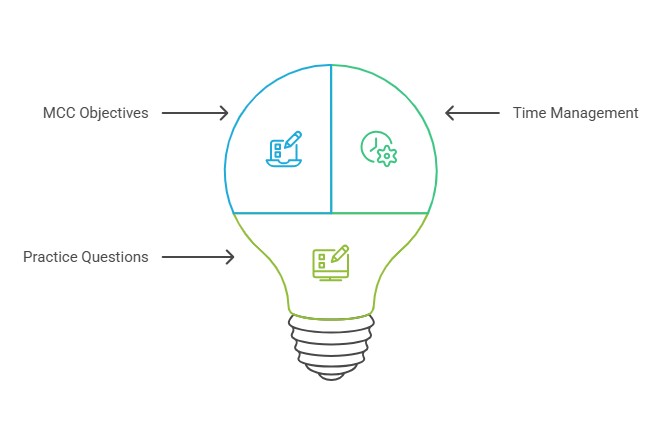
The stakes are high and the material is vast. Yet, amidst this challenge. There is a path forward. A smart and strategic approach. Can transform this daunting task into an achievable goal. Here are three indispensable tips. To guide you through your MCCQE1 preparation.
- Study with the MCC objectives in mind
- Proper Time Management
- Practice with exam style questions regularly
1. Study with the MCC Objectives in Mind
The MCCQE1 isn’t designed to trip you up with obscure details. It is about assessing your ability. Ability to apply medical knowledge in the exam.
You need to make sure. Your study plan matches what the exam is looking for. The things you should really focus on are presentations, ethics and population health.
For example, rather than memorizing every possible diagnosis for chest pain. Focus on understanding the most likely causes. And the appropriate next steps in each case.
This approach not only prepares you for the exam. But also builds the clinical reasoning skills you will need in practice.
In short, when your preparation is guided by the MCC Objectives. Your studying becomes more focused, efficient and clinically relevant. You spend less time guessing what matters and more time mastering the competencies the MCCQE1 is designed to measure.
Here, I have written about the vital role of the MCC objectives in MCCQE1 exam preparation.
2. Master Time Management Through Core Knowledge
Time management is often cited as a major hurdle during the exam. But it is not merely about pacing yourself. It is about confidence in your knowledge. Poor time management often stems from gaps in understanding core medical concepts.
For instance, knowing a lab value isn’t enough. You must understand how to act on it. What does an abnormal result signify? What steps should you take next?
There are certain threshold values that stand as sentinels. Bold, unyielding and universally recognized.
Let’s not mince words. Missing these numbers is more than a simple mistake. It is a glaring error. One that can define your reputation in the worst possible way.
Consider for a moment. The gravity of this responsibility in the chaos of a busy emergency room. or the silent tension of an intensive care unit. These numbers demand respect.
The consequences of missing them are not abstract. They are heartbreakingly real. One oversight. One lapse in vigilance. And a patient’s future hangs in the balance. Your own career can be shattered in the aftermath.
These critical values have earned their notoriety for a reason. Every physician knows their names whispered in the halls. Potassium levels that signal cardiac arrest. Glucose readings that forewarn a coma. Blood pressure numbers that precede a stroke.
They are etched into memory. Because they mark the difference between hope and tragedy.
Therefore, by focusing on these critical connections. You will streamline your thought process. Making it quicker and more efficient. This clarity will help you scan for key clinical clues and manage your time effectively. Even under pressure.
3. Practice with High Quality Questions Regularly
There is a saying that has always stayed with me all these years. The saying is as follow EXCELLENCE IS NOT AN ACT BUT A HABIT. These words ring especially true. When preparing for the MCCQE1 exam.
Success on this challenging medical licensing exam. Does not come from last-minute cramming or sporadic study sessions. It comes from building consistent daily practice with questions. Practices that become second nature over time.
Practice isn’t just important. It is absolutely essential. If there is one piece of advice I would give to every aspiring physician in Canada.
It is this. You need to set aside dedicated time. And make it important in your schedule. Practice with questions regularly and stick to your commitment. Nothing else will work as well. There is no faster way to achieve results.
I encourage you to find resources that actually help you succeed. Ace QBank has proven itself as a reliable option for candidates throughout Canada. More than 2900 high-yield questions await you. Each one carefully constructed and precisely matched to the MCC objectives.
This isn’t just a random collection of questions. It is a thoughtfully curated platform. Designed so that every moment you invest brings you closer to your goal.

What makes Ace QBank so effective isn’t just the sheer volume of questions. But the quality of learning that follows. Each question is accompanied by evidence-based explanations that don’t simply reveal the correct answer.
They walk you through the reasoning, step by step. After every session, take time to review these explanations. Understand why one answer stands above the rest. This is where knowledge transforms into understanding. And understanding becomes clinical intuition.
Reflection is key. By revisiting both correct and incorrect answers. You identify gaps in your knowledge.
Visual learners will find the Qbank especially valuable. The explanation section bursts with hundreds of visual aids.
Summary tables that condense dense information into digestible snapshots. Flow charts that untangle tricky decision pathways. And custom illustrations that bring clarity to complex scenarios. It is a resource that respects all learning styles.
Another crucial skill for exam day is time management. No matter how much knowledge you possess. The pressure of the clock can rattle anyone.
Timed study mode in the Qbank does more than test what you remember. It helps you get used to how fast. You need to work during the actual exam.
You learn to think faster and decide what matters most. When you feel the pressure of test day. We will talk about this more in the next section.
How Ace QBank can Help you with Your MCCQE1 Exam Prep

When you are preparing for the exam. The single most consequential decision you will make. It is not which textbook to open first. It is, which question bank to trust? And on that front, the answer is not a close race.
Ace QBank stands in a category of its own. The reasons for that are concrete, specific, and deeply relevant to the 2025 exam format. Let me walk you through exactly why.
The most fundamental reason Ace QBank leads the field is its uncompromising alignment with the MCC Objectives and the MCCQE1 Blueprint.
This is not a cosmetic claim. The platform’s entire architecture. It’s question design, its content categories and its clinical reasoning framework.
They are structurally engineered around the same two dimensional Blueprint the Medical Council of Canada uses to build the actual exam. Every question exists at the intersection of a Dimension of Care and a Physician Activity.
Precisely mirroring the way, the actual exam constructs its clinical vignettes. With over 2950 high-yield questions organized across 21 distinct clinical categories.
You are not wandering through a random collection of medical trivia. You are working through a purposefully sequenced system that maps your preparation directly onto the exam’s own architecture.
That structural fidelity is something no American-centric question bank. Regardless of its reputation it can offer you for this exam.
The second defining advantage is what I consider the most underrated feature of the entire platform. It is evidence-based medicine explanations.
Here is the critical distinction. When you get a question wrong in the Qbank. The explanation does not simply tell you what the right answer was. It walks you through why your clinical reasoning deviated from Canadian medical standards.
Anchoring every correction in the evidence, the guideline and the logical chain of thought that leads a Canadian physician to that specific decision.
When you get a question right. The explanation reinforces the soundness of your reasoning. And deepens your understanding of the underlying framework. And crucially, these explanations are supported by visual aids.
visual aids such as summary tables, flowcharts and custom illustrations. That simplifies complex clinical pathways into something your brain can retain. Even during the most exhausted study sessions. This is learning architecture, not just answer checking.
Third, and this point matters enormously for the new exam format. The Qbank is the only question bank that trains you to think with Canadian clinical instincts as the default. The guidelines embedded in every question.
Hypertension management per CHEP, diabetes thresholds and colorectal cancer screening intervals. Along with medico-legal standards. Reflect the realities of practising inside Canada’s healthcare system, not somewhere else’s version of medicine.
Candidates who have relied heavily on American platforms. Consistently report being blindsided by the divergence between U.S. and Canadian first-line management steps. Often with full confidence in the wrong answer.
The Qbank eliminates that risk entirely by training your instincts in the right direction from day one. Beyond that the platform is in a constant state of renewal.
New questions are being added multiple times throughout the year to reflect the latest MCC objective updates. And evolving Canadian clinical guidelines. A living resource that refuses to go stale, I should say.
Fourth, the platform’s dual study mode design, Timed Mode and Tutor Mode. This is a genuinely thoughtful response to the two distinct phases every serious candidate moves through during preparation.
Early in your prep, Tutor Mode allows you to slow down. Read every explanation in depth. And build the foundational clinical reasoning frameworks that will carry you through exam day.
As your exam date approaches. Timed Mode simulates the real pressure of 83 seconds per question across 230 MCQs. Training your nervous system to make quick, disciplined and guideline driven decisions without second-guessing.
That progression, from deep understanding to confident performance. It is not accidental. It reflects a preparation philosophy that respects both the what and the how of exam readiness.
Last but not least, what truly elevates Ace QBank above every alternative. It is its performance analytics and built-in self-assessment system.
The analytics component identifies your weak areas with precision. Redirecting your study energy away from comfortable topics. And toward the gaps that will actually cost you marks.
The self-assessment feature. Which uses a distinct, non-overlapping question set specifically to avoid inflating your readiness score. Gives you an honest and data-driven answer to the question every candidate eventually asks. Am I actually ready?
That kind of honest feedback is the difference between feeling prepared and being prepared. And for an exam that stands between you and the practice of medicine in Canada, that distinction is everything.
In my firm opinion, Ace QBank stands entirely in a league of its own because it is uncompromisingly engineered to cover the exact MCC Objectives. And the two-dimensional blueprint you will face on exam day.
With over 2950 high-yield questions organized across 21 clinical categories. You are actively training your clinical reasoning at the precise intersection of a Dimension of Care and a Physician Activity.
What I absolutely love is how it anchors your instincts strictly in Canadian medical standards. From CHEP guidelines for hypertension to our specific medico-legal realities. Ensuring you won’t get blindsided by the American-centric management steps. That, unfortunately, trips up so many brilliant candidates.
Beyond that, this platform acts as an incredible mentor by correcting your clinical reasoning through evidence-based explanations. And the best part is that the explanation section includes visual aids. These brilliant visual aids will actually stick in your brain during those long, exhausting study sessions.
You have the freedom to build a rock-solid foundation early on using Tutor Mode. And as exam day approaches. You can switch seamlessly into Timed Mode to train your nervous system for that intense 83-seconds-per-question reality.
Best of all, its unique self-assessments will zero in on your weak spots. Rather than your comfortable topics. Giving you the honest and data-driven confidence you need to know you are truly ready.
This is how Ace QBank is going to help you absolutely crush this exam. And step confidently into your Canadian medical practice.
How can I Quickly Access Ace QBank Demo Questions?

The clearest way to get started with the Qbank is to begin where there is no risk at all. A free demo and some simple, hands on exploration.
However, you need to sign up for the free demo. The sign up process is straightforward. You register for a complimentary demo account on the platform.
In return, you gain access to 21 sample questions. Enough to give a useful snapshot of the content without overwhelming you. It also gives you an authentic sense of the interface. The question style and the key features before you make any commitment.
What to test during the demo?
During that trial run, there are a few practical tools worth putting through their paces. You can flag questions for later review. A small but significant function that allows you to track areas of uncertainty or topics you want to revisit.
You can also highlight key information in the question stems and in the explanations. Mimicking the way many candidates already mark up textbooks and notes.
Just as important are the different study modes. You can switch between timed mode, which simulates exam conditions. And tutor mode, which allows you to slow down and focus on learning from each question.
There is also the option to experiment with building personalized question blocks. Tailor shorter or longer sessions to your schedule and concentration.
The objective of this exercise is simple but critical. To determine whether this platform aligns with your study habits and offers the structure you need.
In an exam year already marked by change and pressure. The degree to which you and the Qbank are well-matched can truly make a huge difference.
Key Takeaways
Best Question Bank choice for the 2026 MCCQE1. Ace QBank aligns with MCC objectives. >2950 high-yield questions. Evidence-based medicine explanations with visuals. Tutor and Timed modes. performance analytics and two self-assessments.
Master Clinical Reasoning with Evidence-Based Explanations. Every question at Ace QBank includes evidence-based explanations and visual aids. These reinforce your understanding of medical concepts. And help you build the clinical reasoning skills essential for the exam.