The Most Effective Qbank for MCCQE1 Exam

A question bank is an important piece of the puzzle. When it comes to effectively preparing for the Canadian Medical licensing exam.
But how would you define the most effective Qbank for the MCCQE1 exam? What features should a question bank include? And why should you use the Canadian question bank?
In this post, I will start with the essentials for MCCQE1 preparation. Define the core features every high-quality Qbank must include. Then, I will review Ace QBank and highlight the unique features it offers for MCCQE1 exam success.
MCCQE1 Exam Preparation Essentials
You do not simply cram your way into a Canadian medical career. You build it, deliberately and steadily, one brick at a time.
For those of you dedicating your lives to medicine. Preparing for the MCCQE Part 1 is not just another academic challenge. It is the very foundation of your future practice.
To truly succeed, you must start with a perfect strategy that aligns with your mindset. Your daily study plan and your chosen resources are in complete alignment.
It requires a profound understanding of what is truly at stake when you practice medicine in this country.
The ultimate purpose of this exam is to ensure your ability to provide safe, effective and deeply empathetic care within our uniquely Canadian healthcare context. This is about real people and real lives depending on your expertise.
The second non-negotiable pillar of your preparation is your question bank. You need a resource that genuinely matches the rigorous standard of what the exam actually tests on exam day.
This means seeking out materials that are deeply thought-provoking. Challenging you to think like an independent physician rather than a medical student.
Specifically, you must focus your energy on questions firmly rooted in the exact objectives outlined by the Medical Council of Canada (MCC). High-yield questions must accomplish two vital things for your preparation:
- Properly and exhaustively cover every single essential MCC objective.
- Demonstrate precisely how Canadian clinical guidelines are applied in clinical scenarios.
When you align your unwavering dedication with the right strategy and the right Qbank. Success becomes absolutely achievable.
Why MCCQE1 Practice Questions Work?
Let me be direct with you. Because this is too important to dance around. When it comes to preparing for the MCCQE1 exam prep.
There is one tool that consistently separates candidates who merely pass from those who genuinely excel. And that tool is a high-quality, purposefully designed practice question bank.
Not because it is a shortcut. But it is arguably the most honest mirror of your true readiness that exists.
Here is a thorough breakdown of exactly why MCCQE1 practice questions work. And why you need to make them the cornerstone of your preparation strategy.
- Perfect Alignment with Exam Content
- Canada First Clinical Thinking
- Eliminating the Element of Surprise
- Forced Application of Knowledge
- Identifying Knowledge Gaps with Surgical Precision
- Learning the Why and Not Just the What
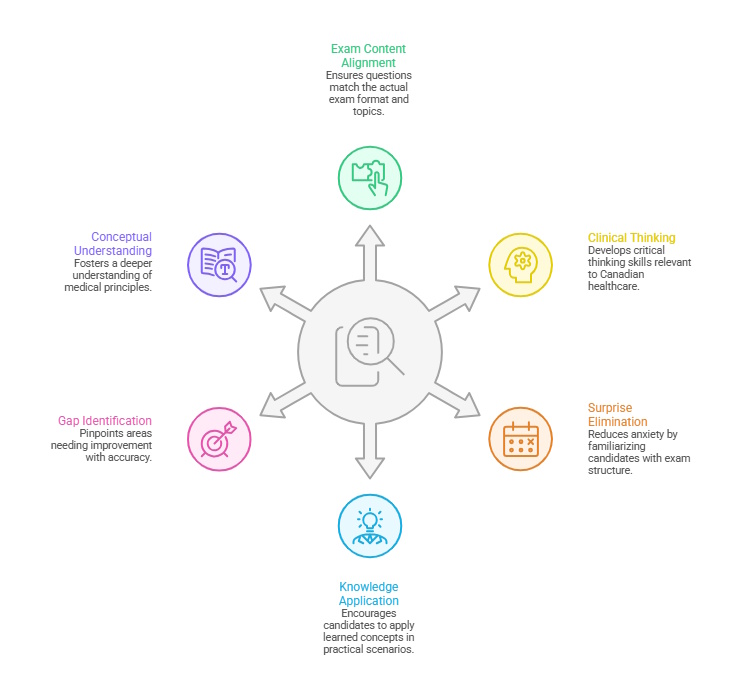
Perfect Alignment with Exam Content
This point is one I feel strongly about. The reason is that the new format of the exam has strongly emphasized this perspective. And unfortunately, it is one of the most commonly overlooked distinctions among international candidates.
The exam does not simply test general medical knowledge. It tests your ability to apply that knowledge specifically within the Canadian clinical context. That means Canadian guidelines, screening programs and Canadian first-line treatment protocols. Along with Canadian public health priorities.
A practice question that asks you to manage a patient with hypertension. According to Hypertension Canada guidelines. It is infinitely more valuable to you than a question referencing generic international protocols.
High-quality practice questions embed this Canada specific clinical reasoning into every scenario. Training your instincts to default to Canadian guidelines first. Which is exactly what the exam demands of you.
This is the kind of relevance that cannot be improvised. It must be deliberately built into the questions you practice with and when it is. The payoff on exam day is enormous.
Canada First Clinical Thinking
This point is one I feel strongly about. The reason is that the new format of the exam has strongly emphasized this perspective. And unfortunately, it is one of the most commonly overlooked distinctions among international candidates.
The exam does not simply test general medical knowledge. It tests your ability to apply that knowledge specifically within the Canadian clinical context. That means Canadian guidelines, screening programs and Canadian first-line treatment protocols. Along with Canadian public health priorities.
A practice question that asks you to manage a patient with hypertension. According to Hypertension Canada guidelines. It is infinitely more valuable to you than a question referencing generic international protocols.
High-quality practice questions embed this Canada specific clinical reasoning into every scenario. Training your instincts to default to Canadian guidelines first. Which is exactly what the exam demands of you.
This is the kind of relevance that cannot be improvised. It must be deliberately built into the questions you practice with and when it is. The payoff on exam day is enormous.
Eliminating the Element of Surprise
Here is something every clinician. I mean, a clinician who has sat the MCCQE Part 1 will tell you candidly. The format of the exam is a skill in itself.
The exam presents clinical vignettes. Often layered and deliberately loaded with both relevant and irrelevant clinical detail. Your job is not just to know the medicine.
Your job is to efficiently parse a complex scenario under time pressure. And arrive at the most appropriate clinical decision.
Consistent exposure to well-constructed practice questions trains your brain to do exactly that. Over hundreds of repetitions, you develop a highly efficient clinical reading pattern.
You begin to instinctively identify the key presenting features. The subtle red flags are embedded in the history. And the decisive laboratory or imaging findings that unlock the correct answer.
By the time you walk into that Prometric centre. The format should feel like an old friend. Not an intimidating stranger. That cognitive comfort is not a minor advantage. It is a genuine performance multiplier.
Forced Application of Knowledge
This is the heart of it all. Because it is the engine that drives everything else.
I have been saying that reading a textbook is passive learning. Your brain receives information. Files it away and largely moves on. Practice questions, on the other hand, are active learning at its most demanding.
When you encounter a clinical vignette and commit to an answer. Your brain is forced to do something remarkable. It must retrieve, organize, connect and apply everything it knows about a medical concept simultaneously. All in the context of a real patient scenario.
This is the process of active retrieval and application of knowledge. It is what cognitive science consistently identifies as the most powerful mechanism for deep, durable memory consolidation.
You are not simply recalling a fact. You are reconstructing a clinical argument. This process and mental effort. It is precisely what burns the knowledge into long-term memory. In a way that passive review simply cannot replicate.
Identifying Knowledge Gaps with Surgical Precision
Here is where practice questions become your most honest advisor. Every question you get wrong is not a failure. It is a gift, because it reveals exactly where your preparation is needed. Reinforcement before exam day, not after.
Without practice questions. Knowledge gaps are invisible. You can review an entire chapter on nephrology. Feel confident and still have a critical blind spot in your understanding of acute kidney injury management that will cost you scores.
Do you see the power of the active retrieval? I meant it when I said “This is the heart of it all”. Practice questions expose those blind spots with ruthless efficiency.
That’s because when you encounter a question and commit to an answer. Your brain is forced to do something remarkable. It must retrieve, organize, connect and apply everything it knows about a medical concept simultaneously.
However, the most effective strategy is to treat every incorrect answer. As a diagnostic finding in its own right, ask yourself:
- Was this a knowledge gap? Meaning you genuinely did not know the concept?
- Was this a reasoning error? Meaning you knew the facts but misapplied them in the clinical scenario?
- Was this a reading error? Meaning you misinterpreted the question stem under time pressure?
Each type of error demands a different corrective response. And recognizing the pattern across your practice sessions. Allows you to personalize your study plan with a level of precision that no generic schedule can offer you. That is a competitive advantage that compounds over time.
Learning the Why and Not Just the What
This is the element of a great question bank that I genuinely believe is undervalued by many candidates. And it may be the single most transformative feature of all.
The answer explanation section of a high-quality MCCQE1 practice question. It is not simply telling you whether you were right or wrong. It is doing something far more powerful. It is teaching you clinical reasoning anchored in evidence.
A well-crafted explanation walks you through the logical chain of thought. One that leads to the correct answer.
It tells you why a particular investigation is ordered first. Why a specific medication is the first-line choice according to Canadian guidelines. And why the distractors are plausible but ultimately incorrect.
It cites the evidence. The guidelines that support the decision-making process. This has two profound effects on your preparation:
First, it replaces rote memorization with genuine understanding. When you understand the why behind a clinical decision. You can apply that reasoning to novel scenarios you have never encountered before. Which is exactly what the exam will demand of you.
Second, it directly improves your exam performance. Because candidates who understand the underlying logic of clinical medicine consistently outperform those who have simply memorized facts.
The exam is designed to reward reasoning. And evidence based medicine explanations train you to reason exactly the way the examiners intend.
The bottom line is this. Practice questions do not just prepare you for the MCCQE Part 1 exam. They transform you into the kind of clinician the exam is designed to identify.
Someone who can reason from evidence and make sound decisions for Canadian patients.
Thus, embrace them not as a chore. But as the most honest and effective teacher in your entire preparation journey.
Core Features Every Effective MCCQE1 Question Bank Must Have

Let’s set the record straight right from the start. Because this matters enormously for how you approach your preparation. The MCCQE Part I exam has changed. As of 2025 the exam is now entirely multiple-choice.
You have 230 MCQ questions in a single format, with a unified standard for clinical reasoning. This shift changes everything about how you should be evaluating the quality of your question bank.
There are several features that distinguish a truly great question bank from a merely adequate one. But I want to focus on the three essential features. Features that I believe define the effectiveness of the question bank in this current format.
These are the pillars I keep coming back to, because they reflect exactly what the exam is now demanding of you.
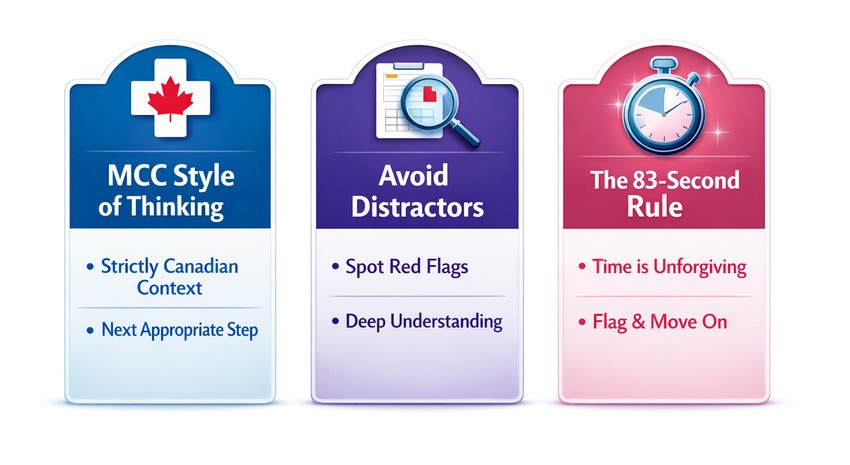
1. The MCC Style of Thinking
This is the feature that separates candidates who genuinely understand Canadian medicine. From those who are simply importing knowledge from other licensing frameworks. The exam is clinically oriented. That means critical thinking and problem-solving will always be in the spotlight.
The MCCQE Part I is not interested in whether you can recite a pathophysiology from memory. The exam is interested in whether you can use that knowledge. When a patient is sitting in front of you.
Every effective practice question should place you inside a clinical scenario. And force you to apply your knowledge of guidelines to a specific patient presentation. That cognitive demand is the act of applying rather than simply recalling.
This is what builds the kind of durable, exam ready understanding that holds up under pressure.
The Canadian Context Is Non-Negotiable. I want to be especially clear on this point. That’s because it is one of the most consequential distinctions you will encounter in your preparation.
You are preparing for the Canadian qualification exam. Meaning, when you obtain your medical licensing exam. You will start practicing in Canada.
Thus, the correct answer should align with Canadian clinical guidelines, full stop. A question about hypertension management, for example. Demands that you think through the lens of the CHEP guidelines. Not American or international equivalents.
These are not interchangeable frameworks. And if your question bank is not consistently grounding you in Canadian-specific evidence. It is quietly working against you.
The other thing worth mentioning here is that two question types make the current format unique. And you need to become deeply comfortable with both of them.
- What is the next most appropriate step in this patient’s diagnosis or management?
- What is the most accurate treatment for this clinical presentation?
Here is what I find genuinely fascinating about these question types. In numerous clinical scenarios, the initial diagnostic or management step is on the MCCQE Part I exam. It is completely different from what you would do following the USMLE steps.
This is not a subtle distinction. It is a fundamental divergence rooted in how the Canadian healthcare system prioritizes investigations, resources and first-line interventions.
Suppose you have prepared using USMLE-style questions with American question banks. This gap will surprise you on exam day in the worst possible way. Your question bank must reflect this Canadian clinical logic without exception.
2. The Art of Not Being Fooled
Here is something that you should know. And the sooner you internalize it, the better your performance will be. Understand the distractors in the question stem.
On a well-constructed MCQ. The wrong answers are not random. They are deliberately engineered to look correct to a candidate who has almost. Almost but not quite mastered the concept.
These carefully crafted wrong answers are called distractors. And their entire purpose is to exploit the predictable gaps in your clinical reasoning. A distractor works by offering you something that feels right at a surface level.
A treatment that is commonly used or an investigation that seems logical. But that falls apart the moment you apply a deeper understanding of Canadian guidelines or a more precise reading of the clinical scenario.
At the outset, learn to spot the distractors in the question stem. Those key details, subtle red flags or clinical clues carry real weight. They will let you discard several answer choices almost immediately.
But that advantage depends on two things. First, you must understand the underlying medical concepts. Second, you must know which clues matter. Without that foundation. Those same details will simply wash over you. You won’t see them as signposts. They will look like noise.
Train yourself to read deliberately. Pause at every symptom, lab value and timeline. Ask, does this fit a pattern I recognize? If it does, use the clue to narrow your focus. If it doesn’t, treat it as a likely distractor.
This is a skill, and like all clinical skills, it is developed through deliberate practice. An effective question bank trains you to scan the clinical vignette for red flags. Those specific details embedded in the stem that, once identified. It allows you to eliminate multiple distractors simultaneously and with confidence.
The critical point I would like to reiterate here is this. You can only see a red flag if you already understand the underlying concept.
A candidate who does not know the clinical significance of a particular finding will read right past it. They will then find themselves in a frustrating situation. Often end up with several apparently correct options.
Unable to confidently select among them. That is not an exam strategy problem. That is a knowledge gap presenting itself in real time. Effective practice questions, prevent exactly that scenario from happening to you on exam day.
3. 83 Seconds Is Both Enough and Unforgiving
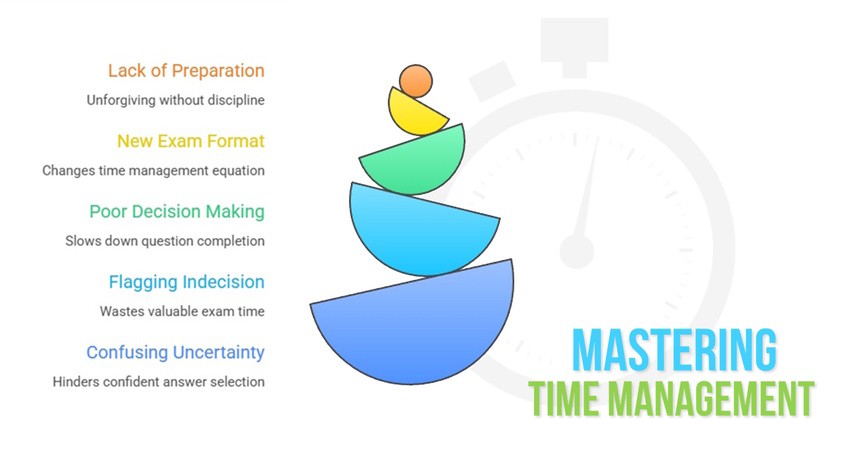
Let me give you the number. A number that should be living rent-free in your mind throughout your entire preparation. 83 seconds.
That is the average time you have per question across 230 MCQs. It is enough time if you are prepared and disciplined. It is absolutely unforgiving if you are not.
We addressed this very challenge in a blog post four years ago. When we discussed time management strategies specifically for the MCQ and CDM case format. And more recently, we returned to this topic to address the unique time pressures of the new 2025 exam format.
Because of the shift to the new format. Changes the time management equation in meaningful ways.
Please think about time management not as an administrative chore. But as a genuine test-taking competency. One that can be practiced and refined just like your clinical reasoning.
The candidates who manage time most effectively are not the ones who read faster. They are the ones who have practiced making decisions. A quick, disciplined and confident decision from a position of genuine understanding.
That confidence comes from one place. Repeated exposure to high quality practice questions under realistic time conditions.
On the other hand, I want to be direct with you about the flagging feature. When a question is genuinely difficult. When you have read it carefully, identified the key clinical details and still cannot confidently commit to an answer.
Do not re-read it several times at the moment. Do not negotiate with yourself. Flag a question and move forward immediately.
This single discipline of the willingness to move on. It will protect dozens of seconds across your exam that compound into minutes. And those minutes translate directly into additional questions answered.
Re-reading a question you are uncertain about rarely produces a different result. Returning to it later, with fresh eyes and the cognitive relief of having completed the remaining questions, very often does.
However, the uncertainty you feel comes in different shades. Sometimes you don’t have a clue. A blank, white-knuckled moment when facts are missing. Other times, you are confused. The pieces are there but they don’t yet fit.
Learning to tell those two feelings apart matters. It is a skill honed in hours and days of practice. If you don’t have a clue, admit it quickly and flag. If you are confused, test the pieces, ask sharper questions before you flag.
But please do not re-read a question several times.
The Best Question Bank for MCCQE1 Exam in Canada?

When you are preparing for the exam. The single most consequential decision you will make. It is not which textbook to open first. It is, which question bank to trust? And on that front, the answer is not a close race.
Ace QBank stands in a category of its own. The reasons for that are concrete, specific, and deeply relevant to the 2025 exam format. Let me walk you through exactly why.
The most fundamental reason Ace QBank leads the field is its uncompromising alignment with the MCC Objectives and the MCCQE1 Blueprint.
This is not a cosmetic claim. The platform’s entire architecture. It’s question design, its content categories and its clinical reasoning framework.
They are structurally engineered around the same two dimensional Blueprint the Medical Council of Canada uses to build the actual exam. Every question exists at the intersection of a Dimension of Care and a Physician Activity.
Precisely mirroring the way, the actual exam constructs its clinical vignettes. With over 2900 high-yield questions organized across 21 distinct clinical categories.

You are not wandering through a random collection of medical trivia. You are working through a purposefully sequenced system that maps your preparation directly onto the exam’s own architecture.
That structural fidelity is something no American-centric question bank. Regardless of its reputation it can offer you for this exam.
The second defining advantage is what I consider the most underrated feature of the entire platform. It is evidence-based medicine explanations.
Here is the critical distinction. When you get a question wrong in Ace QBank. The explanation does not simply tell you what the right answer was. It walks you through why your clinical reasoning deviated from Canadian medical standards.
Anchoring every correction in the evidence, the guideline and the logical chain of thought that leads a Canadian physician to that specific decision.
When you get a question right. The explanation reinforces the soundness of your reasoning. And deepens your understanding of the underlying framework. And crucially, these explanations are supported by visual aids.

visual aids such as summary tables, flowcharts and custom illustrations. That simplifies complex clinical pathways into something your brain can retain. Even during the most exhausted study sessions. This is learning architecture, not just answer checking.
Third, and this point matters enormously for the new exam format. Ace QBank is the only question bank that trains you to think with Canadian clinical instincts as the default. The guidelines embedded in every question.
Hypertension management per CHEP, diabetes thresholds and colorectal cancer screening intervals. Along with medico-legal standards. Reflect the realities of practising inside Canada’s healthcare system, not somewhere else’s version of medicine.
Candidates who have relied heavily on American platforms. Consistently report being blindsided by the divergence between U.S. and Canadian first-line management steps. Often with full confidence in the wrong answer.
The Qbank eliminates that risk entirely by training your instincts in the right direction from day one. Beyond that the platform is in a constant state of renewal.
New questions are being added multiple times throughout the year to reflect the latest MCC objective updates. And evolving Canadian clinical guidelines. A living resource that refuses to go stale, I should say.
Fourth, the platform’s dual study mode design, Timed Mode and Tutor Mode. This is a genuinely thoughtful response to the two distinct phases every serious candidate moves through during preparation.
Early in your prep, Tutor Mode allows you to slow down. Read every explanation in depth. And build the foundational clinical reasoning frameworks that will carry you through exam day.
As your exam date approaches. Timed Mode simulates the real pressure of 83 seconds per question across 230 MCQs. Training your nervous system to make quick, disciplined and guideline driven decisions without second-guessing.
That progression, from deep understanding to confident performance. It is not accidental. It reflects a preparation philosophy that respects both the what and the how of exam readiness.
Last but not least, what truly elevates Ace QBank above every alternative. It is its performance analytics and built-in self-assessment system.
The analytics component identifies your weak areas with precision. Redirecting your study energy away from comfortable topics. And toward the gaps that will actually cost you marks.
The self-assessment feature. Which uses a distinct, non-overlapping question set specifically to avoid inflating your readiness score. Gives you an honest and data-driven answer to the question every candidate eventually asks. Am I actually ready?
That kind of honest feedback is the difference between feeling prepared and being prepared. And for an exam that stands between you and the practice of medicine in Canada, that distinction is everything.
How to Get Started with Ace QBank?

The clearest way to get started with the Qbank is to begin where there is no risk at all. A free demo and some simple, hands on exploration.
However, you need to sign up for the free demo. The sign up process is straightforward. You register for a complimentary demo account on the platform.
In return, you gain access to 21 sample questions. Enough to give a useful snapshot of the content without overwhelming you. It also gives you an authentic sense of the interface. The question style and the key features before you make any commitment.
What to test during the demo?
During that trial run, there are a few practical tools worth putting through their paces. You can flag questions for later review. A small but significant function that allows you to track areas of uncertainty or topics you want to revisit.
You can also highlight key information in the question stems and in the explanations. Mimicking the way many candidates already mark up textbooks and notes.
Just as important are the different study modes. You can switch between timed mode, which simulates exam conditions. And tutor mode, which allows you to slow down and focus on learning from each question.
There is also the option to experiment with building personalized question blocks. Tailor shorter or longer sessions to your schedule and concentration.
The objective of this exercise is simple but critical. To determine whether this platform aligns with your study habits and offers the structure you need.
In an exam year already marked by change and pressure. The degree to which you and the Qbank are well-matched can truly make a huge difference.
When should I start using Ace QBank in my MCCQE 1 study timeline to see the greatest benefit?
You should start earlier than you think you need to. The One Mistake You Must Avoid is waiting until the final few weeks to open your question bank. And using it exclusively as a last-minute cramming tool.
This is because candidates who start late. Get the performance data too late to act on it meaningfully. They encounter distractors they have not been trained to recognize.
And they walk into the exam without the deep, instinct-level familiarity with Canadian clinical guidelines. One that only comes from months of consistent practice.
Key Takeaways
What Makes an Effective Question Bank? Three pillars define quality. Questions aligned with MCC Objectives and the exam Blueprint, evidence-based explanations that teach why an answer is correct. And consistent training in Canadian-first clinical reasoning. Your Qbank should mirror the exact structure the MCC uses to build the real exam.
Canada-First Clinical Thinking is Non-Negotiable. The MCCQE Part 1 does not just test general medical trivia. It tests your ability to practice specifically within the Canadian healthcare framework. You must train your instincts to default strictly to Canadian clinical guidelines, screening programs and first-line treatments.
Ace QBank is Your Ultimate Preparation Engine. When choosing your primary resource. I strongly believe the Qbank stands entirely in a category of its own for your prep. It offers an uncompromising alignment with the MCC Objectives. Featuring over 2900 high-yield questions mapped directly to the exam’s exact blueprint across 21 clinical categories.