2025 MCCQE Part 1 Exam Dates & Scheduling Gone

The close of the 2025 MCCQE Part 1 session. Marked more than just another milestone in Canadian medical licensing. It delivered a clear message about what truly matters for candidates preparing for the exam.
For those who sat the exam, reactions are mixed but thoughtful. Some candidates appreciated the updated format. Saying it better reflected the realities of modern clinical practice by emphasizing clinical reasoning, applied knowledge and patient-centred decision making.
Others found the change challenging. They noted that time management and adapting to new item types were the biggest hurdles. In this blog, we will explore the best strategies that worked this time. Also, we will discuss the role of Ace Qbank and how it has helped candidates.
Why the 2025 MCCQE1 Format Shift Was a Game Changer?
When I first heard about the 2025 format shift for the exam. I felt a mix of relief and curiosity. Relief, because aligning the exam with core medical concepts, Canadian guidelines and MCC objectives just makes sense.
Curiosity, because a change in medical education always carries a ripple effect. Especially for international medical graduates who’ve already navigated more hurdles than most Canadians realize.
For years, many IMGs have felt stuck in a limbo that had less to do with their clinical skills and more to do with decoding the exam’s style.
They knew medicine. They knew how to manage chest pain at 3 a.m. How to hold a family’s fear in the ICU and how to triage complex cases under pressure. But translating all that into an exam that sometimes rewarded test-taking acumen over clinical judgment felt unfair.
The new format changes that. It pulls the focus back to what actually matters:
- Can you apply sound medical reasoning?
- Do you practise safely?
- Do you understand Canadian guidelines and context?
The exam now mirrors the reality of frontline care in Canada, and that is a breath of fresh air.
The emphasis on Canadian guidelines is also a quiet revolution. It reduces ambiguity and raises the standard at the same time. When a question on hypertension pulls directly from Hypertension Canada or a case on depression reflects the Canadian Task Force on Preventive Health Care.
Candidates know where to study. And examiners know what competence looks like. Since these guidelines tie closely to real-world outcomes. Think standardized cancer screening. Evidence-based opioid prescribing and culturally informed mental health care.
Now we are looking at the exam that becomes a bridge from theory to practice, not a barrier.
The other reason this shift matters is that it respects diverse training backgrounds while unifying standards. The earlier approach sometimes felt like a final test of assimilation.
The new approach feels like an integration of global skills with Canadian policy. That balance helps IMGs demonstrate who they already are. Capable physicians ready to meet Canada’s health needs.
In a year when ERs in Nova Scotia and rural communities in Saskatchewan remain stretched. We can’t afford to sideline talented doctors because of mismatched testing signals.
Another reason this shift matters is the removal of the Clinical Decision Making (CDM) Cases. The CDM cases were supposed to be the straightforward part of the exam, and in many ways, they were. But “easy” didn’t always mean clear.
The clinical scenarios often packed layers of ambiguity that tripped up medical graduates who brought solid clinical instincts but expected clearer prompts. You would read a case on syncope and wonder.
Do they want initial stabilization, focused testing or the whole diagnostic arc? The marking keys sometimes rewarded a very specific sequence.
Standardizing on one format and leaning into multiple-choice questions (MCQs) has helped a lot. MCQs force the exam to state the question plainly and define the target. They also anchor content to Canadian guidelines.
For IMGs, that shift reduces cultural and stylistic noise. It rewards clarity, prioritization and safety. Exactly what we need in real clinics from St. John’s to Surrey. When the question format gets simpler, the medicine can be the star. And that’s how it should be.
There is also a psychological lift. Confidence can change outcomes as much as knowledge. When IMGs see an exam that values clinical judgment, communication and practical decision-making. They step into the test room with a sense of fairness.
Yes, the bar remains high. It should. The shift doesn’t lower expectations; it clarifies them. For IMGs, clarity is a gift. It means fewer surprises, more purposeful study and a testing experience that respects competence over test-taking wizardry.
In the end, the 2025 format didn’t just change the exam. It changed the narrative. It signals that Canada values physicians who can think clearly, communicate kindly and act decisively. No matter where they trained.
Proven Strategies for the MCCQE1 Exam Preparation

One of the most enduring and effective strategies for conquering the MCCQE Part 1 Exam. A formidable rite of passage for obtaining a medical licence to practice in Canada.
Lies in mastering the MCC objectives with surgical precision. Yet, to stop there. It would be to see only part of the picture.
That’s because other vital elements demand equal attention. Such as the ability to interpret key clinical images, swiftly analyze critical laboratory values, and construct a sound differential diagnosis is nothing less than essential.
In this high-stakes exam, excellence demands not only knowledge. But also the agility to apply it when the moment calls.
One of these proven strategies is to master the clinical image for the exam. Recognizing clinical images is absolutely crucial for success on your exam. And more importantly, for your future practice. Unfortunately, many underestimate the power of clinical images.
As physicians we often rely on visual cues to make accurate diagnoses. The exam is designed to test not just your theoretical knowledge. But your ability to apply that knowledge when confronted with real patient scenarios.
Many conditions, whether it’s a classic dermatological rash. An abnormal chest X-ray or a pathological finding on a blood smear. They are best understood visually.
The examiners want to know that you can confidently identify these findings. Because in practice, missing them could mean missing a critical diagnosis.
So, when you are studying for the exam. Make sure you spend time reviewing high-quality images and understand what features make each diagnosis unique. This habit will help you not only in exams but every day in the clinic or hospital.
Let’s take the example of a distal radius fracture. This is one of the most common injuries. Injuries you will encounter both in emergency and outpatient settings.
On X-ray you might see a break near the wrist end of the radius bone. But not all distal radius fractures are the same. And recognizing the specific type on imaging is key to proper management.
If you see a Colles’ fracture X-ray. You will notice the classic “dinner fork” deformity. Fracture features dorsal displacement and angulation of the distal fragment, usually from a fall onto an outstretched hand.
On the flip side, if the fragment tips forward (a Smith’s fracture). It likely resulted from a fall onto a flexed wrist.
I can give a more example. Like ECG patterns for anterior or posterior myocardial infarctions (MIs). You will see questions about these because:
- They can look different on ECGs
- They have different management
- Early recognition saves lives
One of Canada’s great physicians. Said “Listen to your patient. He is telling you the diagnosis.” That’s true, but with MIs, you also need to listen to the ECG
Dr. William Osler
The other strategy is for medical graduates preparing for the MCCQE1 exam. It is mastering laboratory values and their management. This is absolutely essential because the exam rewards rapid and accurate clinical decision-making.
Many questions present lab abnormalities. Abnormalities such as severe hyponatremia. As well as life-threatening hyperkalemia or even diabetic ketoacidosis. Where the correct next step depends on knowing not just the normal range. But the critical thresholds and immediate treatments.
Being able to recall these values quickly lets you select the safest. The most accurate answer under exam time pressure.
So when a clinical vignette suddenly hands you a potassium of 6.8 mmol/L or a sodium of 118 mmol/L. You won’t have time to puzzle over ranges. If you have memorized the normal, the critical thresholds and the immediate steps to take.
You move from hesitation to confident action. And this helps you demonstrate the practical reasoning examiners expect.
Knowing the Medical Council of Canada (MCC) objective for the exam is not just a helpful tip. It is absolutely critical to your success. Understanding what the examiners are truly looking for. Gives you a powerful advantage and sets you apart from the crowd.

But beyond simply knowing the objectives. There are proven strategies that can give you that extra edge. Helping you rise above the competition.
These strategies are designed to enhance your recall of the most important points. Ensuring that when the pressure is on.
The right information comes to mind quickly and clearly. With these techniques. You will be able to answer questions not only with greater accuracy. But also with greater speed. An essential skill when every second counts.
For those of you using Ace QBank in your preparation. You have access to an exceptional resource. The Qbank offers hundreds of flowcharts and custom illustrations. Along with high-quality images embedded as quick links or attached to questions.
These visual aids are invaluable. They clarify complex concepts and allow for faster, easier recall. Precisely what you need in the exam setting.
On the other hand, keeping a steady pace throughout the exam. It is just as important as knowing the material itself. The strategies we discussed earlier help you maintain your rhythm. So you don’t get bogged down by tricky questions or lose precious time.
The Qbank literally helps you reinforce knowledge and sharpen your test-taking skills. In the next section, we will take a closer look at time management. Because mastering your timing is just as vital as mastering the content.
Time Management Tactics That Turned Pressure into Performance

When it comes to the MCCQE1 exam preparation. Proper time management skills play a key role. And we are not talking about managing your study time.
I’m referring to the time you spent answering every single question. But what is the best strategy to manage the time properly during the exam? The strategy that helps you turn the exam pressure into a score.
The short answer is that the best strategy is the strategy that helps you answer challenging questions. These challenging questions are also known as Curveball Questions.

The point is that you should become familiar with this type of question. To be able to manage your time during the exam effectively. That’s because they form a significant percentage of the questions and for good reason.
Otherwise, without having a clear understanding of the intentions of challenging questions. You are facing an unknown opponent. Which is like battling shadows in thick fog. Where every step forward is uncertain. And you are left to rely on instinct and adaptability.
Why Do They Ask Challenging Questions?
Challenging questions on the exam are unexpected. These tricky questions are designed to test whether you truly understand medical concepts. And can apply them in unfamiliar contexts. Rather than just recall facts.
They often involve subtle clues, mixed presentations or uncommon scenarios. It is about problem solving, critical thinking and making sound clinical decisions with incomplete information.
Challenging questions are a way to simulate clinical reality. To see how you will perform under pressure. They want to see that you can:
- Stay calm and composed
- Think critically
- Apply your knowledge
- Reason through ambiguity
These questions test how you spot the one detail that changes everything. You will see a classic vignette with a twist, and that small clue shifts diagnosis or management.
Think chest pain that eases when leaning forward. That points to pericarditis, not ACS. Watch for timing, triggers and exam findings like a friction rub. Those details steer your next move.
You will also be pressed to distinguish the best next step from the most accurate test. Immediate management prioritizes stabilization and high-yield bedside tools. While confirmatory diagnostics can follow once the patient is stable or when results will alter care.
For instance, an unstable patient with suspected PE warrants rapid bedside assessment and resuscitation. CT angiography, though highly accurate, fits best when the patient is stable and contrast is safe.
Or imaging and lab results revealing instability, sensitivity and contraindications. For instance, use of D-dimer to exclude low-risk pulmonary embolism, CT angiography for stable higher-risk cases and V/Q scanning when contrast is contraindicated.
How to Manage Challenging Questions for Best Time Management?

Spotting these challenging questions is difficult. Since these questions that pose the greatest challenge often slip by unnoticed. Camouflaged on what many call “the plant” side. However, these tough nuts usually boil down to three distinct types. Here is the list:
- Bait and switch questions (questions that flip the script halfway through)
- Visual questions (demanding sharp eyes and even sharper recall)
- The two-step questions (make you connect dots like a detective)
I won’t bog you down with all the details of each type. What really matters is this. Every one of these questions is crafted for one purpose. Testing your ability to read with razor-sharp attention. You are juggling priorities like red flags and focusing on guideline-based management.
Rush through questions to save time. You will be tempted by an answer that fits first impressions. But it misses a crucial twist buried at the end. Or you will get stuck between two decent options.
Next thing you know, you are forced to double back and speed-read again. Which burns precious minutes off your exam time. If this pattern repeats. You will be staring down a dozen blank answers when time’s up.
You can master time management on Ace QBank. Which can genuinely turn pressure into performance. Start by practising with the time study mode.
When you create a question block in time mode. Try to answer all questions in the allotted time. This helps you build a natural pace. And avoid lingering too long on any single item.
If you hit a tough question that stalls you. Don’t get stuck. Flag it immediately and move on. Ace QBank lets you flag and revisit questions easily. So use this feature to your advantage.
Plan your session with a two-pass approach. On your first pass, answer all the questions you feel confident about within your set time per question. Flag any that seem tricky or time-consuming.
Once you have gone through the full set, check your time. Ideally, you should have at least enough time left for review. Use this window to return to flagged items. Now you will have a clearer mind and less time pressure.
During practice, check the timer regularly. Every 15 minutes review your progress to stay on track. If you are falling behind. Pick up the tempo slightly and avoid getting bogged down.
The best part is that the question bank will give you analytic feedback. It shows how long you spend on each question within the question block. This feature helps you understand why you spend so much time on a particular question.
Let’s circle back to question type. A lot of folks reckon visual questions are a walk in the park. But they aren’t always so friendly. Take an epidural hematoma. Not just about spotting it in a photo. But knowing when surgery trumps conservative care. Only those tuned into clinical indications will nail it.
So how do you avoid spinning out? Simple. Even if it sounds cliché. Just be yourself. The rock-solid doctor you have trained hard to become!
Clinical clues matter, but sticking to a mental checklist. Like checking for vital signs. Next up, age cutoffs and onset.
Scan for physical findings and red-flag symptoms. Double-check the laboratory result. See if they do back up your gut feeling or toss you a curveball?
Working through your checklist with speed and precision is its own skill. One that every candidate can master with enough practice. It’s not rocket science, just practice. Without it? You will be scrambling for answers with seconds ticking away.
The bottom line is simple. The quicker and sharper you read, the faster you will pick the right answer and keep your time in check. In this game, time management isn’t just nice to have. It is your ace in the hole.
It is simple, efficient time management equals strong test-taking skills. The connection couldn’t be clearer. So practice, practice and practice until you build test-taking skills.
How Ace Qbank Supercharged Preparation and Confidence
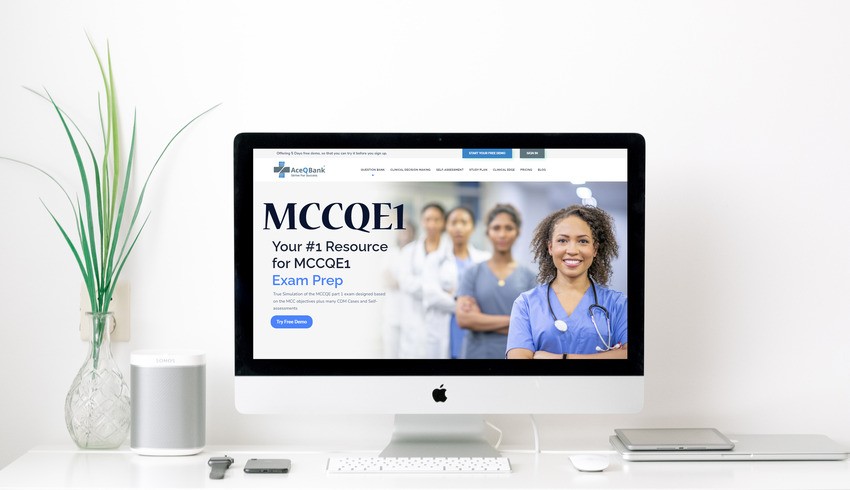
Retrieving information stands as a lifeline for those preparing to cross the threshold of medical qualification exams. The sheer breadth and intricacy of medical knowledge. Dictates that one can only master its art through rigorous and disciplined practice.
For the newly minted doctor about to step into the frontlines of medicine. This is a game-changer. The textbook alone is no longer enough. It belongs to yesterday’s battles.
Today demands something greater. An approach that marries passive absorption with active confrontation. Study the textbooks, certainly. But then you need to challenge yourself with questions. And review what you think you know again and again.
This repeated interplay between reflection and action hones your recall. Until facts become second nature. Decisions become instinctive, sharp as a surgeon’s scalpel.

Now, imagine a comprehensive Canadian question bank designed specifically for medical candidates. It contains high-yield, carefully curated questions mapped to the MCC Objectives. And aligned with current Canadian clinical guidelines.
Each question comes with detailed. Evidence-based explanations for every single option. So you not only learn the correct answer but also understand why each distractor is right or wrong. To reinforce clinical reasoning and facilitate a deeper understanding of medical concepts.
The platform incorporates hundreds of clear flow charts and concise summary tables that distill complex information into easily memorable formats.

Custom illustrations and diagrams are included throughout to boost visual recall of key points. And to help you synthesize diagnostic pathways and management algorithms more efficiently.
The performance analytics feature and targeted remediation that helps you identify weaknesses. And track progress over time and focus your study on high-yield topics.
The resource also offers robust self-assessment tools to evaluate your readiness. If the existence of all these features in one platform seemed like a dream, this is your reality.
These are precisely the features offered by Ace QBank. That is why so many Canadian medical graduates preparing for the MCCQE1 exam choose Ace QBank.
With its alignment to MCC objectives, evidence-based explanations and visual learning aids. Along with comprehensive self-assessments. The Qbank stands out as the gold standard for exam preparation.
Earlier, we discussed the best tactic to effectively manage your time during the exam. Along with two proven strategies to help you score higher.
The best part is that the platform enables you to put all of this into practice. In other words, the question bank serves as a comprehensive. One‑stop resource for preparing for the MCCQE1 exam.
Offering more than 2900 high-yield questions to reinforce your knowledge. And build confidence before test day.
Try Free MCCQE1 Sample Questions

Before you invest your time (or money) in any MCCQE1 study resource, it’s smart to test-drive the actual platform and questions. The QBank makes this easy. It offers 21 free sample questions. No payment, no commitment needed.
You get hands-on platform experience. Explore all the key features. Flagging questions, highlighting important text, switching between tutor and timed modes.
Check the Quality. You want to make sure the explanations are clear, evidence-based and actually teach you something.
Just sign up for the free demo on the website. You don’t need a credit card. You will get access to all 21 sample questions plus the chance to play with the platform’s study features.
This is your chance to see whether the Qbank lives up to its reputation. And if it’s the right question bank for you.
Key Takeaways
2025 MCCQE1 exam format. The 2025 MCCQE Part 1 format change shifted the assessment toward applied clinical reasoning and alignment with Canadian guidelines. Making the exam clearer and fairer. Especially for international medical graduates.
Master MCC objectives plus clinical image and lab value. Master the MCC objectives while also practicing recognition of clinical images. Along with rapid interpretation of critical lab values and constructing focused differentials. These practical skills are repeatedly tested and essential for both the exam and practice.
Ace QBank features and MCCQE1 exam preparation benefits. The Qbank contain high-yield questions aligned with MCC objectives and evidence-based explanations. Along with flowcharts and performance analytics. All features help solidify your knowledge, improve test skills and build confidence before the exam.