Has Alberta Waived the MCCQE1 Exam?

Obtaining a medical licence to practise medicine in Canada has taken a turn towards simplicity. And yet, a deeper scrutiny. Not long ago, the gauntlet of qualification exams loomed large. Today, that burden has been halved. Candidates now stand before fewer hurdles.
But let us not be mistaken. These exams still demand an understanding rooted firmly in the standards that define our nation’s practice. One can say that precision and clarity have replaced ambiguity.
For many aspiring physicians, this is both a relief and a challenge. This blog explains how to become a licensed doctor in Canada. Covers the physician shortage and related policies. Focus on Alberta’s approach, including whether the MCCQE1 exam is still required. Lastly, I will share a reliable question bank for the MCCQE1 exam.
How Does One Become a Doctor in Canada?
The process requires years of education. Thorough training and meeting strict requirements. This journey is marked by rigorous education, comprehensive understanding and proper training.
I used the words rigorous, comprehensive and proper carefully for a reason. Because getting into medical school here is very competitive. When you get into school, you have to develop a deep understanding of medical concepts.
All of this is to have a solid foundation that you rely on during your residency program. So you could focus on your training during residency.
Whether you are a Canadian medical graduate or an internationally trained doctor. The path to licensure although different. But is designed to ensure that every physician meets the country’s high standards for patient care.
For those who are curious about the Process of becoming a Licensed Physician in Canada. I summarize the entire journey into three simple steps:
Step 1 – Medical Education
Step 2 – National Examinations
Step 3 – Postgraduate Training (Residency)
Medical Education
The journey begins with medical school. Canada has 17 accredited medical schools. Each offers a four-year Doctor of Medicine (MD) program.
Medical school admissions are extremely difficult. A bachelor’s degree and excellent academic standing. Plus, appropriate extracurricular experience are prerequisites for the majority of colleges.
Medical education in Canada emphasizes scientific knowledge. Students spend the first two years in classroom and laboratory settings. Followed by two years of clinical rotations in hospitals and clinics.
National Examinations
Licensing in Canada starts with a clear-eyed reality. To practise medicine here you need to pass national exams. The MCCQE Part I tests core medical knowledge and clinical decision-making. The exam is the bedrock of safe care.
However, for internationally trained doctors, the path demands even more. IMGs face additional evaluations to prove competence and meet provincial standards. It is a tough road, no sugar coating it.
But Canada leans on these physicians to fill critical gaps, especially in communities that struggle to recruit.
From the North to small-town Prairies. IMGs keep clinics open and ERs running. In a system stretched thin, their expertise is more than welcome.
In a nutshell, IMGs must have their credentials assessed and complete an additional exam. Before undergoing supervised practice or entering a residency program for full licensure. This additional exam is called the National Assessment Collaboration or NAC exam.
The NAC exam is not that difficult. It is an objective structured clinical examination developed by the Medical Council of Canada (MCC). Mainly to assess IMG readiness for Canadian residency training by evaluating their clinical skills and attitudes.
The exam is like being a physician in charge for a half-day in a Canadian clinic. With this difference, someone in the room observing and you doesn’t need to do paperwork.
Postgraduate Training (Residency)
After medical school the journey shifts from textbooks to the trenches. Graduates step into residency. A specialized training ground in their chosen field.
For specialists, the Royal College of Physicians and Surgeons of Canada sets the bar. For family doctors, it’s the College of Family Physicians of Canada. Clear lines. Clear standards.
Residency isn’t a cakewalk; in fact, the opposite. It is hands-on, high-pressure and relentless. Residents work under close supervision. Learning on the job and slowly taking the wheel as their skill grows. Long shifts. Tough calls. Real lives.
And at the end of that road. Rigorous exams stand as the final gatekeeper of competence.
When the training wraps and the exams are in the rear-view. Physicians apply for a licence through their provincial regulator. Each province sets its own checklist (CPSA or CPSO). No shortcuts.
But across the map, the goal stays the same. National standards for education, training and professionalism that Canadians can trust.
It’s a path defined by accountability, not shortcuts. A system built to protect patients and uphold the integrity of the profession. Coast to coast, no funny business.
Alberta’s Bold Moves to Tackle the Physician Shortage

Despite the high number of doctors. Canada faces a persistent physician shortage. The shortage isn’t just about numbers. It is about distribution.
Although cities such as Toronto, Vancouver, and Calgary draw many doctors. Smaller towns and Indigenous communities, on the other hand. Frequently have difficulty attracting and keeping medical professionals.
Alberta’s doctor shortage is no longer just a headline. It is a reality affecting millions. And the worst part is that it is growing. This shortage is now creeping into cities. Sparking concern for the future of our healthcare system.
So, what’s fuelling this crisis? It is a combination of factors. First, the workforce is getting older. Lots of experienced doctors are nearing retirement. Which shrinks the pool just as demand keeps growing.

Second, recruitment is struggling. Fewer graduates are choosing high-need specialties. Other career options are pulling talent away. And it is tricky to bring in internationally trained clinicians smoothly.
There are other factors that do not fit well within the scope of this discussion. However, the point is that these issues contribute to each other, resulting in longer wait times and heavier workloads for those who remain. This has resulted in a gradual drop in access that people are starting to notice.
The College of Family Physicians of Canada warns that for every 10 family doctors leaving practice. Only about seven new recruits enter family medicine. A ratio that simply can’t keep up with demand.
This shortfall puts extra pressure on those who remain. Leading to longer wait times and declining patient satisfaction.
Why aren’t enough new graduates choosing family medicine? Surveys suggest medical students worry about pay disparities, excessive paperwork and lack of support compared to other specialties.
Amid these challenges, provinces are rethinking how to fill gaps. One promising strategy is to make it easier for IMGs to practice here.
That’s why Alberta’s new policy which has been effective since June 9, 2025. Waive the MCCQE Part 1 requirement for IMGs who completed recognized postgraduate training. Postgraduate training in countries with similar medical standards, such as the UK or Australia.
This change aims to speed up licensing and attract more qualified physicians quickly. It is a significant step. But experts stress it’s not the only answer.
As policymakers and healthcare leaders consider solutions. Canadians will be watching closely. The stakes couldn’t be higher, as at the heart of this issue are individuals waiting for the care they deserve.
Has Alberta Waived the MCCQE1 Exam?

For those unfamiliar. The MCCQE1 is a national exam administered by the Medical Council of Canada.
It is designed to assess a physician’s medical knowledge and clinical decision-making skills. And it’s been a standard requirement for licensure across the country.
For IMGs, the exam has been a significant hurdle, adding time to the licensing process. But in a move that’s making headlines and sparking conversations across the medical community. Alberta is changing the game.
Since June 9, 2025, Alberta has waived the MCCQE1 requirement. Not for all countries. The exam requirement has been waived for certain internationally trained physicians.
This policy shift is more than just a regulatory update. It is a strategic response to a growing healthcare challenge.
But why is Alberta making this change now? Let me start with the “why.” Alberta, like many regions in Canada is grappling with a physician shortage. Shortage that’s impacting patient care. Especially in rural and remote communities.
The province’s doctor shortage results in longer wait times. Closed emergency departments and communities are struggling to access basic healthcare.
However, the shortage isn’t limited to family doctors. Specialists in psychiatry, emergency medicine and anesthesiology. Along with Pediatrics, are all in high demand.
In some regions, patients wait months for appointments or referrals. A situation that’s simply unsustainable as Alberta’s population grows and ages.
Who Will Benefit from Alberta Waiving the MCCQE1 Exam?

Alberta’s new policy doesn’t open the floodgates for all IMGs. Instead, it’s targeted. As I mentioned earlier.
The waiver applies to physicians who have completed recognized postgraduate training and are certified in certain countries.
Countries that meet medical standards similar to Canada’s. This translates to countries like the United States and the United Kingdom. As well as Ireland and Australia.
However, these doctors will still be required to fulfill additional licensing criteria. Criteria that are set by the College of Physicians & Surgeons of Alberta (CPSA). This involves medical credential verification and others.
That said, Alberta’s Healthcare System by removing the MCCQE1 barrier for qualified IMGs. Has simply streamlined the path to practice for them. This means more doctors can enter the workforce faster. Filling critical gaps in both urban and rural settings.
The province hopes this will not only reduce wait times. But also make Alberta a more attractive destination for foreign-trained physicians.
Of course, every policy change comes with questions. Some experts caution that while the waiver addresses immediate shortages. It is essential to ensure that all physicians meet Alberta’s standards for quality and safety.
The CPSA will continue to assess candidates’ credentials and training. And ongoing professional development will remain a cornerstone of medical practice in the province.
Looking ahead for internationally trained physicians. Alberta’s decision is a welcome development. One that recognizes their expertise and the urgent need for their skills.
For patients, it is a step toward better access and shorter wait times. And for the healthcare system as a whole. It is a signal that flexibility is essential in meeting the needs of a changing population.
A Premier Resource for MCCQE1 Exam Preparation

The key to conquering this exam is about covering objectives strategically. Understanding your knowledge gaps and mastering the art of test-taking. That’s where a top-tier question bank comes in. And I’m here to tell you why Ace QBank is the premier resource you need.
The entire purpose of practicing with questions in a question bank is to find out what you don’t know. It is about mastering those challenging medical concepts and honing your test-taking strategies.
But not all question banks are created equal. For the MCCQE1, your question bank must be Canadian. The questions need to be based on the MCC objectives and aligned with Canadian guidelines.
Otherwise, you are missing the entire point. That’s what makes Ace QBank the best question bank for MCCQE1 exam preparation. It is not just a collection of questions. The Qbank is meticulously designed to align with the MCC objectives and the latest Canadian guidelines.
A recent update to the question bank has further solidified its alignment with Canadian medical standards, and I have written about its features before. But it does not hurt to go over them once more.
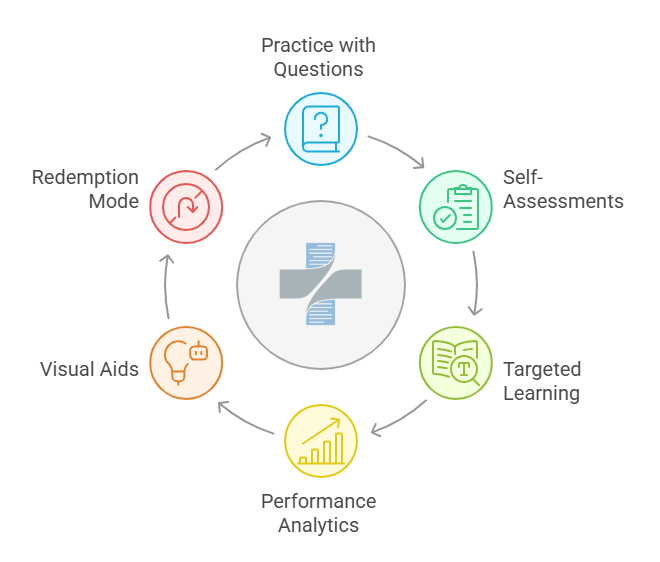
Here are the Qbank features that will help you crush the MCCQE1 exam:
- A High-Yield MCCQE1 Question Bank
Ace QBank offers more than 2900 high-yield questions. Questions are meticulously aligned with the MCC Objectives. These are thought-provoking clinical vignettes that force you to dig deep.
Apply your medical knowledge and think critically before selecting an answer. This process not only enhances your critical thinking. But also sharpens your problem-solving skills, which are essential for the MCCQE1 and for your future as a physician.
And as if that wasn’t enough, the recent addition of 100 new, high-yield questions to the qbank will further help you sharpen your knowledge and cover any remaining gaps. It’s this commitment to providing the most relevant and challenging content that sets the Qbank apart.
- Self-Assessments for the MCCQE1
Preparing for a major exam means knowing when you’re truly ready. Ace QBank offers two MCCQE1 self-assessments that simulate the real test and measure your readiness. These tests are built to mimic the real exam experience. To help you assess your preparedness.
However, what makes them unique is that they contain an entirely different set of questions from the main question bank. So you won’t have seen them during practice.
This intentional design delivers an unbiased. An accurate measure of your knowledge and test-taking skills. It is the ultimate trial run before you enter the exam room.
- Two Distinct Study Modes for Targeted Learning
We all learn differently. And we all have our own areas of strength and weakness. The Qbank understands this. It provides two distinct study modes to cater to your individual needs.
- Timed Study Mode. This mode is perfect for covering the categories you are already familiar with. It simulates the time pressure of the actual exam. Helping you enhance your time management skills and build your confidence.
- Tutor Study Mode. This mode is your best friend for those challenging categories that make you break out in a cold sweat. It allows you to take your time. Let you dive deep into the explanations and truly understand the underlying concepts. Without the pressure of a ticking clock.
When you log into your account. You will see 21 categories on your dashboard. Some of these will be a breeze for you. While others will be more challenging. You can create a personalized study plan that maximizes your efficiency. Just by strategically using these two study modes.
- Performance Analytics to Uncover Your Weaknesses
This is where the Qbank truly shines. The platform’s performance analytics feature is a game-changer for developing your test-taking skills and addressing your knowledge gaps.
It doesn’t just show what you got wrong. It explains why. It even tracks how long you take to answer each question. Giving you real insight into your thinking process.
With access to evidence-based medicine explanations and a reference section that mentions the specific MCC objective corresponding to each question, you can get to the bottom of why you answered a question incorrectly or why you spent so much time on it.
This data-driven approach to studying is what separates the good candidates from the great ones.
- Visual Aids to Boost Recall of Key Points
Let’s be honest: a good picture can be worth a thousand words, especially when it comes to recalling complex medical information.
Fortunately, the question bank is packed with hundreds of visual aids within the explanation section of the question bank. We’re talking about summary tables, flowcharts, and custom illustrations that are designed to help you remember key points more effectively.
These aren’t just generic images pulled from a stock photo website. These are custom-designed illustrations and flowcharts that simplify complex management and diagnostic steps, making it much easier to remember the next best step in a clinical scenario.
- Redemption Mode
I call this feature “Redemption Mode.” Because it helps you redeem your mistakes. However, there is no actual mode called “Redemption Mode” on the platform.
This unique feature allows you to create a question block consisting of all your incorrectly answered questions. It gives you a second chance to tackle the medical concepts that tricked you the first time around.
If you get a question wrong again, it’s a clear sign that the medical concept still isn’t clear. But don’t worry, the reference section is there to guide you. Simply find the objective that corresponds to the question. And take the time to cover it properly. This targeted approach will solidify your understanding.
What makes Ace QBank different from other prep tools (like CanadaQBank, UWorld, or textbooks)?
You are preparing for a uniquely Canadian exam. So you need a uniquely Canadian question bank.
For years, medical students across Canada have wrestled with the paradox of MCCQE1 preparation. “The Scarcity of Truly Canadian Resources”.
Many have tried to adapt American question banks. Only to find themselves lost in a maze of irrelevant clinical guidelines and out-of-date protocols.
Others have leaned on recycled materials handed down through generations. Each year further removed from the realities of contemporary Canadian medicine.
But today, Ace QBank stands tall as the gold standard for MCCQE1 exam preparation. It is an essential companion for every aspiring Canadian physician. Let’s break down why it’s in a class of its own:
- Laser Focused on the MCC Objectives
- The “Canadian Guidelines” Advantage
- Explanations That Actually Teach
- A Commitment to Being Current
- Laser Focused on the MCC Objectives
This is the single most important factor. Ace QBank isn’t a repurposed USMLE question bank or a generic medical QBank. Its entire foundation is built upon the official Medical Council of Canada (MCC) objectives list.
Every single question is meticulously crafted to test a specific objective. Ensuring that you are not just learning medicine. But you are properly covering the MCC objectives. Learning the exact medical concepts the MCC expects you to know.
This direct alignment is something that resources like UWorld simply cannot offer. As their content is tailored for the USMLE steps.
- The “Canadian Guidelines” Advantage
This is a massive differentiator. While UWorld is excellent for general medical principles. It is a critical mistake to rely on it for the MCCQE Part 1 exam.
Simply because it lacks Canadian guidelines. The MCCQE1 will absolutely test you on Canadian-specific approaches to diagnosis steps, proper management and the most accurate treatment.
This is where the Qbank shines. Its explanation section is second to none. Embedding the latest Canadian guidelines directly into the content.
You are not just learning the correct answer. You will learn why the answer is the correct one, and why the other option didn’t cut it.
This is a feature that neither CanadaQBank nor UWorld has executed to the same level of detail and evidence-based precision.
- Explanations That Actually Teach
Let’s be honest, the value of a question bank is in the explanations. Ace Qbank explanations are not just a few sentences. They are comprehensive and evidence-based, like a mini-lesson. They are packed with:
- Canadian clinical practice guidelines
- High-yield flowcharts
- Concise summary tables
- Helpful illustrations
This multi-faceted approach deepens your understanding. And helps you create the mental frameworks needed to tackle complex clinical scenarios on exam day. That means you are not just memorizing facts. You are building clinical reasoning skills.
On the other hand, the visual aids will boost your record of the key points on the exam date. If you have written about where we discussed proper time management during the exam. Then you know that this can significantly enhance your time management during the exam.
- A Commitment to Being Current
Medicine never stands still and neither should your study materials. The Qbank demonstrates a clear commitment to keeping its content relentlessly up-to-date.
The recent question bank update which includes over 100 new high-yield questions. It is a perfect testament to this. It makes sure you are focusing on the most relevant material for the exam. And not spending time on outdated concepts that won’t be tested.
So, don’t make the mistake of just reading textbooks. Your primary study tool should be a high-quality QBank. Start early and do not be afraid to get questions wrong. The explanations are where the real learning happens.
On the other hand, you absolutely must supplement your studying with a resource that covers Canadian topics.
Many successful candidates use a combination of resources. For instance, you might use Toronto Notes for foundational knowledge and the Qbank for high intensity exam prep.
Your goal is to walk into that exam feeling confident. And prepared for anything they throw at you. You are setting yourself up for success by training with Ace QBank. The Qbank is the most complete and current resource available.
How long does it usually take to prepare properly for the MCCQE1?
Most medical school graduates typically take about 3 to 6 months. However, this exam is tough as nails. Questions are based on the MCC objectives and Canadian guidelines. How much time you will need really depends on how much you already know.
Canadian med students usually have it easier. Since they have been grilled on these topics from day one. For them, it is about sharpening those test-taking skills and zeroing in on high-yield areas.
For IMGs, though, the grind might stretch to six months or sometimes even a full year. At the end of the day, the is about staying cool under pressure. And nailing those tricky multiple choice questions one after another.
So whether you are hustling for three months or slogging through a year long bootcamp. Keep your eyes on the prize, track your progress and tackle those MCC objectives.
Try the MCCQE Part 1 Sample Questions Before You Commit

There are 21 MCCQE Part 1 sample questions that you can try. And gain hands-on experience with the platform before making any commitment.
This exploration matters. It gives you the chance to see firsthand how the Qbank can support your preparation in ways that actually make a difference.
Once you are inside, you will discover features that transform how you study. Flag questions you want to revisit later. Highlight key information within questions and explanations, creating your own visual roadmap through complex material.
These aren’t random add-ons. They are thoughtfully integrated tools designed to help you focus your study sessions and make your learning genuinely more effective.
The demo also lets you create personalized question blocks tailored to your specific needs. Choose from different study modes. Timed practice when you need to simulate exam conditions, or tutor mode when you want detailed explanations as you go.
Look, studying for the MCCQE Part 1 is challenging enough. Without wondering if your prep tools are actually helping. Sign up for the free demo today. Dive into the 21 sample questions. Try out every feature and then decide if this is the right Qbank for you.
Key Takeaways
Alberta Waives MCCQE Part I for Qualified IMGs. This waiver is for select internationally trained physicians who completed recognized postgraduate training in countries with comparable standards (e.g., UK, Australia, US, Ireland).
For those still preparing for the MCCQE Part I. A Canadian-aligned QBank (like Ace QBank) that uses MCC objectives, Canadian guidelines, and evidence-based medicine explanations. To facilitate the MCCQE Part 1 exam preparation.