More Canadian Guidelines with New MCCQE1 Update

Medical licensing exams prioritize clinical guidelines. Because they encapsulate the evidence-based standards that define good medical practice.
The Medical Council of Canada also uses these guidelines as benchmarks for evaluating professional conduct in practice. Hence, familiarity and understanding of Canadian clinical guidelines are fundamental for passing the medical licensing exam in Canada.
In this blog, we will explore how clinical guidelines play a crucial role in MCCQE1 exam success and why they are now more important than ever for candidates. You will also learn how easily you can access the clinical guidelines within Ace QBank.
How Canadian Clinical Guidelines Boost MCCQE1 Results
Clinical guidelines are a powerful study tool for candidates preparing for the MCCQE Part 1. The clinical guidelines condense national standards of care into evidence based recommendations.
Guidelines also standardize diagnostic thresholds and management steps used across Canadian practice.
Consequently, familiarity with them helps you make clinical decisions quickly and confidently. The point is that you are expected to know these guidelines to demonstrate proficiency in diagnosing. Treating and managing patients safely and effectively.
They also sharpen your MCCQE1 exam prep. Speaking of the MCCQE1 exam preparation. As someone who has been through this journey. The single most valuable investment you can make is mastering Canadian clinical practice guidelines.
Think of the MCCQE1 not just as a test of what you know. But how do you think? The exam is designed to see if you can function as a safe, effective physician in the Canadian healthcare system. And the guidelines are the very blueprint for that system.
When you encounter a clinical case in the form of a multiple-choice question. You find out the “correct” answer is always the one that aligns with current Canadian guidelines.
That alone tells you that these aren’t just arbitrary rules. They are evidence-based recommendations that form the backbone of patient management in Canada.
So, by internalizing these guidelines. You are developing the clinical reflexes that the exam is designed to test. And practicing with high-yield questions based on these guidelines. Not only does it help you see the patterns in the questions.
But also anticipate the expected management steps. This helps you navigate the scenarios with the confidence of a seasoned clinician on the exam day.
Therefore, mastering the guidelines is your way to achieving a higher score in the exam. And more importantly, to build a strong foundation for your future practice.
Why Canadian Guidelines Matter More Than Ever for MCCQE1?

The MCCQE Part 1, a key licensing exam for medical graduates aspiring to practice independently in Canada. It assesses medical knowledge, clinical reasoning and decision making in the unique context of Canadian healthcare.
As of 2025, clinical guidelines have become more essential than ever for success in the MCCQE Part 1 exam. This is due to significant changes in the exam format and the evolving medical practice in Canada.
You see, unlike conventional medical exams. The MCCQE1 interrogates a candidate’s capacity to think on their feet. It tests judgment, communication and ethical discernment. The elements that turn clinical knowledge into responsible care.
It is designed to evaluate whether you can safely and effectively apply medical knowledge within Canada’s distinct healthcare system.
For example, recommended screening protocols. Vaccination schedules and management plans differ from those in other countries.
You must be familiar with these to answer scenario-based questions correctly. Studying resources outside the Canadian context risks missing key components of clinical reasoning expected on the exam.
Canadian Guidelines for MCCQE1 Success | |
Ensuring Competence in Practice | Passing the MCCQE Part 1 certifies that candidates can meet Canada’s standards of safe, ethical and effective healthcare delivery. |
Reducing Knowledge Gaps | Canadian guidelines cover the legal, social and systemic factors influencing medicine. Aspects that foreign resources may neglect. |
Adapting to Exam Content | The MCQs emphasize Canadian screening guidelines, management protocols and public health priorities. Demanding familiarity with official Canadian guidelines and standards. |
Enhancing Cultural Awareness | Canada’s emphasis on culturally sensitive care. Especially concerning Indigenous health. Means this knowledge is both tested and necessary for clinical competence. |
As I mentioned earlier. Starting April 2025, the MCCQE Part 1 shifted to a 100% multiple-choice question (MCQ) format. Eliminating the Clinical Decision-Making (CDM) case component.
This change shortens exam duration and aims to reduce fatigue. But also requires you to adapt your preparation to more rapid, focused clinical reasoning through MCQs.
Because each MCQ now probes understanding of clinical guidelines. Mastering these guidelines is critical for interpreting. And responding to questions accurately under time constraints.
That said, the removal of CDM cases means there is less opportunity to demonstrate clinical judgment through interactive case simulations. So studying Canadian standards and protocols thoroughly takes on even greater importance.
Now, here I would like to bring the objectives listed by the Medical Council of Canada (MCC) to the spotlight. I always emphasize proper coverage of the MCC objectives. The clinical guidelines are not an extra element.
These clinical guidelines are embedded within certain objectives. In fact, passing the exam signals that you are well-versed in the objectives and clinical guidelines.
After all, the MCCQE1 is a certification that a physician has met Canadian standards for safe and effective medical practice.
Where Can I Find MCCQE1 Sample Questions Based on the Canadian Guidelines?
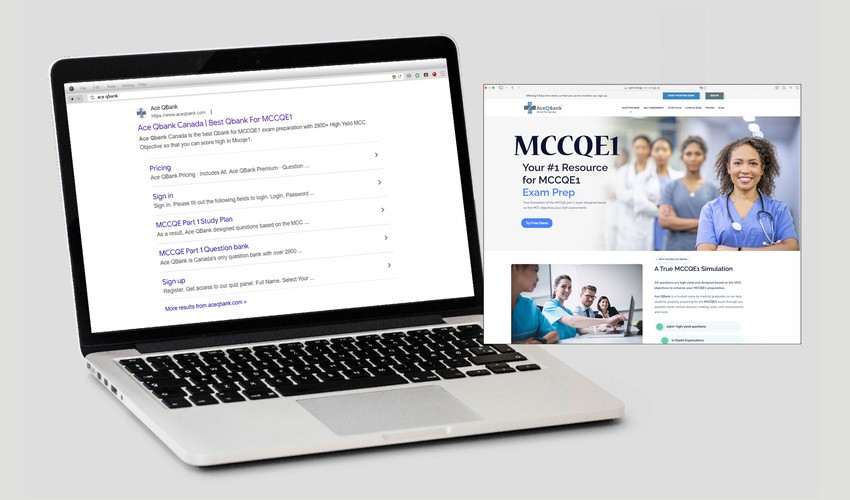
Many see the MCCQE1 as a beast of an exam. A marathon of medical knowledge designed to ensure you are ready to care for patients in Canada.
I do not believe I am alone when I say we all agree that understanding clinical guidelines is essential for the exam. But just reading them is like trying to learn to swim by watching videos. You need to jump in, get wet and actually practice.
This is to bridge the gap between knowing the information and applying it. So, active learning is the way to go. And nothing screams ‘active learning’ more than sample questions.
Challenging clinical scenarios that test your medical knowledge. Identify your weaknesses and truly internalize the vast web of Canadian clinical guidelines.
Now, where can you find the best MCCQE1 sample questions that align with Canadian guidelines? The short answer is, Ace QBank.
And for good reason. What sets the Qbank apart is its consistent high-yield nature. That means every question in the Qbank aligns with the MCC objectives, adheres to clinical guidelines and integrates the CanMEDS framework.
The best part about the question bank is that it is dynamic! Yes, the Qbank regularly updates its content. Adding fresh questions and refining content to reflect the latest guidelines and clinical practices.
As a matter of fact, we just recently announced the release of 100+ new questions. In a field where standards evolve rapidly. This commitment to currency is invaluable.
Over 90% of users report improved confidence and performance after using the Qbank, according to their internal surveys. Imagine walking into a Prometric Centre knowing you have tackled scenarios that mirror the test’s rigour and focus. That’s the edge this Qbank offers.
So, when you are looking for the best place to find MCCQE1 sample questions. Questions that are high-yield, based on Canadian guidelines and the MCC objectives. The answer is clear.
Ace QBank is your go-to. It is more than a question bank. It is a pathway to bridging knowledge gaps and building unshakable competence.
What Makes Ace QBank Perfect for the MCCQE1 Exam Preparation?

You are preparing for an exam that tests more than memory. The MCCQE1 measures clinical knowledge, resilience under pressure and strategic thinking.
I have been in your shoes. Creating summary notes, clock-watching and second-guessing myself. I still have my summary notes tucked away in the basement.
Back in the day, I thought I had it all figured out. The material? Nailed it. But when exam season rolled around, my strategy fell flat.
Because knowing the facts didn’t even scratch the surface. No one tells you that these tests want more than memorization. They demand pattern recognition, sharp time management and a solid dose of confidence.
Luckily for you, that’s where Ace QBank shines. It targets those needs with thoughtful, Canada-focused questions that mirror exam style. The explanations don’t waste your time. They build clinical reasoning you can carry into practice. Ultimately, a dynamic training ecosystem built to turn effort into results.
First things first, let’s talk about the foundation. The platform’s questions are explicitly based on the MCC objectives and mapped to the CanMEDS framework. That matters because it mirrors how Canada trains and evaluates physicians.
Just as important, the explanation sections incorporate the most recent Canadian clinical guidelines. So you are not just getting the correct answer. You are getting the evidence-based medicine explanation for all options.
In each explanation section, you will also spot summary tables that lay out the essentials in a snap. Flow charts map out those tricky concepts, guiding you through step by step. Custom illustrations add an extra layer of understanding. Turning complicated ideas into visuals you can grasp in seconds.
Not to mention, the most up-to-date clinical guidelines. Depending on the objective you might see all these resources or just a handful. Each is tailored to help you get a solid grip on the medical concept at hand.
Now let’s talk scope and quality. The question bank contains more than 2900 high yield questions. Handpicked by medical experts to meet strict “high yield” criteria. The content is continuously refined and updated.
So when guidance shifts, the explanations evolve with it. This is critical in fast moving areas like preventive care, diabetes and infectious diseases. Where small changes in recommendations can alter the best next step.
What transforms the question bank from “good” to “game changing” are the features. Features that make your study time both strategic and efficient:
- Customizable Practice Tests across 21 categories let you target exactly where you need reps—cardiology one day, ethics the next. Focused practice like this is consistently linked to better retention; studies in health professions education show targeted retrieval can raise knowledge retention by up to 30%.
- Two complementary study modes help you master both speed and understanding:
- Time Study Mode simulates the exam’s pressure so you can calibrate pacing and finish blocks on time. Start with categories you know to dial in your rhythm before layering in harder content.
- Tutor Study Mode delivers immediate, detailed feedback and guideline-aligned explanations after each question. Use it to unpack the “why,” especially in your hardest topics, so you build knowledge and confidence simultaneously. Alternating these modes deliberately trains accuracy, endurance, and timing without sacrificing depth.
- Progress Tracking and Analytics break down performance. But you shouldn’t just skim over mistakes; you need to diagnose them. Was it a knowledge gap? A misread question stem? Medical graduates who thoroughly analyze mistakes after practice. Often see score gains of 10 –25% over time.
- Redemption Mode turns wrong answers into a personalized curriculum. It automatically compiles your previously missed questions into fresh blocks on a spaced schedule. That transforms “I’ve seen this before” into “I own this now.”
- Powerful visuals drive recall when seconds count. Over 200 embedded algorithms, summary tables, and custom illustrations are included. All to translate complex topics into clear and memorable patterns. The result is lower cognitive load, faster retrieval and stronger decisions under time pressure.
- Two Self Assessments, separate from the main question pool. Provide an unbiased snapshot of readiness. The score is helpful but the real value is in the post-test analysis. Identify gaps, refine your plan and prioritize high impact objectives for your final push. Used with targeted follow-ups, these assessments are strong predictors of exam success.
The truth is that active retrieval with feedback strengthens long-term memory. Spaced review reduces forgetting. Focused practice improves transfer. And analytics build metacognition. The habit of understanding how you learn. So your study sessions stay efficient and intentional.
Use the Qbank with intention. Start Tutor Mode in your toughest categories to secure the fundamentals and guideline logic. Layer in Time Study Mode on familiar domains to calibrate pacing. After every block, triage your mistakes.
Tag your weak objectives and queue Redemption Mode. Then, schedule a self-assessment to pressure test your plan and adjust before the final stretch.
Together, the rigorous alignment with the MCC objectives, evidence‑based medicine explanation and ongoing updates make Ace QBank a uniquely effective. Purpose‑built resource for mastering the MCCQE1.
Where Can I Easily Find Canadian Guidelines in Ace QBank?

Stop hunting for clinical guidelines. They are built into the explanation section that follows each question.
Across the 2900+ MCCQE1 style questions. You will see the guideline identified alongside the clinical reasoning. So you can connect the correct answer to the standard of care.
That matters because the exam assesses the application of the MCC Objectives within the CanMEDS roles. Essentially, guideline informed decision making under exam pressure.
But here is how to find it fast. Complete any question in a block. Whether you are in Timed or Tutor mode. And open the second tap of the explanation section.
The corresponding Canadian guideline is clearly called out in that panel. Anchoring the rationale for the best answer and clarifying why distractors fall short. This consistent placement means no extra clicks, no separate search and no guessing.
This is deliberate because pairing retrieval practice with explicit guideline references strengthens long‑term retention. Exactly what the exam demands.
In short, the guidelines are always in the explanation section. Across all 2900+ questions, right where you need them.
Ready to try the MCCQE Part I Free Sample Questions?

To try the MCCQE1 free sample questions. First, register for a free demo account. This gives you more than just sample questions. It provides access and hands-on experience to familiarize yourself with the platform.
This hands-on exploration. Giving you a chance to see how it can support your preparation in a meaningful way.
Once inside, you will be able to try out important features. Features such as flagging questions that you want to revisit later. And also highlighting key information within questions and explanations.
These tools are thoughtfully integrated to help you focus your study sessions. Making your learning more effective.
Additionally, the demo lets you create personalized question blocks. And select from different study modes including timed practice or tutor mode.
Sign up for the free demo and dive into the questions. Test the functionality of the platform. See how the Qbank can transform your study experience.
Key Takeaways
Clinical guidelines are central to MCCQE1 success. The exam tests the ability to practise safely within the Canadian healthcare system. So answers typically reflect current Canadian guideline recommendations (diagnostic thresholds, management steps, antibiotic stewardship).
Recent exam format and content changes make clinical guidelines more important. From April 2025, the exam is 100% MCQs (no CDM cases), increasing the need for fast, guideline-based clinical reasoning under time pressure.
Active practice with guideline aligned questions is essential. Reading guidelines isn’t enough. Practicing with high-yield Canadian-focused questions builds the pattern recognition, speed, and retention the exam requires.
Ace QBank integrates Canadian guidelines directly into practice. Latest update just added over 100 MCCQE1-style questions with the clinical guidelines in explanations. Now you have access to more than 2900 questions. Questions that make it an efficient way to learn and apply clinical guidelines for the exam.